

48
2 Bubbling Properties in Pulsed Fluidised Beds
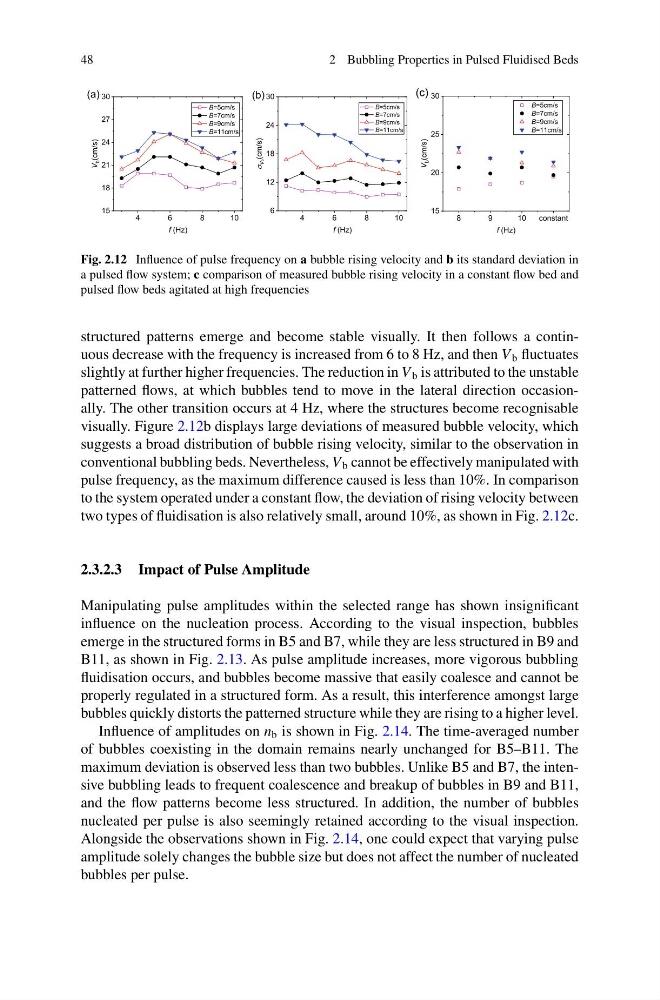
Fig. 2.12 Influence of pulse frequency on a bubble rising velocity and b its standard deviation in
a pulsed flow system; c comparison of measured bubble rising velocity in a constant flow bed and
pulsed flow beds agitated at high frequencies
structured patterns emerge and become stable visually. It then follows a continuous decrease with the frequency is increased from 6 to 8 Hz, and then V b fluctuates
slightly at further higher frequencies. The reduction in V b is attributed to the unstable
patterned flows, at which bubbles tend to move in the lateral direction occasionally. The other transition occurs at 4 Hz, where the structures become recognisable
visually. Figure 2.12b displays large deviations of measured bubble velocity, which
suggests a broad distribution of bubble rising velocity, similar to the observation in
conventional bubbling beds. Nevertheless, V b cannot be effectively manipulated with
pulse frequency, as the maximum difference caused is less than 10%. In comparison
to the system operated under a constant flow, the deviation of rising velocity between
two types of fluidisation is also relatively small, around 10%, as shown in Fig. 2.12c.
2.3.2.3 Impact of Pulse Amplitude
Manipulating pulse amplitudes within the selected range has shown insignificant
influence on the nucleation process. According to the visual inspection, bubbles
emerge in the structured forms in B5 and B7, while they are less structured in B9 and
B11, as shown in Fig. 2.13. As pulse amplitude increases, more vigorous bubbling
fluidisation occurs, and bubbles become massive that easily coalesce and cannot be
properly regulated in a structured form. As a result, this interference amongst large
bubbles quickly distorts the patterned structure while they are rising to a higher level.
Influence of amplitudes on n b is shown in Fig. 2.14. The time-averaged number
of bubbles coexisting in the domain remains nearly unchanged for B5–B11. The
maximum deviation is observed less than two bubbles. Unlike B5 and B7, the intensive bubbling leads to frequent coalescence and breakup of bubbles in B9 and B11,
and the flow patterns become less structured. In addition, the number of bubbles
nucleated per pulse is also seemingly retained according to the visual inspection.
Alongside the observations shown in Fig. 2.14, one could expect that varying pulse
amplitude solely changes the bubble size but does not affect the number of nucleated
bubbles per pulse.
2 Bubbling Properties in Pulsed Fluidised Beds
Fig. 2.12 Influence of pulse frequency on a bubble rising velocity and b its standard deviation in
a pulsed flow system; c comparison of measured bubble rising velocity in a constant flow bed and
pulsed flow beds agitated at high frequencies
structured patterns emerge and become stable visually. It then follows a continuous decrease with the frequency is increased from 6 to 8 Hz, and then V b fluctuates
slightly at further higher frequencies. The reduction in V b is attributed to the unstable
patterned flows, at which bubbles tend to move in the lateral direction occasionally. The other transition occurs at 4 Hz, where the structures become recognisable
visually. Figure 2.12b displays large deviations of measured bubble velocity, which
suggests a broad distribution of bubble rising velocity, similar to the observation in
conventional bubbling beds. Nevertheless, V b cannot be effectively manipulated with
pulse frequency, as the maximum difference caused is less than 10%. In comparison
to the system operated under a constant flow, the deviation of rising velocity between
two types of fluidisation is also relatively small, around 10%, as shown in Fig. 2.12c.
2.3.2.3 Impact of Pulse Amplitude
Manipulating pulse amplitudes within the selected range has shown insignificant
influence on the nucleation process. According to the visual inspection, bubbles
emerge in the structured forms in B5 and B7, while they are less structured in B9 and
B11, as shown in Fig. 2.13. As pulse amplitude increases, more vigorous bubbling
fluidisation occurs, and bubbles become massive that easily coalesce and cannot be
properly regulated in a structured form. As a result, this interference amongst large
bubbles quickly distorts the patterned structure while they are rising to a higher level.
Influence of amplitudes on n b is shown in Fig. 2.14. The time-averaged number
of bubbles coexisting in the domain remains nearly unchanged for B5–B11. The
maximum deviation is observed less than two bubbles. Unlike B5 and B7, the intensive bubbling leads to frequent coalescence and breakup of bubbles in B9 and B11,
and the flow patterns become less structured. In addition, the number of bubbles
nucleated per pulse is also seemingly retained according to the visual inspection.
Alongside the observations shown in Fig. 2.14, one could expect that varying pulse
amplitude solely changes the bubble size but does not affect the number of nucleated
bubbles per pulse.