

26
1 Introduction
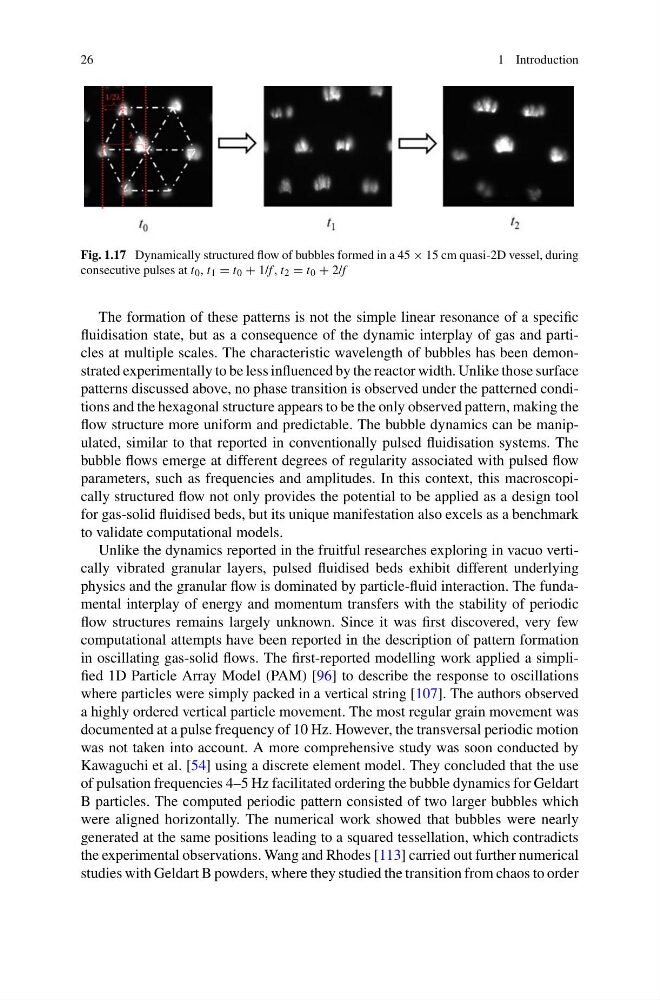
Fig. 1.17 Dynamically structured flow of bubbles formed in a 45 × 15 cm quasi-2D vessel, during
consecutive pulses at t 0 , t 1 = t 0 + 1/f , t 2 = t 0 + 2/f
The formation of these patterns is not the simple linear resonance of a specific
fluidisation state, but as a consequence of the dynamic interplay of gas and particles at multiple scales. The characteristic wavelength of bubbles has been demonstrated experimentally to be less influenced by the reactor width. Unlike those surface
patterns discussed above, no phase transition is observed under the patterned conditions and the hexagonal structure appears to be the only observed pattern, making the
flow structure more uniform and predictable. The bubble dynamics can be manipulated, similar to that reported in conventionally pulsed fluidisation systems. The
bubble flows emerge at different degrees of regularity associated with pulsed flow
parameters, such as frequencies and amplitudes. In this context, this macroscopically structured flow not only provides the potential to be applied as a design tool
for gas-solid fluidised beds, but its unique manifestation also excels as a benchmark
to validate computational models.
Unlike the dynamics reported in the fruitful researches exploring in vacuo vertically vibrated granular layers, pulsed fluidised beds exhibit different underlying
physics and the granular flow is dominated by particle-fluid interaction. The fundamental interplay of energy and momentum transfers with the stability of periodic
flow structures remains largely unknown. Since it was first discovered, very few
computational attempts have been reported in the description of pattern formation
in oscillating gas-solid flows. The first-reported modelling work applied a simplified 1D Particle Array Model (PAM) [96] to describe the response to oscillations
where particles were simply packed in a vertical string [107]. The authors observed
a highly ordered vertical particle movement. The most regular grain movement was
documented at a pulse frequency of 10 Hz. However, the transversal periodic motion
was not taken into account. A more comprehensive study was soon conducted by
Kawaguchi et al. [54] using a discrete element model. They concluded that the use
of pulsation frequencies 4–5 Hz facilitated ordering the bubble dynamics for Geldart
B particles. The computed periodic pattern consisted of two larger bubbles which
were aligned horizontally. The numerical work showed that bubbles were nearly
generated at the same positions leading to a squared tessellation, which contradicts
the experimental observations. Wang and Rhodes [113] carried out further numerical
studies with Geldart B powders, where they studied the transition from chaos to order
1 Introduction
Fig. 1.17 Dynamically structured flow of bubbles formed in a 45 × 15 cm quasi-2D vessel, during
consecutive pulses at t 0 , t 1 = t 0 + 1/f , t 2 = t 0 + 2/f
The formation of these patterns is not the simple linear resonance of a specific
fluidisation state, but as a consequence of the dynamic interplay of gas and particles at multiple scales. The characteristic wavelength of bubbles has been demonstrated experimentally to be less influenced by the reactor width. Unlike those surface
patterns discussed above, no phase transition is observed under the patterned conditions and the hexagonal structure appears to be the only observed pattern, making the
flow structure more uniform and predictable. The bubble dynamics can be manipulated, similar to that reported in conventionally pulsed fluidisation systems. The
bubble flows emerge at different degrees of regularity associated with pulsed flow
parameters, such as frequencies and amplitudes. In this context, this macroscopically structured flow not only provides the potential to be applied as a design tool
for gas-solid fluidised beds, but its unique manifestation also excels as a benchmark
to validate computational models.
Unlike the dynamics reported in the fruitful researches exploring in vacuo vertically vibrated granular layers, pulsed fluidised beds exhibit different underlying
physics and the granular flow is dominated by particle-fluid interaction. The fundamental interplay of energy and momentum transfers with the stability of periodic
flow structures remains largely unknown. Since it was first discovered, very few
computational attempts have been reported in the description of pattern formation
in oscillating gas-solid flows. The first-reported modelling work applied a simplified 1D Particle Array Model (PAM) [96] to describe the response to oscillations
where particles were simply packed in a vertical string [107]. The authors observed
a highly ordered vertical particle movement. The most regular grain movement was
documented at a pulse frequency of 10 Hz. However, the transversal periodic motion
was not taken into account. A more comprehensive study was soon conducted by
Kawaguchi et al. [54] using a discrete element model. They concluded that the use
of pulsation frequencies 4–5 Hz facilitated ordering the bubble dynamics for Geldart
B particles. The computed periodic pattern consisted of two larger bubbles which
were aligned horizontally. The numerical work showed that bubbles were nearly
generated at the same positions leading to a squared tessellation, which contradicts
the experimental observations. Wang and Rhodes [113] carried out further numerical
studies with Geldart B powders, where they studied the transition from chaos to order