

1.6 Origin of Bubble Patterns in Pulsed Fluidised Beds
27
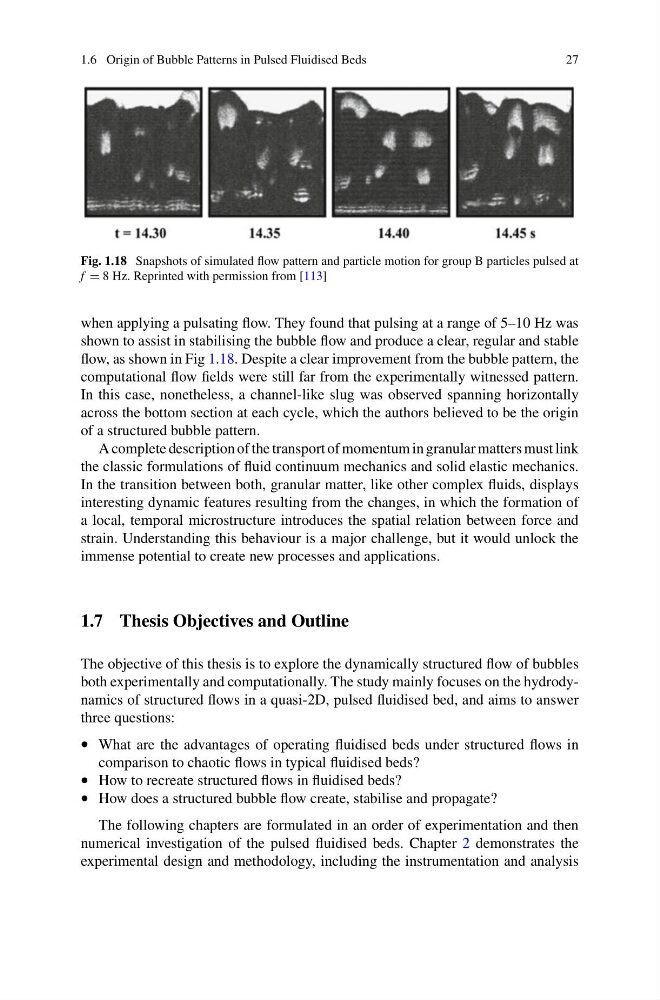
Fig. 1.18 Snapshots of simulated flow pattern and particle motion for group B particles pulsed at
f = 8 Hz. Reprinted with permission from [113]
when applying a pulsating flow. They found that pulsing at a range of 5–10 Hz was
shown to assist in stabilising the bubble flow and produce a clear, regular and stable
flow, as shown in Fig 1.18. Despite a clear improvement from the bubble pattern, the
computational flow fields were still far from the experimentally witnessed pattern.
In this case, nonetheless, a channel-like slug was observed spanning horizontally
across the bottom section at each cycle, which the authors believed to be the origin
of a structured bubble pattern.
A complete description of the transport of momentum in granular matters must link
the classic formulations of fluid continuum mechanics and solid elastic mechanics.
In the transition between both, granular matter, like other complex fluids, displays
interesting dynamic features resulting from the changes, in which the formation of
a local, temporal microstructure introduces the spatial relation between force and
strain. Understanding this behaviour is a major challenge, but it would unlock the
immense potential to create new processes and applications.
1.7 Thesis Objectives and Outline
The objective of this thesis is to explore the dynamically structured flow of bubbles
both experimentally and computationally. The study mainly focuses on the hydrodynamics of structured flows in a quasi-2D, pulsed fluidised bed, and aims to answer
three questions:
• What are the advantages of operating fluidised beds under structured flows in
comparison to chaotic flows in typical fluidised beds?
• How to recreate structured flows in fluidised beds?
• How does a structured bubble flow create, stabilise and propagate?
The following chapters are formulated in an order of experimentation and then
numerical investigation of the pulsed fluidised beds. Chapter 2 demonstrates the
experimental design and methodology, including the instrumentation and analysis
27
Fig. 1.18 Snapshots of simulated flow pattern and particle motion for group B particles pulsed at
f = 8 Hz. Reprinted with permission from [113]
when applying a pulsating flow. They found that pulsing at a range of 5–10 Hz was
shown to assist in stabilising the bubble flow and produce a clear, regular and stable
flow, as shown in Fig 1.18. Despite a clear improvement from the bubble pattern, the
computational flow fields were still far from the experimentally witnessed pattern.
In this case, nonetheless, a channel-like slug was observed spanning horizontally
across the bottom section at each cycle, which the authors believed to be the origin
of a structured bubble pattern.
A complete description of the transport of momentum in granular matters must link
the classic formulations of fluid continuum mechanics and solid elastic mechanics.
In the transition between both, granular matter, like other complex fluids, displays
interesting dynamic features resulting from the changes, in which the formation of
a local, temporal microstructure introduces the spatial relation between force and
strain. Understanding this behaviour is a major challenge, but it would unlock the
immense potential to create new processes and applications.
1.7 Thesis Objectives and Outline
The objective of this thesis is to explore the dynamically structured flow of bubbles
both experimentally and computationally. The study mainly focuses on the hydrodynamics of structured flows in a quasi-2D, pulsed fluidised bed, and aims to answer
three questions:
• What are the advantages of operating fluidised beds under structured flows in
comparison to chaotic flows in typical fluidised beds?
• How to recreate structured flows in fluidised beds?
• How does a structured bubble flow create, stabilise and propagate?
The following chapters are formulated in an order of experimentation and then
numerical investigation of the pulsed fluidised beds. Chapter 2 demonstrates the
experimental design and methodology, including the instrumentation and analysis