

1.6 Origin of Bubble Patterns in Pulsed Fluidised Beds
25
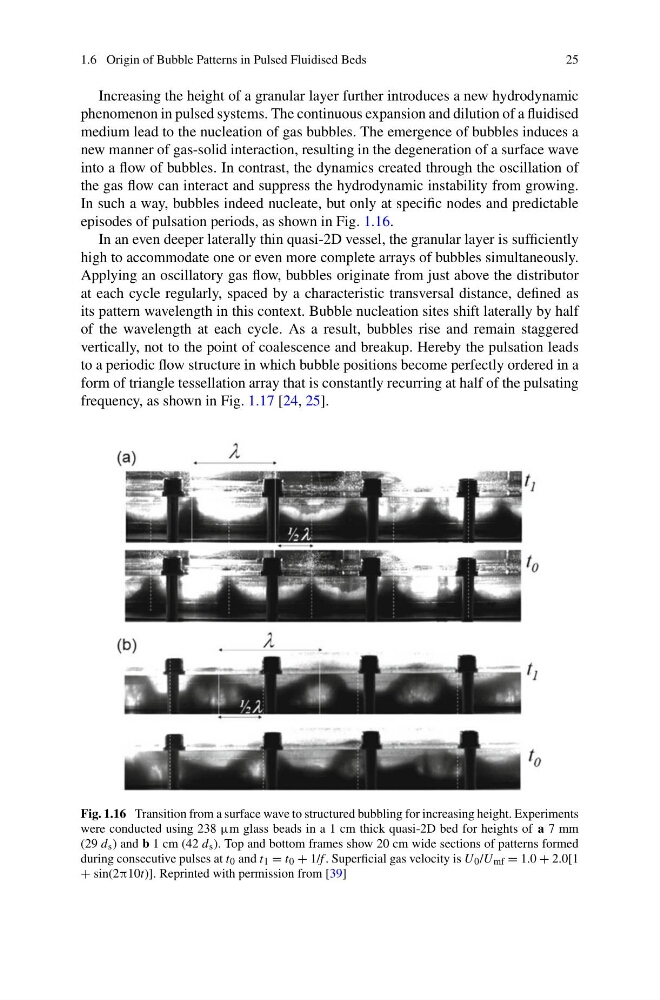
Increasing the height of a granular layer further introduces a new hydrodynamic
phenomenon in pulsed systems. The continuous expansion and dilution of a fluidised
medium lead to the nucleation of gas bubbles. The emergence of bubbles induces a
new manner of gas-solid interaction, resulting in the degeneration of a surface wave
into a flow of bubbles. In contrast, the dynamics created through the oscillation of
the gas flow can interact and suppress the hydrodynamic instability from growing.
In such a way, bubbles indeed nucleate, but only at specific nodes and predictable
episodes of pulsation periods, as shown in Fig. 1.16.
In an even deeper laterally thin quasi-2D vessel, the granular layer is sufficiently
high to accommodate one or even more complete arrays of bubbles simultaneously.
Applying an oscillatory gas flow, bubbles originate from just above the distributor
at each cycle regularly, spaced by a characteristic transversal distance, defined as
its pattern wavelength in this context. Bubble nucleation sites shift laterally by half
of the wavelength at each cycle. As a result, bubbles rise and remain staggered
vertically, not to the point of coalescence and breakup. Hereby the pulsation leads
to a periodic flow structure in which bubble positions become perfectly ordered in a
form of triangle tessellation array that is constantly recurring at half of the pulsating
frequency, as shown in Fig. 1.17 [24, 25].
Fig. 1.16 Transition from a surface wave to structured bubbling for increasing height. Experiments
were conducted using 238 μm glass beads in a 1 cm thick quasi-2D bed for heights of a 7 mm
(29 d s ) and b 1 cm (42 d s ). Top and bottom frames show 20 cm wide sections of patterns formed
during consecutive pulses at t 0 and t 1 = t 0 + 1/f . Superficial gas velocity is U 0 /U mf = 1.0 + 2.0[1
+ sin(2π10t)]. Reprinted with permission from [39]
25
Increasing the height of a granular layer further introduces a new hydrodynamic
phenomenon in pulsed systems. The continuous expansion and dilution of a fluidised
medium lead to the nucleation of gas bubbles. The emergence of bubbles induces a
new manner of gas-solid interaction, resulting in the degeneration of a surface wave
into a flow of bubbles. In contrast, the dynamics created through the oscillation of
the gas flow can interact and suppress the hydrodynamic instability from growing.
In such a way, bubbles indeed nucleate, but only at specific nodes and predictable
episodes of pulsation periods, as shown in Fig. 1.16.
In an even deeper laterally thin quasi-2D vessel, the granular layer is sufficiently
high to accommodate one or even more complete arrays of bubbles simultaneously.
Applying an oscillatory gas flow, bubbles originate from just above the distributor
at each cycle regularly, spaced by a characteristic transversal distance, defined as
its pattern wavelength in this context. Bubble nucleation sites shift laterally by half
of the wavelength at each cycle. As a result, bubbles rise and remain staggered
vertically, not to the point of coalescence and breakup. Hereby the pulsation leads
to a periodic flow structure in which bubble positions become perfectly ordered in a
form of triangle tessellation array that is constantly recurring at half of the pulsating
frequency, as shown in Fig. 1.17 [24, 25].
Fig. 1.16 Transition from a surface wave to structured bubbling for increasing height. Experiments
were conducted using 238 μm glass beads in a 1 cm thick quasi-2D bed for heights of a 7 mm
(29 d s ) and b 1 cm (42 d s ). Top and bottom frames show 20 cm wide sections of patterns formed
during consecutive pulses at t 0 and t 1 = t 0 + 1/f . Superficial gas velocity is U 0 /U mf = 1.0 + 2.0[1
+ sin(2π10t)]. Reprinted with permission from [39]