

1.5 Dynamic Patterns in Shallow Granular Layers
19
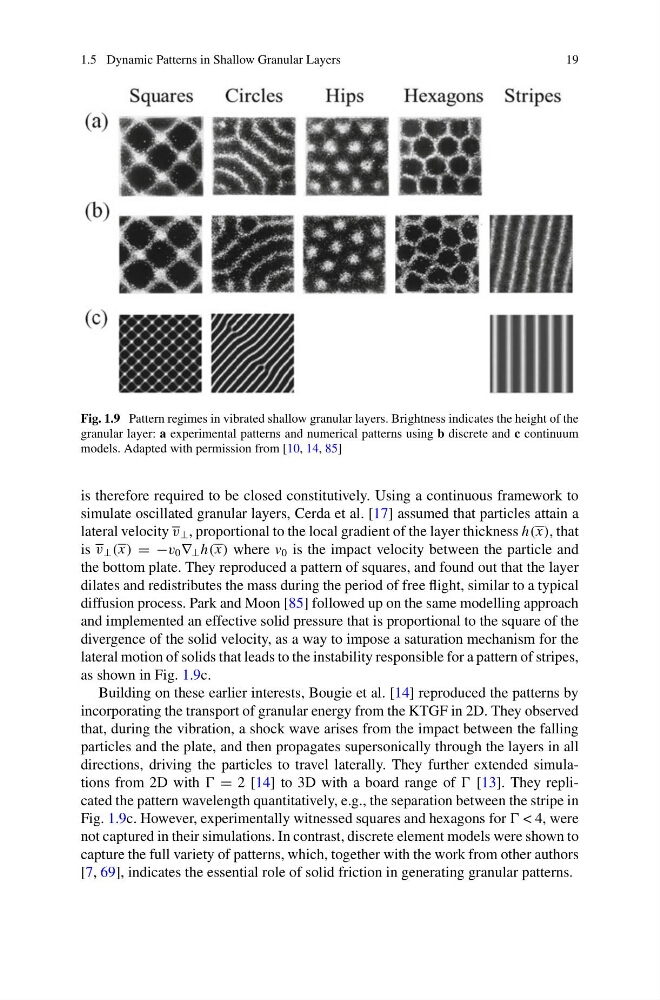
Fig. 1.9 Pattern regimes in vibrated shallow granular layers. Brightness indicates the height of the
granular layer: a experimental patterns and numerical patterns using b discrete and c continuum
models. Adapted with permission from [10, 14, 85]
is therefore required to be closed constitutively. Using a continuous framework to
simulate oscillated granular layers, Cerda et al. [17] assumed that particles attain a
lateral velocity v ⊥ , proportional to the local gradient of the layer thickness h(x), that
is v ⊥ (x) = −v 0 ∇ ⊥ h(x) where v 0 is the impact velocity between the particle and
the bottom plate. They reproduced a pattern of squares, and found out that the layer
dilates and redistributes the mass during the period of free flight, similar to a typical
diffusion process. Park and Moon [85] followed up on the same modelling approach
and implemented an effective solid pressure that is proportional to the square of the
divergence of the solid velocity, as a way to impose a saturation mechanism for the
lateral motion of solids that leads to the instability responsible for a pattern of stripes,
as shown in Fig. 1.9c.
Building on these earlier interests, Bougie et al. [14] reproduced the patterns by
incorporating the transport of granular energy from the KTGF in 2D. They observed
that, during the vibration, a shock wave arises from the impact between the falling
particles and the plate, and then propagates supersonically through the layers in all
directions, driving the particles to travel laterally. They further extended simulations from 2D with = 2 [14] to 3D with a board range of [13]. They replicated the pattern wavelength quantitatively, e.g., the separation between the stripe in
Fig. 1.9c. However, experimentally witnessed squares and hexagons for < 4, were
not captured in their simulations. In contrast, discrete element models were shown to
capture the full variety of patterns, which, together with the work from other authors
[7, 69], indicates the essential role of solid friction in generating granular patterns.
19
Fig. 1.9 Pattern regimes in vibrated shallow granular layers. Brightness indicates the height of the
granular layer: a experimental patterns and numerical patterns using b discrete and c continuum
models. Adapted with permission from [10, 14, 85]
is therefore required to be closed constitutively. Using a continuous framework to
simulate oscillated granular layers, Cerda et al. [17] assumed that particles attain a
lateral velocity v ⊥ , proportional to the local gradient of the layer thickness h(x), that
is v ⊥ (x) = −v 0 ∇ ⊥ h(x) where v 0 is the impact velocity between the particle and
the bottom plate. They reproduced a pattern of squares, and found out that the layer
dilates and redistributes the mass during the period of free flight, similar to a typical
diffusion process. Park and Moon [85] followed up on the same modelling approach
and implemented an effective solid pressure that is proportional to the square of the
divergence of the solid velocity, as a way to impose a saturation mechanism for the
lateral motion of solids that leads to the instability responsible for a pattern of stripes,
as shown in Fig. 1.9c.
Building on these earlier interests, Bougie et al. [14] reproduced the patterns by
incorporating the transport of granular energy from the KTGF in 2D. They observed
that, during the vibration, a shock wave arises from the impact between the falling
particles and the plate, and then propagates supersonically through the layers in all
directions, driving the particles to travel laterally. They further extended simulations from 2D with = 2 [14] to 3D with a board range of [13]. They replicated the pattern wavelength quantitatively, e.g., the separation between the stripe in
Fig. 1.9c. However, experimentally witnessed squares and hexagons for < 4, were
not captured in their simulations. In contrast, discrete element models were shown to
capture the full variety of patterns, which, together with the work from other authors
[7, 69], indicates the essential role of solid friction in generating granular patterns.