

20
1 Introduction
1.5.3 Gas-Driven Patterns
Pulsating gas flows alters fluid-solid interaction force, resulting in a different balance
of energy input and dissipation different from vibration. The gas fills interparticle
gaps distributed over the entire volume, and pulsation causes changes in interphase
drag that is directly and simultaneously imposed onto all particles. Although the gasdriven patterns share many similarities with the vibration-driven patterns, its relevant
studies are not as fruitful as the latter. Introducing the gas phase renders a multiphase
system, and a pattern arises from spatiotemporal couple between the two phases,
involving more complex dynamics. The underlying physics leading to a gas-driven
surface pattern is far from well understood.
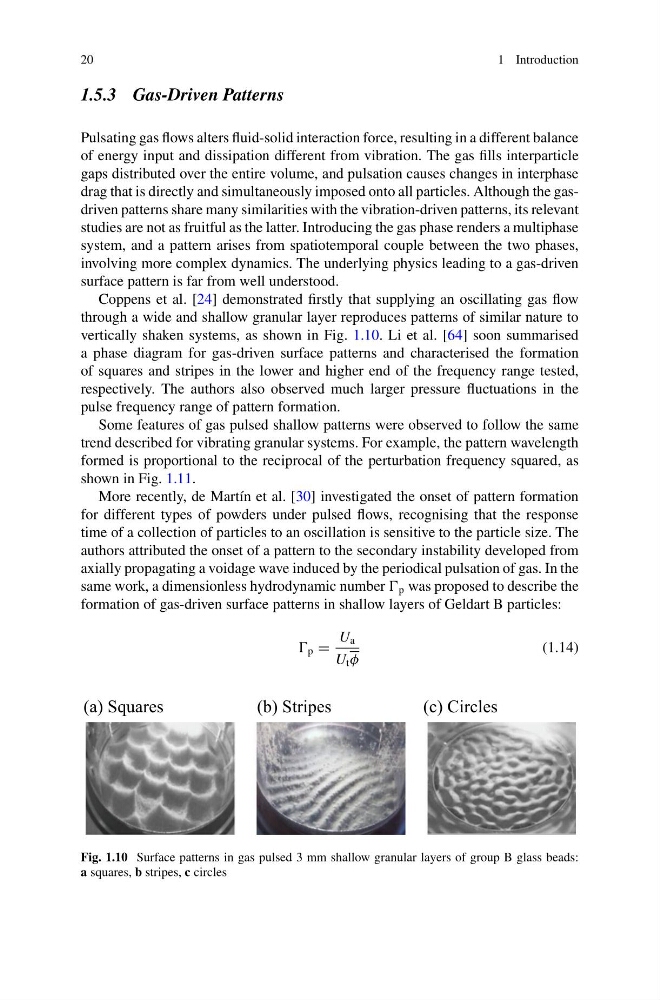
Coppens et al. [24] demonstrated firstly that supplying an oscillating gas flow
through a wide and shallow granular layer reproduces patterns of similar nature to
vertically shaken systems, as shown in Fig. 1.10. Li et al. [64] soon summarised
a phase diagram for gas-driven surface patterns and characterised the formation
of squares and stripes in the lower and higher end of the frequency range tested,
respectively. The authors also observed much larger pressure fluctuations in the
pulse frequency range of pattern formation.
Some features of gas pulsed shallow patterns were observed to follow the same
trend described for vibrating granular systems. For example, the pattern wavelength
formed is proportional to the reciprocal of the perturbation frequency squared, as
shown in Fig. 1.11.
More recently, de Martín et al. [30] investigated the onset of pattern formation
for different types of powders under pulsed flows, recognising that the response
time of a collection of particles to an oscillation is sensitive to the particle size. The
authors attributed the onset of a pattern to the secondary instability developed from
axially propagating a voidage wave induced by the periodical pulsation of gas. In the
same work, a dimensionless hydrodynamic number p was proposed to describe the
formation of gas-driven surface patterns in shallow layers of Geldart B particles:
p =
U a
U t φ
(1.14)
(a) Squares
(b) Stripes
(c) Circles
Fig. 1.10 Surface patterns in gas pulsed 3 mm shallow granular layers of group B glass beads:
a squares, b stripes, c circles
1 Introduction
1.5.3 Gas-Driven Patterns
Pulsating gas flows alters fluid-solid interaction force, resulting in a different balance
of energy input and dissipation different from vibration. The gas fills interparticle
gaps distributed over the entire volume, and pulsation causes changes in interphase
drag that is directly and simultaneously imposed onto all particles. Although the gasdriven patterns share many similarities with the vibration-driven patterns, its relevant
studies are not as fruitful as the latter. Introducing the gas phase renders a multiphase
system, and a pattern arises from spatiotemporal couple between the two phases,
involving more complex dynamics. The underlying physics leading to a gas-driven
surface pattern is far from well understood.
Coppens et al. [24] demonstrated firstly that supplying an oscillating gas flow
through a wide and shallow granular layer reproduces patterns of similar nature to
vertically shaken systems, as shown in Fig. 1.10. Li et al. [64] soon summarised
a phase diagram for gas-driven surface patterns and characterised the formation
of squares and stripes in the lower and higher end of the frequency range tested,
respectively. The authors also observed much larger pressure fluctuations in the
pulse frequency range of pattern formation.
Some features of gas pulsed shallow patterns were observed to follow the same
trend described for vibrating granular systems. For example, the pattern wavelength
formed is proportional to the reciprocal of the perturbation frequency squared, as
shown in Fig. 1.11.
More recently, de Martín et al. [30] investigated the onset of pattern formation
for different types of powders under pulsed flows, recognising that the response
time of a collection of particles to an oscillation is sensitive to the particle size. The
authors attributed the onset of a pattern to the secondary instability developed from
axially propagating a voidage wave induced by the periodical pulsation of gas. In the
same work, a dimensionless hydrodynamic number p was proposed to describe the
formation of gas-driven surface patterns in shallow layers of Geldart B particles:
p =
U a
U t φ
(1.14)
(a) Squares
(b) Stripes
(c) Circles
Fig. 1.10 Surface patterns in gas pulsed 3 mm shallow granular layers of group B glass beads:
a squares, b stripes, c circles