

18
1 Introduction
determined by the energy input and dissipation through interparticle collisions and
friction [80, 95]. In a vibrated layer, the pattern wavelength decreases as the frequency
increases, till it saturates at large values [22, 69, 79]. The critical frequency of saturation varies with the depth of granular layers, as it is believed to associate with the
mechanical energy propagating through the layer, but only negligible changes with
the particle diameter [106]. Umbanhowar et al. [104] reported a linear relationship
between the wavelength and the reciprocal of pulse frequency squared, comparable
to the Faraday wave in liquids.
The works above discuss vibrated granular layers by considering the particle as
a rigid body. The way of energy transmission and dissipation, nevertheless, depends
significantly on inelastic interparticle collision as well as interphase friction. It is not
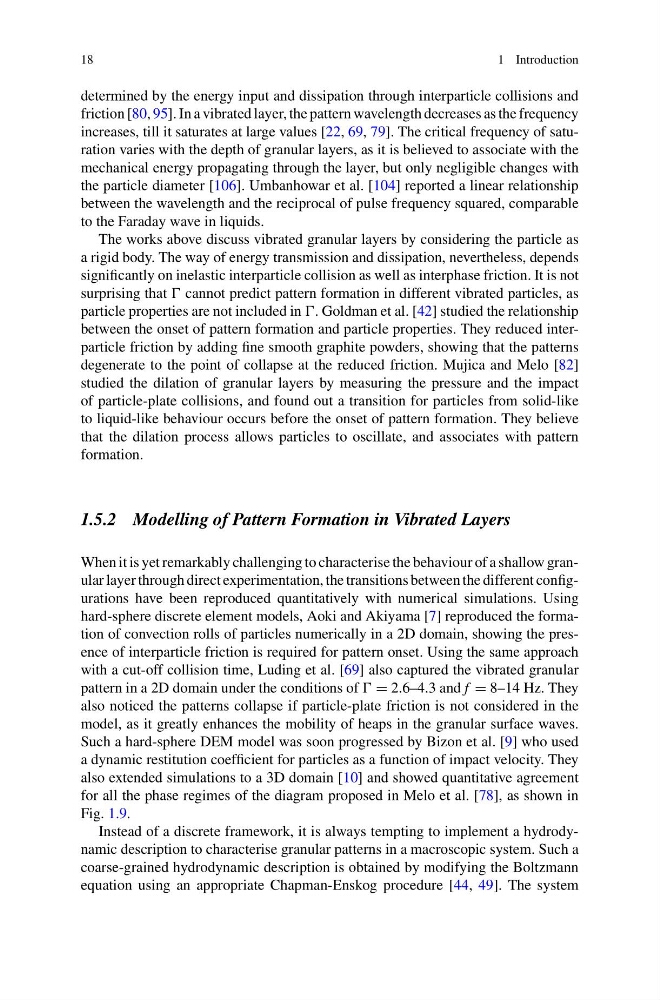
surprising that cannot predict pattern formation in different vibrated particles, as
particle properties are not included in . Goldman et al. [42] studied the relationship
between the onset of pattern formation and particle properties. They reduced interparticle friction by adding fine smooth graphite powders, showing that the patterns
degenerate to the point of collapse at the reduced friction. Mujica and Melo [82]
studied the dilation of granular layers by measuring the pressure and the impact
of particle-plate collisions, and found out a transition for particles from solid-like
to liquid-like behaviour occurs before the onset of pattern formation. They believe
that the dilation process allows particles to oscillate, and associates with pattern
formation.
1.5.2 Modelling of Pattern Formation in Vibrated Layers
When it is yet remarkably challenging to characterise the behaviour of a shallow granular layer through direct experimentation, the transitions between the different configurations have been reproduced quantitatively with numerical simulations. Using
hard-sphere discrete element models, Aoki and Akiyama [7] reproduced the formation of convection rolls of particles numerically in a 2D domain, showing the presence of interparticle friction is required for pattern onset. Using the same approach
with a cut-off collision time, Luding et al. [69] also captured the vibrated granular
pattern in a 2D domain under the conditions of = 2.6–4.3 and f = 8–14 Hz. They
also noticed the patterns collapse if particle-plate friction is not considered in the
model, as it greatly enhances the mobility of heaps in the granular surface waves.
Such a hard-sphere DEM model was soon progressed by Bizon et al. [9] who used
a dynamic restitution coefficient for particles as a function of impact velocity. They
also extended simulations to a 3D domain [10] and showed quantitative agreement
for all the phase regimes of the diagram proposed in Melo et al. [78], as shown in
Fig. 1.9.
Instead of a discrete framework, it is always tempting to implement a hydrodynamic description to characterise granular patterns in a macroscopic system. Such a
coarse-grained hydrodynamic description is obtained by modifying the Boltzmann
equation using an appropriate Chapman-Enskog procedure [44, 49]. The system
1 Introduction
determined by the energy input and dissipation through interparticle collisions and
friction [80, 95]. In a vibrated layer, the pattern wavelength decreases as the frequency
increases, till it saturates at large values [22, 69, 79]. The critical frequency of saturation varies with the depth of granular layers, as it is believed to associate with the
mechanical energy propagating through the layer, but only negligible changes with
the particle diameter [106]. Umbanhowar et al. [104] reported a linear relationship
between the wavelength and the reciprocal of pulse frequency squared, comparable
to the Faraday wave in liquids.
The works above discuss vibrated granular layers by considering the particle as
a rigid body. The way of energy transmission and dissipation, nevertheless, depends
significantly on inelastic interparticle collision as well as interphase friction. It is not
surprising that cannot predict pattern formation in different vibrated particles, as
particle properties are not included in . Goldman et al. [42] studied the relationship
between the onset of pattern formation and particle properties. They reduced interparticle friction by adding fine smooth graphite powders, showing that the patterns
degenerate to the point of collapse at the reduced friction. Mujica and Melo [82]
studied the dilation of granular layers by measuring the pressure and the impact
of particle-plate collisions, and found out a transition for particles from solid-like
to liquid-like behaviour occurs before the onset of pattern formation. They believe
that the dilation process allows particles to oscillate, and associates with pattern
formation.
1.5.2 Modelling of Pattern Formation in Vibrated Layers
When it is yet remarkably challenging to characterise the behaviour of a shallow granular layer through direct experimentation, the transitions between the different configurations have been reproduced quantitatively with numerical simulations. Using
hard-sphere discrete element models, Aoki and Akiyama [7] reproduced the formation of convection rolls of particles numerically in a 2D domain, showing the presence of interparticle friction is required for pattern onset. Using the same approach
with a cut-off collision time, Luding et al. [69] also captured the vibrated granular
pattern in a 2D domain under the conditions of = 2.6–4.3 and f = 8–14 Hz. They
also noticed the patterns collapse if particle-plate friction is not considered in the
model, as it greatly enhances the mobility of heaps in the granular surface waves.
Such a hard-sphere DEM model was soon progressed by Bizon et al. [9] who used
a dynamic restitution coefficient for particles as a function of impact velocity. They
also extended simulations to a 3D domain [10] and showed quantitative agreement
for all the phase regimes of the diagram proposed in Melo et al. [78], as shown in
Fig. 1.9.
Instead of a discrete framework, it is always tempting to implement a hydrodynamic description to characterise granular patterns in a macroscopic system. Such a
coarse-grained hydrodynamic description is obtained by modifying the Boltzmann
equation using an appropriate Chapman-Enskog procedure [44, 49]. The system