

1.5 Dynamic Patterns in Shallow Granular Layers
17
=
4π
2 f
2 B
g
(1.13)
where f is the frequency, B is the amplitude, and g is the gravitational acceleration.
A thin granular layer would be considered on the verge of detaching from the plate at
= 1, where the maximum acceleration caused by vibration equals the gravitational
acceleration.
Under different conditions of vibration, patterns display distinctive visual manifestation, such as squares, stripes, hexagons, spirals and “oscillons” (soliton waves),
depending on the frequency and the Froude number applied [79, 83, 105]. A periodic structure emerges beyond a given onset, commonly termed as critical Froude
number c , which is strongly associated with the particle properties and the presence
of surrounding air. When reaching c , a vibrated granular layer distributes in square
grids across the bottom of the container, maintaining an identical wavelength in
both orthogonal directions. As continues to increase, stripes with a smaller wavelength gradually replace the squares, and a strong curvature begins to emerge around
the walls [104]. Umbanhowar and Swinney [106] found that the critical frequency
for a square-stripe transition is linearly proportional to the reciprocal of bed height
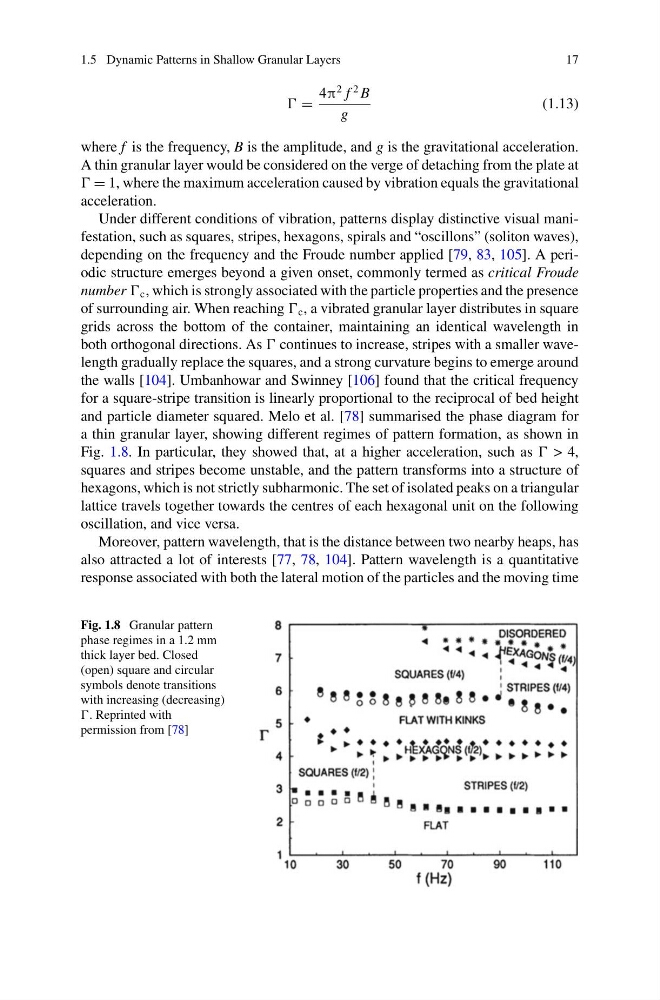
and particle diameter squared. Melo et al. [78] summarised the phase diagram for
a thin granular layer, showing different regimes of pattern formation, as shown in
Fig. 1.8. In particular, they showed that, at a higher acceleration, such as > 4,
squares and stripes become unstable, and the pattern transforms into a structure of
hexagons, which is not strictly subharmonic. The set of isolated peaks on a triangular
lattice travels together towards the centres of each hexagonal unit on the following
oscillation, and vice versa.
Moreover, pattern wavelength, that is the distance between two nearby heaps, has
also attracted a lot of interests [77, 78, 104]. Pattern wavelength is a quantitative
response associated with both the lateral motion of the particles and the moving time
Fig. 1.8 Granular pattern
phase regimes in a 1.2 mm
thick layer bed. Closed
(open) square and circular
symbols denote transitions
with increasing (decreasing)
. Reprinted with
permission from [78]
17
=
4π
2 f
2 B
g
(1.13)
where f is the frequency, B is the amplitude, and g is the gravitational acceleration.
A thin granular layer would be considered on the verge of detaching from the plate at
= 1, where the maximum acceleration caused by vibration equals the gravitational
acceleration.
Under different conditions of vibration, patterns display distinctive visual manifestation, such as squares, stripes, hexagons, spirals and “oscillons” (soliton waves),
depending on the frequency and the Froude number applied [79, 83, 105]. A periodic structure emerges beyond a given onset, commonly termed as critical Froude
number c , which is strongly associated with the particle properties and the presence
of surrounding air. When reaching c , a vibrated granular layer distributes in square
grids across the bottom of the container, maintaining an identical wavelength in
both orthogonal directions. As continues to increase, stripes with a smaller wavelength gradually replace the squares, and a strong curvature begins to emerge around
the walls [104]. Umbanhowar and Swinney [106] found that the critical frequency
for a square-stripe transition is linearly proportional to the reciprocal of bed height
and particle diameter squared. Melo et al. [78] summarised the phase diagram for
a thin granular layer, showing different regimes of pattern formation, as shown in
Fig. 1.8. In particular, they showed that, at a higher acceleration, such as > 4,
squares and stripes become unstable, and the pattern transforms into a structure of
hexagons, which is not strictly subharmonic. The set of isolated peaks on a triangular
lattice travels together towards the centres of each hexagonal unit on the following
oscillation, and vice versa.
Moreover, pattern wavelength, that is the distance between two nearby heaps, has
also attracted a lot of interests [77, 78, 104]. Pattern wavelength is a quantitative
response associated with both the lateral motion of the particles and the moving time
Fig. 1.8 Granular pattern
phase regimes in a 1.2 mm
thick layer bed. Closed
(open) square and circular
symbols denote transitions
with increasing (decreasing)
. Reprinted with
permission from [78]