

16
1 Introduction
1.5.1 Vibro-Driven Patterns
There is extensive literature studying the pattern formation in vibrated shallow granular systems. In the late 1980s, Douady et al. [34] observed experimentally how
subharmonic granular waves appear in quasi-2D geometries when a granular layer
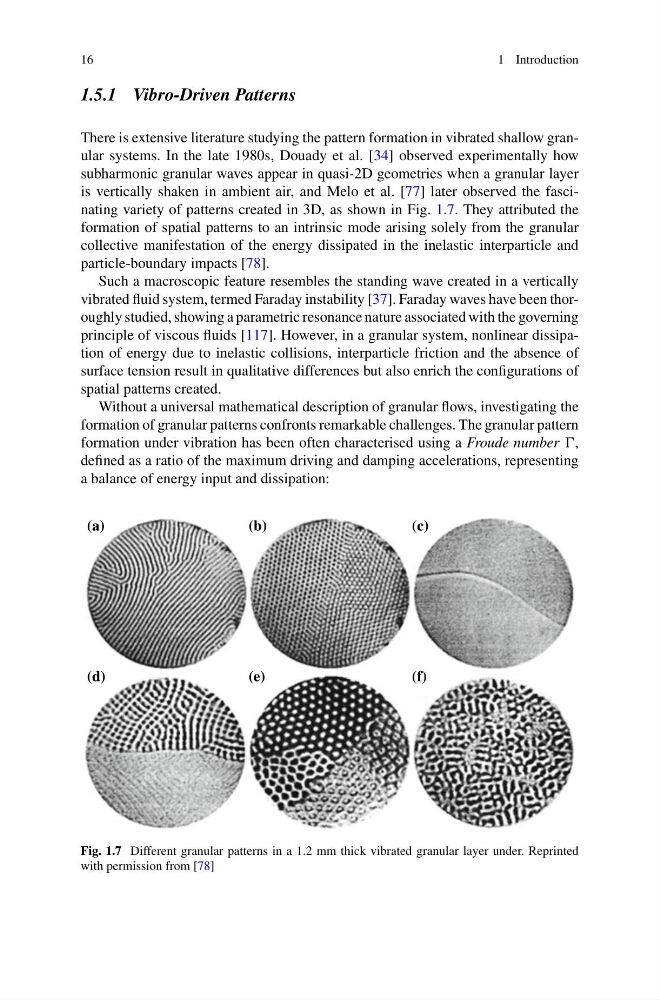
is vertically shaken in ambient air, and Melo et al. [77] later observed the fascinating variety of patterns created in 3D, as shown in Fig. 1.7. They attributed the
formation of spatial patterns to an intrinsic mode arising solely from the granular
collective manifestation of the energy dissipated in the inelastic interparticle and
particle-boundary impacts [78].
Such a macroscopic feature resembles the standing wave created in a vertically
vibrated fluid system, termed Faraday instability [37]. Faraday waves have been thoroughly studied, showing a parametric resonance nature associated with the governing
principle of viscous fluids [117]. However, in a granular system, nonlinear dissipation of energy due to inelastic collisions, interparticle friction and the absence of
surface tension result in qualitative differences but also enrich the configurations of
spatial patterns created.
Without a universal mathematical description of granular flows, investigating the
formation of granular patterns confronts remarkable challenges. The granular pattern
formation under vibration has been often characterised using a Froude number
defined as a ratio of the maximum driving and damping accelerations, representing
a balance of energy input and dissipation:
(a)
(b)
(c)
(d)
(e)
(f)
Fig. 1.7 Different granular patterns in a 1.2 mm thick vibrated granular layer under. Reprinted
with permission from [78]
1 Introduction
1.5.1 Vibro-Driven Patterns
There is extensive literature studying the pattern formation in vibrated shallow granular systems. In the late 1980s, Douady et al. [34] observed experimentally how
subharmonic granular waves appear in quasi-2D geometries when a granular layer
is vertically shaken in ambient air, and Melo et al. [77] later observed the fascinating variety of patterns created in 3D, as shown in Fig. 1.7. They attributed the
formation of spatial patterns to an intrinsic mode arising solely from the granular
collective manifestation of the energy dissipated in the inelastic interparticle and
particle-boundary impacts [78].
Such a macroscopic feature resembles the standing wave created in a vertically
vibrated fluid system, termed Faraday instability [37]. Faraday waves have been thoroughly studied, showing a parametric resonance nature associated with the governing
principle of viscous fluids [117]. However, in a granular system, nonlinear dissipation of energy due to inelastic collisions, interparticle friction and the absence of
surface tension result in qualitative differences but also enrich the configurations of
spatial patterns created.
Without a universal mathematical description of granular flows, investigating the
formation of granular patterns confronts remarkable challenges. The granular pattern
formation under vibration has been often characterised using a Froude number
defined as a ratio of the maximum driving and damping accelerations, representing
a balance of energy input and dissipation:
(a)
(b)
(c)
(d)
(e)
(f)
Fig. 1.7 Different granular patterns in a 1.2 mm thick vibrated granular layer under. Reprinted
with permission from [78]