

1.5 Dynamic Patterns in Shallow Granular Layers
15
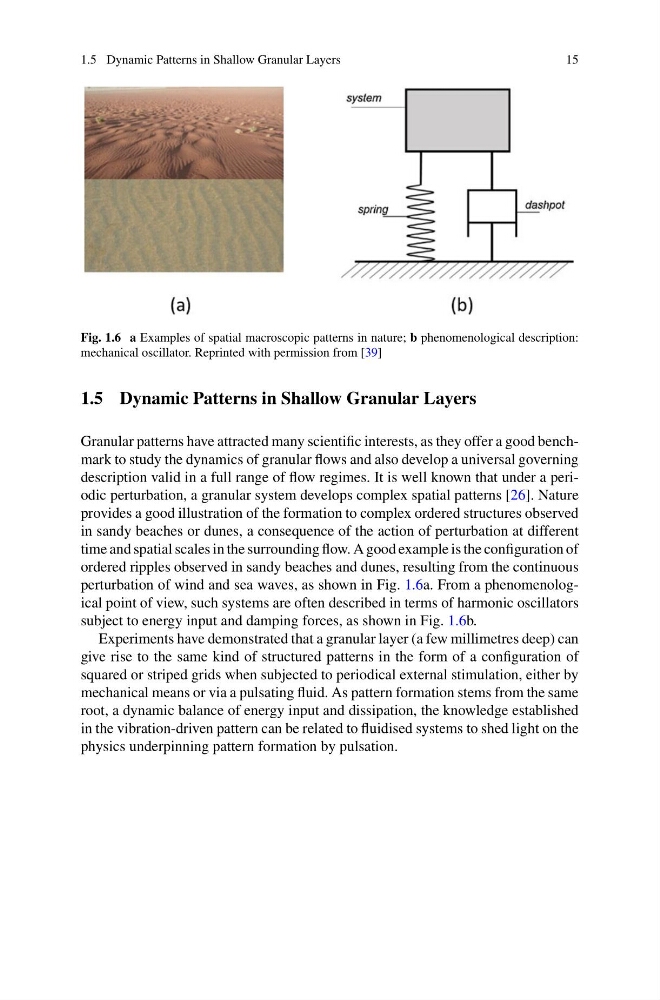
Fig. 1.6 a Examples of spatial macroscopic patterns in nature; b phenomenological description:
mechanical oscillator. Reprinted with permission from [39]
1.5 Dynamic Patterns in Shallow Granular Layers
Granular patterns have attracted many scientific interests, as they offer a good benchmark to study the dynamics of granular flows and also develop a universal governing
description valid in a full range of flow regimes. It is well known that under a periodic perturbation, a granular system develops complex spatial patterns [26]. Nature
provides a good illustration of the formation to complex ordered structures observed
in sandy beaches or dunes, a consequence of the action of perturbation at different
time and spatial scales in the surrounding flow. A good example is the configuration of
ordered ripples observed in sandy beaches and dunes, resulting from the continuous
perturbation of wind and sea waves, as shown in Fig. 1.6a. From a phenomenological point of view, such systems are often described in terms of harmonic oscillators
subject to energy input and damping forces, as shown in Fig. 1.6b.
Experiments have demonstrated that a granular layer (a few millimetres deep) can
give rise to the same kind of structured patterns in the form of a configuration of
squared or striped grids when subjected to periodical external stimulation, either by
mechanical means or via a pulsating fluid. As pattern formation stems from the same
root, a dynamic balance of energy input and dissipation, the knowledge established
in the vibration-driven pattern can be related to fluidised systems to shed light on the
physics underpinning pattern formation by pulsation.
15
Fig. 1.6 a Examples of spatial macroscopic patterns in nature; b phenomenological description:
mechanical oscillator. Reprinted with permission from [39]
1.5 Dynamic Patterns in Shallow Granular Layers
Granular patterns have attracted many scientific interests, as they offer a good benchmark to study the dynamics of granular flows and also develop a universal governing
description valid in a full range of flow regimes. It is well known that under a periodic perturbation, a granular system develops complex spatial patterns [26]. Nature
provides a good illustration of the formation to complex ordered structures observed
in sandy beaches or dunes, a consequence of the action of perturbation at different
time and spatial scales in the surrounding flow. A good example is the configuration of
ordered ripples observed in sandy beaches and dunes, resulting from the continuous
perturbation of wind and sea waves, as shown in Fig. 1.6a. From a phenomenological point of view, such systems are often described in terms of harmonic oscillators
subject to energy input and damping forces, as shown in Fig. 1.6b.
Experiments have demonstrated that a granular layer (a few millimetres deep) can
give rise to the same kind of structured patterns in the form of a configuration of
squared or striped grids when subjected to periodical external stimulation, either by
mechanical means or via a pulsating fluid. As pattern formation stems from the same
root, a dynamic balance of energy input and dissipation, the knowledge established
in the vibration-driven pattern can be related to fluidised systems to shed light on the
physics underpinning pattern formation by pulsation.