

1.3 Multi-scale Modelling of Gas-Solid Flows
7
Vi
Vj
Ri
Rj
ωi
ωj
nij
tij
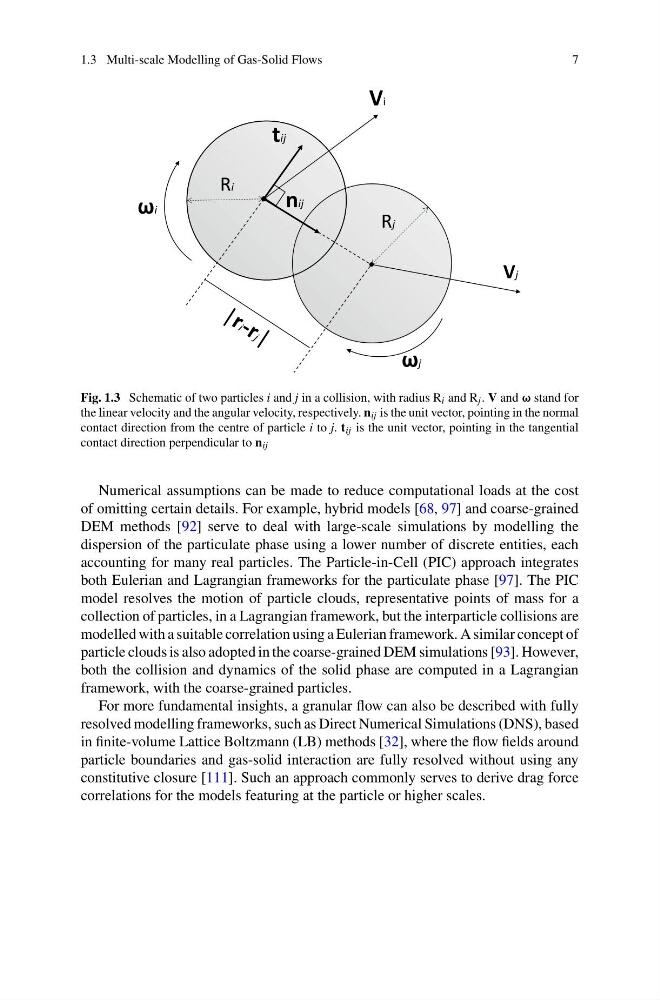
Fig. 1.3 Schematic of two particles i and j in a collision, with radius R i and R j . V and ω stand for
the linear velocity and the angular velocity, respectively. n ij is the unit vector, pointing in the normal
contact direction from the centre of particle i to j. t ij is the unit vector, pointing in the tangential
contact direction perpendicular to n ij
Numerical assumptions can be made to reduce computational loads at the cost
of omitting certain details. For example, hybrid models [68, 97] and coarse-grained
DEM methods [92] serve to deal with large-scale simulations by modelling the
dispersion of the particulate phase using a lower number of discrete entities, each
accounting for many real particles. The Particle-in-Cell (PIC) approach integrates
both Eulerian and Lagrangian frameworks for the particulate phase [97]. The PIC
model resolves the motion of particle clouds, representative points of mass for a
collection of particles, in a Lagrangian framework, but the interparticle collisions are
modelled with a suitable correlation using a Eulerian framework. A similar concept of
particle clouds is also adopted in the coarse-grained DEM simulations [93]. However,
both the collision and dynamics of the solid phase are computed in a Lagrangian
framework, with the coarse-grained particles.
For more fundamental insights, a granular flow can also be described with fully
resolved modelling frameworks, such as Direct Numerical Simulations (DNS), based
in finite-volume Lattice Boltzmann (LB) methods [32], where the flow fields around
particle boundaries and gas-solid interaction are fully resolved without using any
constitutive closure [111]. Such an approach commonly serves to derive drag force
correlations for the models featuring at the particle or higher scales.
7
Vi
Vj
Ri
Rj
ωi
ωj
nij
tij
Fig. 1.3 Schematic of two particles i and j in a collision, with radius R i and R j . V and ω stand for
the linear velocity and the angular velocity, respectively. n ij is the unit vector, pointing in the normal
contact direction from the centre of particle i to j. t ij is the unit vector, pointing in the tangential
contact direction perpendicular to n ij
Numerical assumptions can be made to reduce computational loads at the cost
of omitting certain details. For example, hybrid models [68, 97] and coarse-grained
DEM methods [92] serve to deal with large-scale simulations by modelling the
dispersion of the particulate phase using a lower number of discrete entities, each
accounting for many real particles. The Particle-in-Cell (PIC) approach integrates
both Eulerian and Lagrangian frameworks for the particulate phase [97]. The PIC
model resolves the motion of particle clouds, representative points of mass for a
collection of particles, in a Lagrangian framework, but the interparticle collisions are
modelled with a suitable correlation using a Eulerian framework. A similar concept of
particle clouds is also adopted in the coarse-grained DEM simulations [93]. However,
both the collision and dynamics of the solid phase are computed in a Lagrangian
framework, with the coarse-grained particles.
For more fundamental insights, a granular flow can also be described with fully
resolved modelling frameworks, such as Direct Numerical Simulations (DNS), based
in finite-volume Lattice Boltzmann (LB) methods [32], where the flow fields around
particle boundaries and gas-solid interaction are fully resolved without using any
constitutive closure [111]. Such an approach commonly serves to derive drag force
correlations for the models featuring at the particle or higher scales.