

6
1 Introduction
category, two state-of-the-art approaches are prevalent: the discrete element model
(Euler-Lagrange) approach and the two-fluid model (Euler-Euler) approach [43].
1.3.1 Discrete Element Model
The Discrete element model (DEM) adopts a Lagrangian framework that explicitly
tracks individual particle trajectory following Newton’s laws of motion, and solves
both its translational and rotational actions [103, 110]. For every single particle of
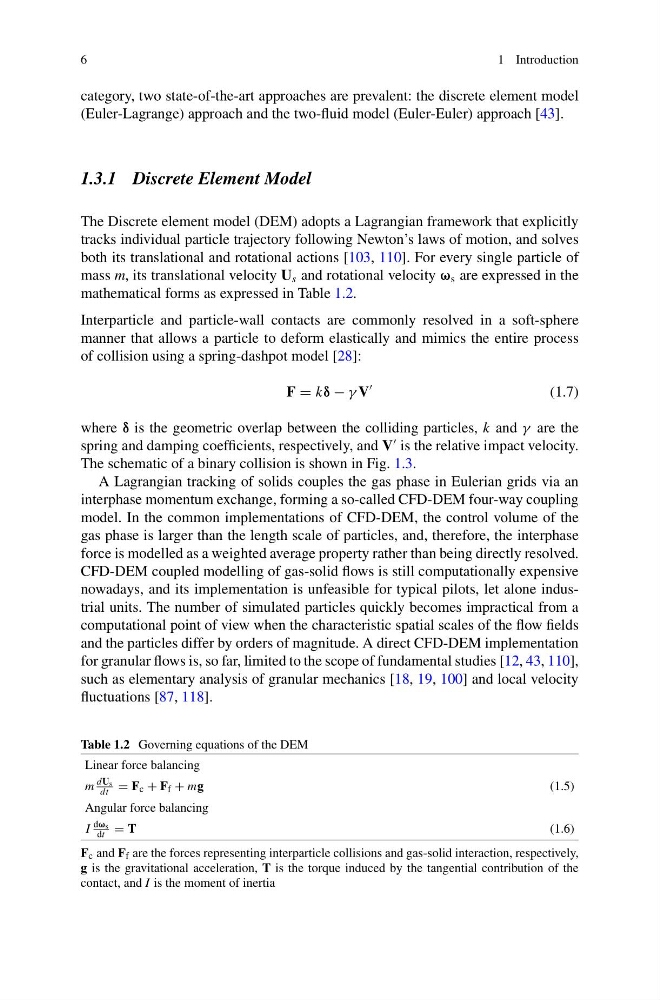
mass m, its translational velocity U s and rotational velocity ω s are expressed in the
mathematical forms as expressed in Table 1.2.
Interparticle and particle-wall contacts are commonly resolved in a soft-sphere
manner that allows a particle to deform elastically and mimics the entire process
of collision using a spring-dashpot model [28]:
F = kδ − γ V
(1.7)
where δ is the geometric overlap between the colliding particles, k and γ are the
spring and damping coefficients, respectively, and V
is the relative impact velocity.
The schematic of a binary collision is shown in Fig. 1.3.
A Lagrangian tracking of solids couples the gas phase in Eulerian grids via an
interphase momentum exchange, forming a so-called CFD-DEM four-way coupling
model. In the common implementations of CFD-DEM, the control volume of the
gas phase is larger than the length scale of particles, and, therefore, the interphase
force is modelled as a weighted average property rather than being directly resolved.
CFD-DEM coupled modelling of gas-solid flows is still computationally expensive
nowadays, and its implementation is unfeasible for typical pilots, let alone industrial units. The number of simulated particles quickly becomes impractical from a
computational point of view when the characteristic spatial scales of the flow fields
and the particles differ by orders of magnitude. A direct CFD-DEM implementation
for granular flows is, so far, limited to the scope of fundamental studies [12, 43, 110],
such as elementary analysis of granular mechanics [18, 19, 100] and local velocity
fluctuations [87, 118].
Table 1.2 Governing equations of the DEM
Linear force balancing
m
dUs
dt = F c + F f + mg
(1.5)
Angular force balancing
I
dωs
dt = T
(1.6)
F c and F f are the forces representing interparticle collisions and gas-solid interaction, respectively,
g is the gravitational acceleration, T is the torque induced by the tangential contribution of the
contact, and I is the moment of inertia
1 Introduction
category, two state-of-the-art approaches are prevalent: the discrete element model
(Euler-Lagrange) approach and the two-fluid model (Euler-Euler) approach [43].
1.3.1 Discrete Element Model
The Discrete element model (DEM) adopts a Lagrangian framework that explicitly
tracks individual particle trajectory following Newton’s laws of motion, and solves
both its translational and rotational actions [103, 110]. For every single particle of
mass m, its translational velocity U s and rotational velocity ω s are expressed in the
mathematical forms as expressed in Table 1.2.
Interparticle and particle-wall contacts are commonly resolved in a soft-sphere
manner that allows a particle to deform elastically and mimics the entire process
of collision using a spring-dashpot model [28]:
F = kδ − γ V
(1.7)
where δ is the geometric overlap between the colliding particles, k and γ are the
spring and damping coefficients, respectively, and V
is the relative impact velocity.
The schematic of a binary collision is shown in Fig. 1.3.
A Lagrangian tracking of solids couples the gas phase in Eulerian grids via an
interphase momentum exchange, forming a so-called CFD-DEM four-way coupling
model. In the common implementations of CFD-DEM, the control volume of the
gas phase is larger than the length scale of particles, and, therefore, the interphase
force is modelled as a weighted average property rather than being directly resolved.
CFD-DEM coupled modelling of gas-solid flows is still computationally expensive
nowadays, and its implementation is unfeasible for typical pilots, let alone industrial units. The number of simulated particles quickly becomes impractical from a
computational point of view when the characteristic spatial scales of the flow fields
and the particles differ by orders of magnitude. A direct CFD-DEM implementation
for granular flows is, so far, limited to the scope of fundamental studies [12, 43, 110],
such as elementary analysis of granular mechanics [18, 19, 100] and local velocity
fluctuations [87, 118].
Table 1.2 Governing equations of the DEM
Linear force balancing
m
dUs
dt = F c + F f + mg
(1.5)
Angular force balancing
I
dωs
dt = T
(1.6)
F c and F f are the forces representing interparticle collisions and gas-solid interaction, respectively,
g is the gravitational acceleration, T is the torque induced by the tangential contribution of the
contact, and I is the moment of inertia