

1.3 Multi-scale Modelling of Gas-Solid Flows
5
1.3 Multi-scale Modelling of Gas-Solid Flows
Computational fluid dynamics (CFD) techniques have been increasingly used to
provide fundamental insights into fluidisation and to overcome difficulties of direct
experimental practice, in particular for large-scale systems, which are costly and
complicated in terms of design and operation. Over the past years, numerical
modelling has been serving as a powerful tool to study flow dynamics in granular systems and access detailed information, such as individual particle motion,
interparticle collision force and contact time [53, 89, 102]. For such a reason, it is
substantially beneficial to the design, operation and rational scale-up of gas-solid
fluidised beds reactors.
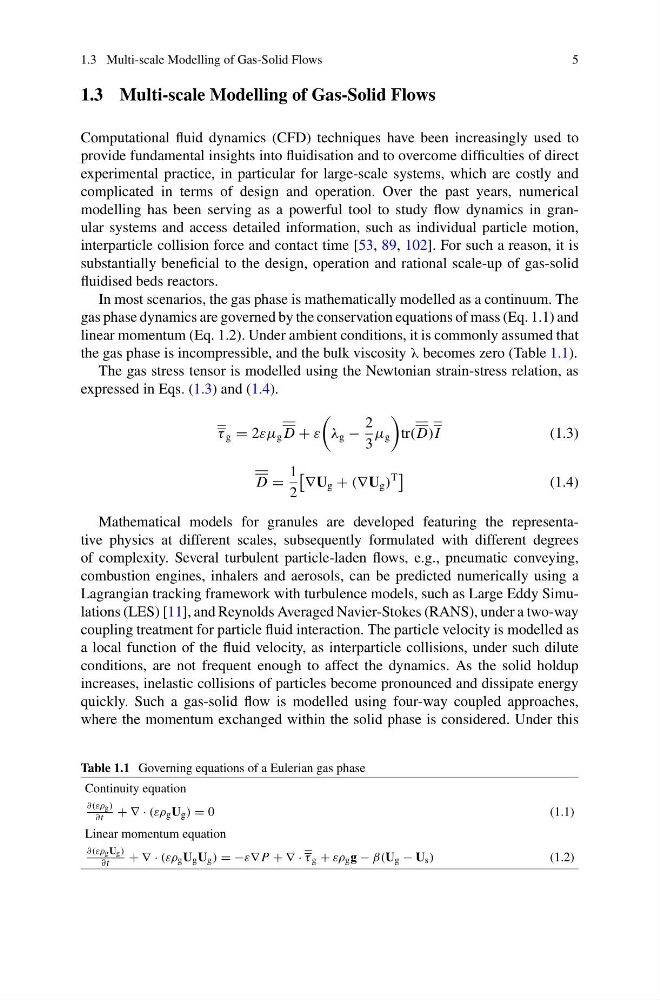
In most scenarios, the gas phase is mathematically modelled as a continuum. The
gas phase dynamics are governed by the conservation equations of mass (Eq. 1.1) and
linear momentum (Eq. 1.2). Under ambient conditions, it is commonly assumed that
the gas phase is incompressible, and the bulk viscosity λ becomes zero (Table 1.1).
The gas stress tensor is modelled using the Newtonian strain-stress relation, as
expressed in Eqs. (1.3) and (1.4).
τ g = 2εμ g D + ε
λ g −
2
3
μ g
tr(D)I
(1.3)
D =
1
2
∇U g + (∇U g )
T
(1.4)
Mathematical models for granules are developed featuring the representative physics at different scales, subsequently formulated with different degrees
of complexity. Several turbulent particle-laden flows, e.g., pneumatic conveying,
combustion engines, inhalers and aerosols, can be predicted numerically using a
Lagrangian tracking framework with turbulence models, such as Large Eddy Simulations (LES) [11], and Reynolds Averaged Navier-Stokes (RANS), under a two-way
coupling treatment for particle fluid interaction. The particle velocity is modelled as
a local function of the fluid velocity, as interparticle collisions, under such dilute
conditions, are not frequent enough to affect the dynamics. As the solid holdup
increases, inelastic collisions of particles become pronounced and dissipate energy
quickly. Such a gas-solid flow is modelled using four-way coupled approaches,
where the momentum exchanged within the solid phase is considered. Under this
Table 1.1 Governing equations of a Eulerian gas phase
Continuity equation
∂(ερg)
∂t + ∇ · (ερ g U g ) = 0
(1.1)
Linear momentum equation
∂(ερgUg)
∂t
+ ∇ · (ερ g U g U g ) = −ε∇ P + ∇ · τ g + ερ g g − β(U g − U s )
(1.2)
5
1.3 Multi-scale Modelling of Gas-Solid Flows
Computational fluid dynamics (CFD) techniques have been increasingly used to
provide fundamental insights into fluidisation and to overcome difficulties of direct
experimental practice, in particular for large-scale systems, which are costly and
complicated in terms of design and operation. Over the past years, numerical
modelling has been serving as a powerful tool to study flow dynamics in granular systems and access detailed information, such as individual particle motion,
interparticle collision force and contact time [53, 89, 102]. For such a reason, it is
substantially beneficial to the design, operation and rational scale-up of gas-solid
fluidised beds reactors.
In most scenarios, the gas phase is mathematically modelled as a continuum. The
gas phase dynamics are governed by the conservation equations of mass (Eq. 1.1) and
linear momentum (Eq. 1.2). Under ambient conditions, it is commonly assumed that
the gas phase is incompressible, and the bulk viscosity λ becomes zero (Table 1.1).
The gas stress tensor is modelled using the Newtonian strain-stress relation, as
expressed in Eqs. (1.3) and (1.4).
τ g = 2εμ g D + ε
λ g −
2
3
μ g
tr(D)I
(1.3)
D =
1
2
∇U g + (∇U g )
T
(1.4)
Mathematical models for granules are developed featuring the representative physics at different scales, subsequently formulated with different degrees
of complexity. Several turbulent particle-laden flows, e.g., pneumatic conveying,
combustion engines, inhalers and aerosols, can be predicted numerically using a
Lagrangian tracking framework with turbulence models, such as Large Eddy Simulations (LES) [11], and Reynolds Averaged Navier-Stokes (RANS), under a two-way
coupling treatment for particle fluid interaction. The particle velocity is modelled as
a local function of the fluid velocity, as interparticle collisions, under such dilute
conditions, are not frequent enough to affect the dynamics. As the solid holdup
increases, inelastic collisions of particles become pronounced and dissipate energy
quickly. Such a gas-solid flow is modelled using four-way coupled approaches,
where the momentum exchanged within the solid phase is considered. Under this
Table 1.1 Governing equations of a Eulerian gas phase
Continuity equation
∂(ερg)
∂t + ∇ · (ερ g U g ) = 0
(1.1)
Linear momentum equation
∂(ερgUg)
∂t
+ ∇ · (ερ g U g U g ) = −ε∇ P + ∇ · τ g + ερ g g − β(U g − U s )
(1.2)