

4
1 Introduction
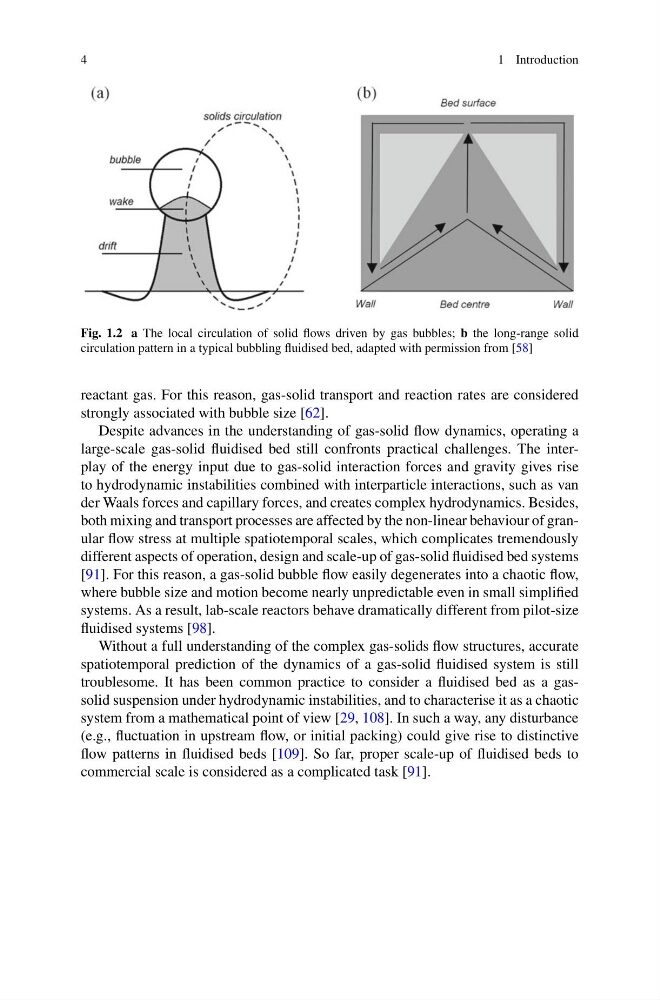
Fig. 1.2 a The local circulation of solid flows driven by gas bubbles; b the long-range solid
circulation pattern in a typical bubbling fluidised bed, adapted with permission from [58]
reactant gas. For this reason, gas-solid transport and reaction rates are considered
strongly associated with bubble size [62].
Despite advances in the understanding of gas-solid flow dynamics, operating a
large-scale gas-solid fluidised bed still confronts practical challenges. The interplay of the energy input due to gas-solid interaction forces and gravity gives rise
to hydrodynamic instabilities combined with interparticle interactions, such as van
der Waals forces and capillary forces, and creates complex hydrodynamics. Besides,
both mixing and transport processes are affected by the non-linear behaviour of granular flow stress at multiple spatiotemporal scales, which complicates tremendously
different aspects of operation, design and scale-up of gas-solid fluidised bed systems
[91]. For this reason, a gas-solid bubble flow easily degenerates into a chaotic flow,
where bubble size and motion become nearly unpredictable even in small simplified
systems. As a result, lab-scale reactors behave dramatically different from pilot-size
fluidised systems [98].
Without a full understanding of the complex gas-solids flow structures, accurate
spatiotemporal prediction of the dynamics of a gas-solid fluidised system is still
troublesome. It has been common practice to consider a fluidised bed as a gassolid suspension under hydrodynamic instabilities, and to characterise it as a chaotic
system from a mathematical point of view [29, 108]. In such a way, any disturbance
(e.g., fluctuation in upstream flow, or initial packing) could give rise to distinctive
flow patterns in fluidised beds [109]. So far, proper scale-up of fluidised beds to
commercial scale is considered as a complicated task [91].
1 Introduction
Fig. 1.2 a The local circulation of solid flows driven by gas bubbles; b the long-range solid
circulation pattern in a typical bubbling fluidised bed, adapted with permission from [58]
reactant gas. For this reason, gas-solid transport and reaction rates are considered
strongly associated with bubble size [62].
Despite advances in the understanding of gas-solid flow dynamics, operating a
large-scale gas-solid fluidised bed still confronts practical challenges. The interplay of the energy input due to gas-solid interaction forces and gravity gives rise
to hydrodynamic instabilities combined with interparticle interactions, such as van
der Waals forces and capillary forces, and creates complex hydrodynamics. Besides,
both mixing and transport processes are affected by the non-linear behaviour of granular flow stress at multiple spatiotemporal scales, which complicates tremendously
different aspects of operation, design and scale-up of gas-solid fluidised bed systems
[91]. For this reason, a gas-solid bubble flow easily degenerates into a chaotic flow,
where bubble size and motion become nearly unpredictable even in small simplified
systems. As a result, lab-scale reactors behave dramatically different from pilot-size
fluidised systems [98].
Without a full understanding of the complex gas-solids flow structures, accurate
spatiotemporal prediction of the dynamics of a gas-solid fluidised system is still
troublesome. It has been common practice to consider a fluidised bed as a gassolid suspension under hydrodynamic instabilities, and to characterise it as a chaotic
system from a mathematical point of view [29, 108]. In such a way, any disturbance
(e.g., fluctuation in upstream flow, or initial packing) could give rise to distinctive
flow patterns in fluidised beds [109]. So far, proper scale-up of fluidised beds to
commercial scale is considered as a complicated task [91].