

5.5 Results and Discussion
135
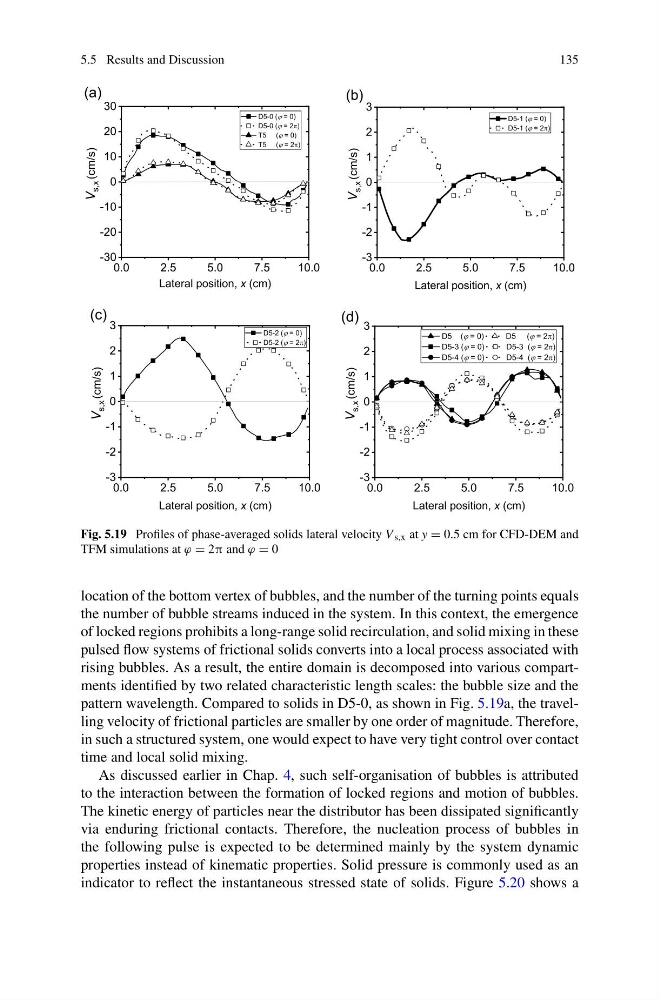
Fig. 5.19 Profiles of phase-averaged solids lateral velocity V s,x at y = 0.5 cm for CFD-DEM and
TFM simulations at ϕ = 2π and ϕ = 0
location of the bottom vertex of bubbles, and the number of the turning points equals
the number of bubble streams induced in the system. In this context, the emergence
of locked regions prohibits a long-range solid recirculation, and solid mixing in these
pulsed flow systems of frictional solids converts into a local process associated with
rising bubbles. As a result, the entire domain is decomposed into various compartments identified by two related characteristic length scales: the bubble size and the
pattern wavelength. Compared to solids in D5-0, as shown in Fig. 5.19a, the travelling velocity of frictional particles are smaller by one order of magnitude. Therefore,
in such a structured system, one would expect to have very tight control over contact
time and local solid mixing.
As discussed earlier in Chap. 4, such self-organisation of bubbles is attributed
to the interaction between the formation of locked regions and motion of bubbles.
The kinetic energy of particles near the distributor has been dissipated significantly
via enduring frictional contacts. Therefore, the nucleation process of bubbles in
the following pulse is expected to be determined mainly by the system dynamic
properties instead of kinematic properties. Solid pressure is commonly used as an
indicator to reflect the instantaneous stressed state of solids. Figure 5.20 shows a
135
Fig. 5.19 Profiles of phase-averaged solids lateral velocity V s,x at y = 0.5 cm for CFD-DEM and
TFM simulations at ϕ = 2π and ϕ = 0
location of the bottom vertex of bubbles, and the number of the turning points equals
the number of bubble streams induced in the system. In this context, the emergence
of locked regions prohibits a long-range solid recirculation, and solid mixing in these
pulsed flow systems of frictional solids converts into a local process associated with
rising bubbles. As a result, the entire domain is decomposed into various compartments identified by two related characteristic length scales: the bubble size and the
pattern wavelength. Compared to solids in D5-0, as shown in Fig. 5.19a, the travelling velocity of frictional particles are smaller by one order of magnitude. Therefore,
in such a structured system, one would expect to have very tight control over contact
time and local solid mixing.
As discussed earlier in Chap. 4, such self-organisation of bubbles is attributed
to the interaction between the formation of locked regions and motion of bubbles.
The kinetic energy of particles near the distributor has been dissipated significantly
via enduring frictional contacts. Therefore, the nucleation process of bubbles in
the following pulse is expected to be determined mainly by the system dynamic
properties instead of kinematic properties. Solid pressure is commonly used as an
indicator to reflect the instantaneous stressed state of solids. Figure 5.20 shows a