

5.5 Results and Discussion
133
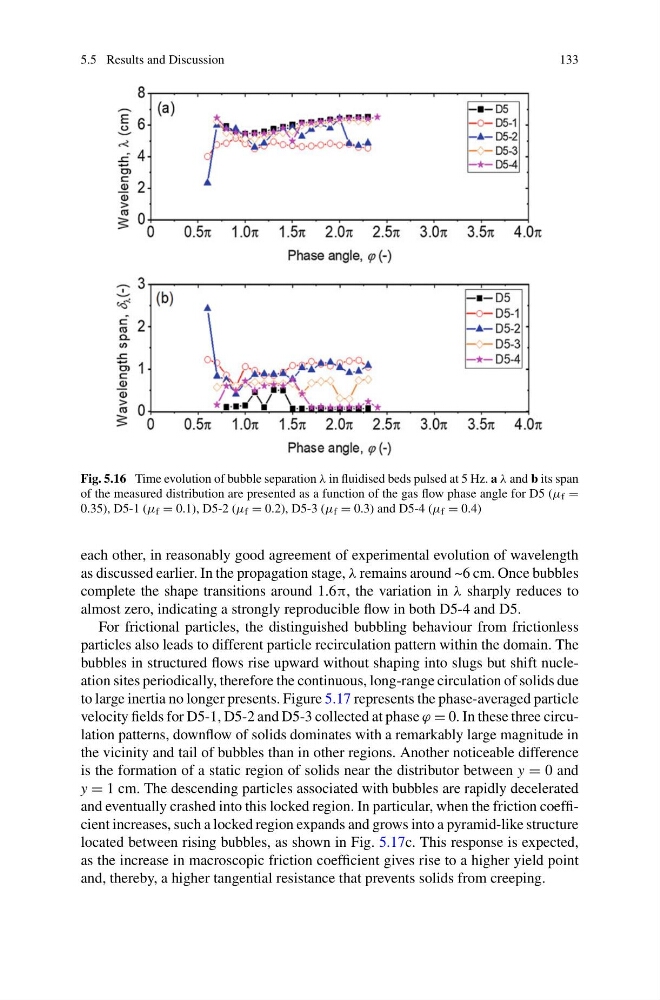
Fig. 5.16 Time evolution of bubble separation λ in fluidised beds pulsed at 5 Hz. a λ and b its span
of the measured distribution are presented as a function of the gas flow phase angle for D5 (μ f =
0.35), D5-1 (μ f = 0.1), D5-2 (μ f = 0.2), D5-3 (μ f = 0.3) and D5-4 (μ f = 0.4)
each other, in reasonably good agreement of experimental evolution of wavelength
as discussed earlier. In the propagation stage, λ remains around ~6 cm. Once bubbles
complete the shape transitions around 1.6π, the variation in λ sharply reduces to
almost zero, indicating a strongly reproducible flow in both D5-4 and D5.
For frictional particles, the distinguished bubbling behaviour from frictionless
particles also leads to different particle recirculation pattern within the domain. The
bubbles in structured flows rise upward without shaping into slugs but shift nucleation sites periodically, therefore the continuous, long-range circulation of solids due
to large inertia no longer presents. Figure 5.17 represents the phase-averaged particle
velocity fields for D5-1, D5-2 and D5-3 collected at phase ϕ = 0. In these three circulation patterns, downflow of solids dominates with a remarkably large magnitude in
the vicinity and tail of bubbles than in other regions. Another noticeable difference
is the formation of a static region of solids near the distributor between y = 0 and
y = 1 cm. The descending particles associated with bubbles are rapidly decelerated
and eventually crashed into this locked region. In particular, when the friction coefficient increases, such a locked region expands and grows into a pyramid-like structure
located between rising bubbles, as shown in Fig. 5.17c. This response is expected,
as the increase in macroscopic friction coefficient gives rise to a higher yield point
and, thereby, a higher tangential resistance that prevents solids from creeping.
133
Fig. 5.16 Time evolution of bubble separation λ in fluidised beds pulsed at 5 Hz. a λ and b its span
of the measured distribution are presented as a function of the gas flow phase angle for D5 (μ f =
0.35), D5-1 (μ f = 0.1), D5-2 (μ f = 0.2), D5-3 (μ f = 0.3) and D5-4 (μ f = 0.4)
each other, in reasonably good agreement of experimental evolution of wavelength
as discussed earlier. In the propagation stage, λ remains around ~6 cm. Once bubbles
complete the shape transitions around 1.6π, the variation in λ sharply reduces to
almost zero, indicating a strongly reproducible flow in both D5-4 and D5.
For frictional particles, the distinguished bubbling behaviour from frictionless
particles also leads to different particle recirculation pattern within the domain. The
bubbles in structured flows rise upward without shaping into slugs but shift nucleation sites periodically, therefore the continuous, long-range circulation of solids due
to large inertia no longer presents. Figure 5.17 represents the phase-averaged particle
velocity fields for D5-1, D5-2 and D5-3 collected at phase ϕ = 0. In these three circulation patterns, downflow of solids dominates with a remarkably large magnitude in
the vicinity and tail of bubbles than in other regions. Another noticeable difference
is the formation of a static region of solids near the distributor between y = 0 and
y = 1 cm. The descending particles associated with bubbles are rapidly decelerated
and eventually crashed into this locked region. In particular, when the friction coefficient increases, such a locked region expands and grows into a pyramid-like structure
located between rising bubbles, as shown in Fig. 5.17c. This response is expected,
as the increase in macroscopic friction coefficient gives rise to a higher yield point
and, thereby, a higher tangential resistance that prevents solids from creeping.