

5.5 Results and Discussion
131
5.5.5 Flow Behaviour of Frictional Particles in Pulsed Beds
The critical role of solid friction can be evaluated by comparing flow patterns generated with particles of different interparticle friction. Enabling solid friction brings
back the tangential contacts in CFD-DEM simulation and includes solid rotation
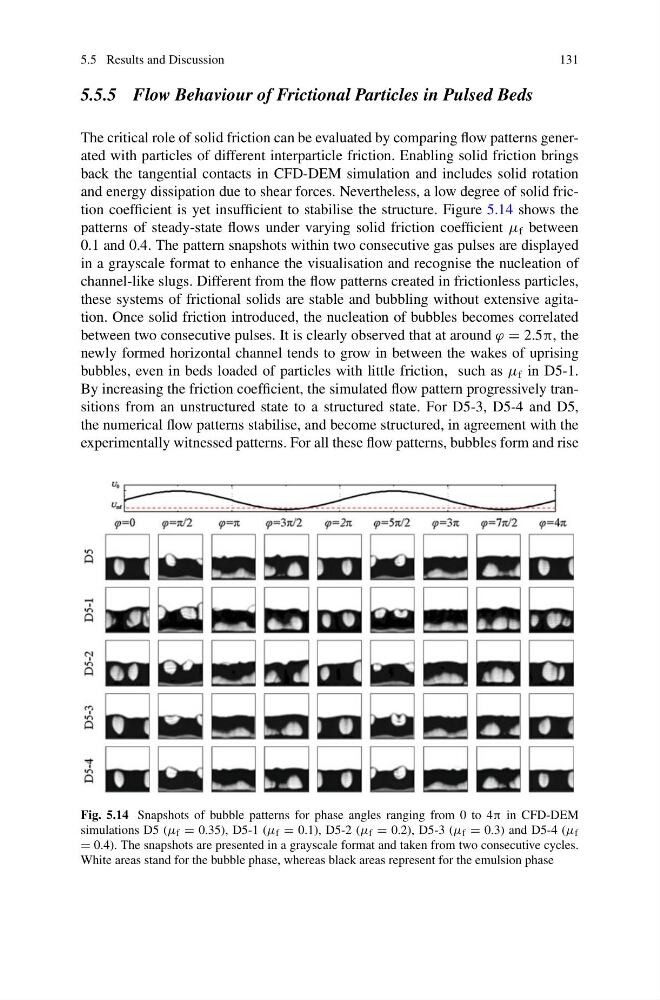
and energy dissipation due to shear forces. Nevertheless, a low degree of solid friction coefficient is yet insufficient to stabilise the structure. Figure 5.14 shows the
patterns of steady-state flows under varying solid friction coefficient μ f between
0.1 and 0.4. The pattern snapshots within two consecutive gas pulses are displayed
in a grayscale format to enhance the visualisation and recognise the nucleation of
channel-like slugs. Different from the flow patterns created in frictionless particles,
these systems of frictional solids are stable and bubbling without extensive agitation. Once solid friction introduced, the nucleation of bubbles becomes correlated
between two consecutive pulses. It is clearly observed that at around ϕ = 2.5π, the
newly formed horizontal channel tends to grow in between the wakes of uprising
bubbles, even in beds loaded of particles with little friction, such as μ f in D5-1.
By increasing the friction coefficient, the simulated flow pattern progressively transitions from an unstructured state to a structured state. For D5-3, D5-4 and D5,
the numerical flow patterns stabilise, and become structured, in agreement with the
experimentally witnessed patterns. For all these flow patterns, bubbles form and rise
Fig. 5.14 Snapshots of bubble patterns for phase angles ranging from 0 to 4π in CFD-DEM
simulations D5 (μ f = 0.35), D5-1 (μ f = 0.1), D5-2 (μ f = 0.2), D5-3 (μ f = 0.3) and D5-4 (μ f
= 0.4). The snapshots are presented in a grayscale format and taken from two consecutive cycles.
White areas stand for the bubble phase, whereas black areas represent for the emulsion phase
131
5.5.5 Flow Behaviour of Frictional Particles in Pulsed Beds
The critical role of solid friction can be evaluated by comparing flow patterns generated with particles of different interparticle friction. Enabling solid friction brings
back the tangential contacts in CFD-DEM simulation and includes solid rotation
and energy dissipation due to shear forces. Nevertheless, a low degree of solid friction coefficient is yet insufficient to stabilise the structure. Figure 5.14 shows the
patterns of steady-state flows under varying solid friction coefficient μ f between
0.1 and 0.4. The pattern snapshots within two consecutive gas pulses are displayed
in a grayscale format to enhance the visualisation and recognise the nucleation of
channel-like slugs. Different from the flow patterns created in frictionless particles,
these systems of frictional solids are stable and bubbling without extensive agitation. Once solid friction introduced, the nucleation of bubbles becomes correlated
between two consecutive pulses. It is clearly observed that at around ϕ = 2.5π, the
newly formed horizontal channel tends to grow in between the wakes of uprising
bubbles, even in beds loaded of particles with little friction, such as μ f in D5-1.
By increasing the friction coefficient, the simulated flow pattern progressively transitions from an unstructured state to a structured state. For D5-3, D5-4 and D5,
the numerical flow patterns stabilise, and become structured, in agreement with the
experimentally witnessed patterns. For all these flow patterns, bubbles form and rise
Fig. 5.14 Snapshots of bubble patterns for phase angles ranging from 0 to 4π in CFD-DEM
simulations D5 (μ f = 0.35), D5-1 (μ f = 0.1), D5-2 (μ f = 0.2), D5-3 (μ f = 0.3) and D5-4 (μ f
= 0.4). The snapshots are presented in a grayscale format and taken from two consecutive cycles.
White areas stand for the bubble phase, whereas black areas represent for the emulsion phase