

130
5 The Role of Solid Mechanics in Stabilising Structured Flows
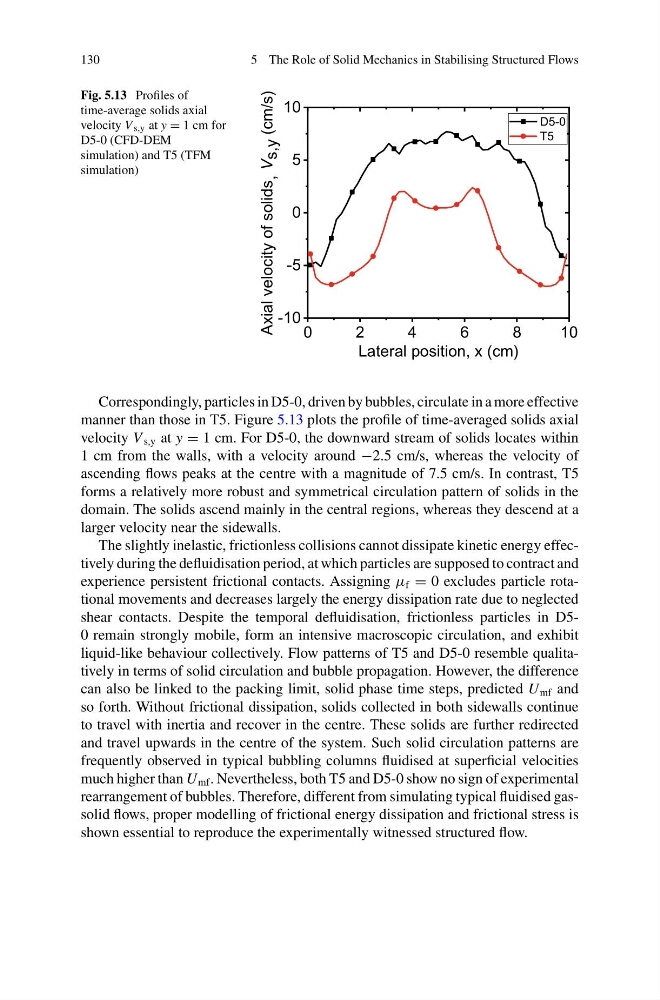
Fig. 5.13 Profiles of
time-average solids axial
velocity V s,y at y = 1 cm for
D5-0 (CFD-DEM
simulation) and T5 (TFM
simulation)
0
2
4
6
8
10
-10
-5
0
5
10
Axial velocity of solids
, V
s,y (cm/s)
Lateral position, x (cm)
D5-0
T5
Correspondingly, particles in D5-0, driven by bubbles, circulate in a more effective
manner than those in T5. Figure 5.13 plots the profile of time-averaged solids axial
velocity V s,y at y = 1 cm. For D5-0, the downward stream of solids locates within
1 cm from the walls, with a velocity around −2.5 cm/s, whereas the velocity of
ascending flows peaks at the centre with a magnitude of 7.5 cm/s. In contrast, T5
forms a relatively more robust and symmetrical circulation pattern of solids in the
domain. The solids ascend mainly in the central regions, whereas they descend at a
larger velocity near the sidewalls.
The slightly inelastic, frictionless collisions cannot dissipate kinetic energy effectively during the defluidisation period, at which particles are supposed to contract and
experience persistent frictional contacts. Assigning μ f = 0 excludes particle rotational movements and decreases largely the energy dissipation rate due to neglected
shear contacts. Despite the temporal defluidisation, frictionless particles in D50 remain strongly mobile, form an intensive macroscopic circulation, and exhibit
liquid-like behaviour collectively. Flow patterns of T5 and D5-0 resemble qualitatively in terms of solid circulation and bubble propagation. However, the difference
can also be linked to the packing limit, solid phase time steps, predicted U mf and
so forth. Without frictional dissipation, solids collected in both sidewalls continue
to travel with inertia and recover in the centre. These solids are further redirected
and travel upwards in the centre of the system. Such solid circulation patterns are
frequently observed in typical bubbling columns fluidised at superficial velocities
much higher than U mf . Nevertheless, both T5 and D5-0 show no sign of experimental
rearrangement of bubbles. Therefore, different from simulating typical fluidised gassolid flows, proper modelling of frictional energy dissipation and frictional stress is
shown essential to reproduce the experimentally witnessed structured flow.
5 The Role of Solid Mechanics in Stabilising Structured Flows
Fig. 5.13 Profiles of
time-average solids axial
velocity V s,y at y = 1 cm for
D5-0 (CFD-DEM
simulation) and T5 (TFM
simulation)
0
2
4
6
8
10
-10
-5
0
5
10
Axial velocity of solids
, V
s,y (cm/s)
Lateral position, x (cm)
D5-0
T5
Correspondingly, particles in D5-0, driven by bubbles, circulate in a more effective
manner than those in T5. Figure 5.13 plots the profile of time-averaged solids axial
velocity V s,y at y = 1 cm. For D5-0, the downward stream of solids locates within
1 cm from the walls, with a velocity around −2.5 cm/s, whereas the velocity of
ascending flows peaks at the centre with a magnitude of 7.5 cm/s. In contrast, T5
forms a relatively more robust and symmetrical circulation pattern of solids in the
domain. The solids ascend mainly in the central regions, whereas they descend at a
larger velocity near the sidewalls.
The slightly inelastic, frictionless collisions cannot dissipate kinetic energy effectively during the defluidisation period, at which particles are supposed to contract and
experience persistent frictional contacts. Assigning μ f = 0 excludes particle rotational movements and decreases largely the energy dissipation rate due to neglected
shear contacts. Despite the temporal defluidisation, frictionless particles in D50 remain strongly mobile, form an intensive macroscopic circulation, and exhibit
liquid-like behaviour collectively. Flow patterns of T5 and D5-0 resemble qualitatively in terms of solid circulation and bubble propagation. However, the difference
can also be linked to the packing limit, solid phase time steps, predicted U mf and
so forth. Without frictional dissipation, solids collected in both sidewalls continue
to travel with inertia and recover in the centre. These solids are further redirected
and travel upwards in the centre of the system. Such solid circulation patterns are
frequently observed in typical bubbling columns fluidised at superficial velocities
much higher than U mf . Nevertheless, both T5 and D5-0 show no sign of experimental
rearrangement of bubbles. Therefore, different from simulating typical fluidised gassolid flows, proper modelling of frictional energy dissipation and frictional stress is
shown essential to reproduce the experimentally witnessed structured flow.