

4.2 Model Implementation
95
4.2.2 Governing Equations of Discrete Element Model
CFD-DEM approach shares the same governing equations for the gas phase with a
two-fluid model. For the solid phase, it resolves interparticle collisions directly, and
tracks both translational and rotational motion of every single particle according to
Newton’s laws of motion. For a single particle of mass m, its translational velocity
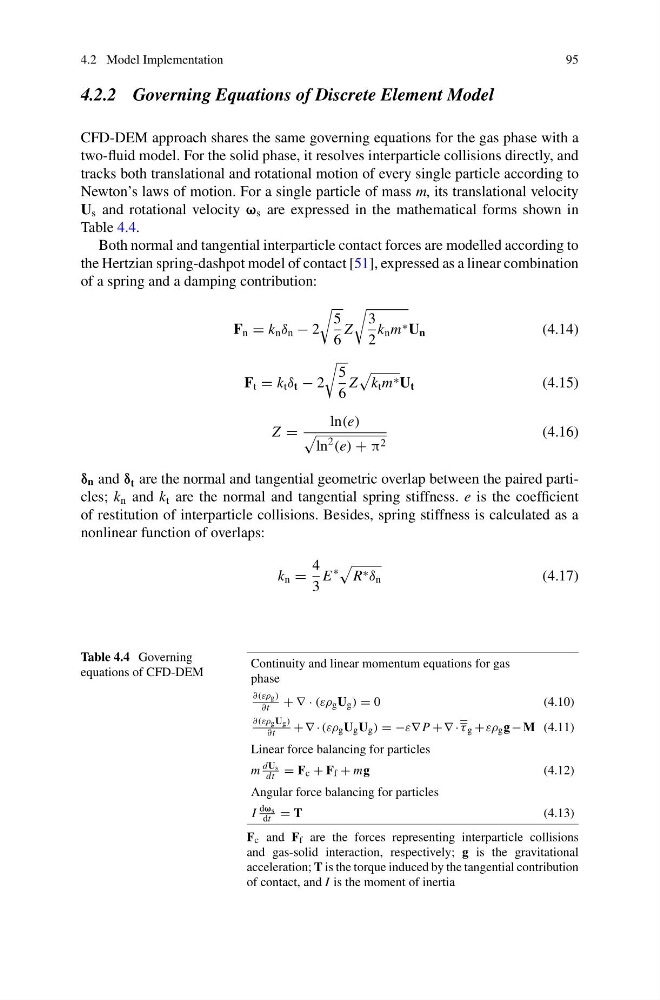
U s and rotational velocity ω s are expressed in the mathematical forms shown in
Table 4.4.
Both normal and tangential interparticle contact forces are modelled according to
the Hertzian spring-dashpot model of contact [51], expressed as a linear combination
of a spring and a damping contribution:
F n = k n δ n − 2
5
6
Z
3
2
k n m ∗ U n
(4.14)
F t = k t δ t − 2
5
6
Z
k t m ∗ U t
(4.15)
Z =
ln(e)
ln
2
(e) + π 2
(4.16)
δ n and δ t are the normal and tangential geometric overlap between the paired particles; k n and k t are the normal and tangential spring stiffness. e is the coefficient
of restitution of interparticle collisions. Besides, spring stiffness is calculated as a
nonlinear function of overlaps:
k n =
4
3
E
∗
R ∗ δ n
(4.17)
Table 4.4 Governing
equations of CFD-DEM
Continuity and linear momentum equations for gas
phase
∂(ερg)
∂t + ∇ · (ερ g U g ) = 0
(4.10)
∂(ερgUg)
∂t
+ ∇ · (ερ g U g U g ) = −ε∇ P + ∇ · τ g + ερ g g − M (4.11)
Linear force balancing for particles
m
dUs
dt = F c + F f + mg
(4.12)
Angular force balancing for particles
I
dωs
dt = T
(4.13)
F c and F f are the forces representing interparticle collisions
and gas-solid interaction, respectively; g is the gravitational
acceleration; T is the torque induced by the tangential contribution
of contact, and I is the moment of inertia
95
4.2.2 Governing Equations of Discrete Element Model
CFD-DEM approach shares the same governing equations for the gas phase with a
two-fluid model. For the solid phase, it resolves interparticle collisions directly, and
tracks both translational and rotational motion of every single particle according to
Newton’s laws of motion. For a single particle of mass m, its translational velocity
U s and rotational velocity ω s are expressed in the mathematical forms shown in
Table 4.4.
Both normal and tangential interparticle contact forces are modelled according to
the Hertzian spring-dashpot model of contact [51], expressed as a linear combination
of a spring and a damping contribution:
F n = k n δ n − 2
5
6
Z
3
2
k n m ∗ U n
(4.14)
F t = k t δ t − 2
5
6
Z
k t m ∗ U t
(4.15)
Z =
ln(e)
ln
2
(e) + π 2
(4.16)
δ n and δ t are the normal and tangential geometric overlap between the paired particles; k n and k t are the normal and tangential spring stiffness. e is the coefficient
of restitution of interparticle collisions. Besides, spring stiffness is calculated as a
nonlinear function of overlaps:
k n =
4
3
E
∗
R ∗ δ n
(4.17)
Table 4.4 Governing
equations of CFD-DEM
Continuity and linear momentum equations for gas
phase
∂(ερg)
∂t + ∇ · (ερ g U g ) = 0
(4.10)
∂(ερgUg)
∂t
+ ∇ · (ερ g U g U g ) = −ε∇ P + ∇ · τ g + ερ g g − M (4.11)
Linear force balancing for particles
m
dUs
dt = F c + F f + mg
(4.12)
Angular force balancing for particles
I
dωs
dt = T
(4.13)
F c and F f are the forces representing interparticle collisions
and gas-solid interaction, respectively; g is the gravitational
acceleration; T is the torque induced by the tangential contribution
of contact, and I is the moment of inertia