

3.5.2 Exhaust Gases
Vegetable oil processing plants are large energy and steam consumers making use of
auxiliary boilers for the generation of steam energy. Emissions related to the
operation of these steam energy sources typically consist of combustion
by-products such as NO x , SO x , PM, volatile organic compounds (VOCs), and
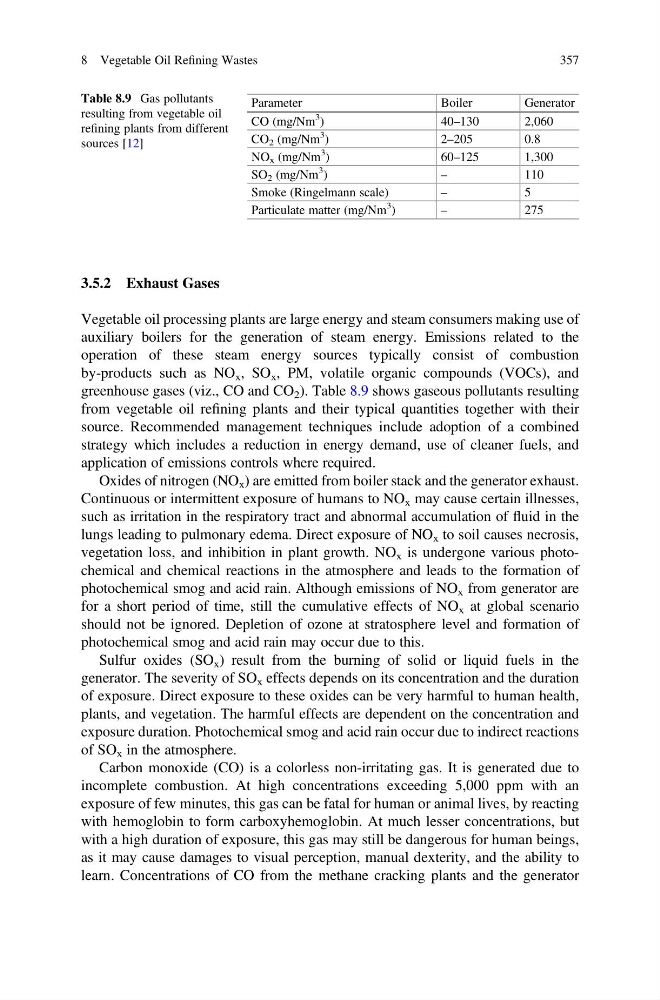
greenhouse gases (viz., CO and CO 2 ). Table 8.9 shows gaseous pollutants resulting
from vegetable oil refining plants and their typical quantities together with their
source. Recommended management techniques include adoption of a combined
strategy which includes a reduction in energy demand, use of cleaner fuels, and
application of emissions controls where required.
Oxides of nitrogen (NO x ) are emitted from boiler stack and the generator exhaust.
Continuous or intermittent exposure of humans to NO x may cause certain illnesses,
such as irritation in the respiratory tract and abnormal accumulation of fluid in the
lungs leading to pulmonary edema. Direct exposure of NO x to soil causes necrosis,
vegetation loss, and inhibition in plant growth. NO x is undergone various photochemical and chemical reactions in the atmosphere and leads to the formation of
photochemical smog and acid rain. Although emissions of NO x from generator are
for a short period of time, still the cumulative effects of NO x at global scenario
should not be ignored. Depletion of ozone at stratosphere level and formation of
photochemical smog and acid rain may occur due to this.
Sulfur oxides (SO x ) result from the burning of solid or liquid fuels in the
generator. The severity of SO x effects depends on its concentration and the duration
of exposure. Direct exposure to these oxides can be very harmful to human health,
plants, and vegetation. The harmful effects are dependent on the concentration and
exposure duration. Photochemical smog and acid rain occur due to indirect reactions
of SO x in the atmosphere.
Carbon monoxide (CO) is a colorless non-irritating gas. It is generated due to
incomplete combustion. At high concentrations exceeding 5,000 ppm with an
exposure of few minutes, this gas can be fatal for human or animal lives, by reacting
with hemoglobin to form carboxyhemoglobin. At much lesser concentrations, but
with a high duration of exposure, this gas may still be dangerous for human beings,
as it may cause damages to visual perception, manual dexterity, and the ability to
learn. Concentrations of CO from the methane cracking plants and the generator
Table 8.9 Gas pollutants
resulting from vegetable oil
refining plants from different
sources [12]
Parameter
Boiler
Generator
CO (mg/Nm
3
)
4 0 –130
2,060
CO 2 (mg/Nm
3
)
2 –205
0.8
NO x (mg/Nm
3
)
6 0 –125
1,300
SO 2 (mg/Nm
3
)
–
110
Smoke (Ringelmann scale)
–
5
Particulate matter (mg/Nm
3 )
–
275
8 Vegetable Oil Refining Wastes
357
Vegetable oil processing plants are large energy and steam consumers making use of
auxiliary boilers for the generation of steam energy. Emissions related to the
operation of these steam energy sources typically consist of combustion
by-products such as NO x , SO x , PM, volatile organic compounds (VOCs), and
greenhouse gases (viz., CO and CO 2 ). Table 8.9 shows gaseous pollutants resulting
from vegetable oil refining plants and their typical quantities together with their
source. Recommended management techniques include adoption of a combined
strategy which includes a reduction in energy demand, use of cleaner fuels, and
application of emissions controls where required.
Oxides of nitrogen (NO x ) are emitted from boiler stack and the generator exhaust.
Continuous or intermittent exposure of humans to NO x may cause certain illnesses,
such as irritation in the respiratory tract and abnormal accumulation of fluid in the
lungs leading to pulmonary edema. Direct exposure of NO x to soil causes necrosis,
vegetation loss, and inhibition in plant growth. NO x is undergone various photochemical and chemical reactions in the atmosphere and leads to the formation of
photochemical smog and acid rain. Although emissions of NO x from generator are
for a short period of time, still the cumulative effects of NO x at global scenario
should not be ignored. Depletion of ozone at stratosphere level and formation of
photochemical smog and acid rain may occur due to this.
Sulfur oxides (SO x ) result from the burning of solid or liquid fuels in the
generator. The severity of SO x effects depends on its concentration and the duration
of exposure. Direct exposure to these oxides can be very harmful to human health,
plants, and vegetation. The harmful effects are dependent on the concentration and
exposure duration. Photochemical smog and acid rain occur due to indirect reactions
of SO x in the atmosphere.
Carbon monoxide (CO) is a colorless non-irritating gas. It is generated due to
incomplete combustion. At high concentrations exceeding 5,000 ppm with an
exposure of few minutes, this gas can be fatal for human or animal lives, by reacting
with hemoglobin to form carboxyhemoglobin. At much lesser concentrations, but
with a high duration of exposure, this gas may still be dangerous for human beings,
as it may cause damages to visual perception, manual dexterity, and the ability to
learn. Concentrations of CO from the methane cracking plants and the generator
Table 8.9 Gas pollutants
resulting from vegetable oil
refining plants from different
sources [12]
Parameter
Boiler
Generator
CO (mg/Nm
3
)
4 0 –130
2,060
CO 2 (mg/Nm
3
)
2 –205
0.8
NO x (mg/Nm
3
)
6 0 –125
1,300
SO 2 (mg/Nm
3
)
–
110
Smoke (Ringelmann scale)
–
5
Particulate matter (mg/Nm
3 )
–
275
8 Vegetable Oil Refining Wastes
357