

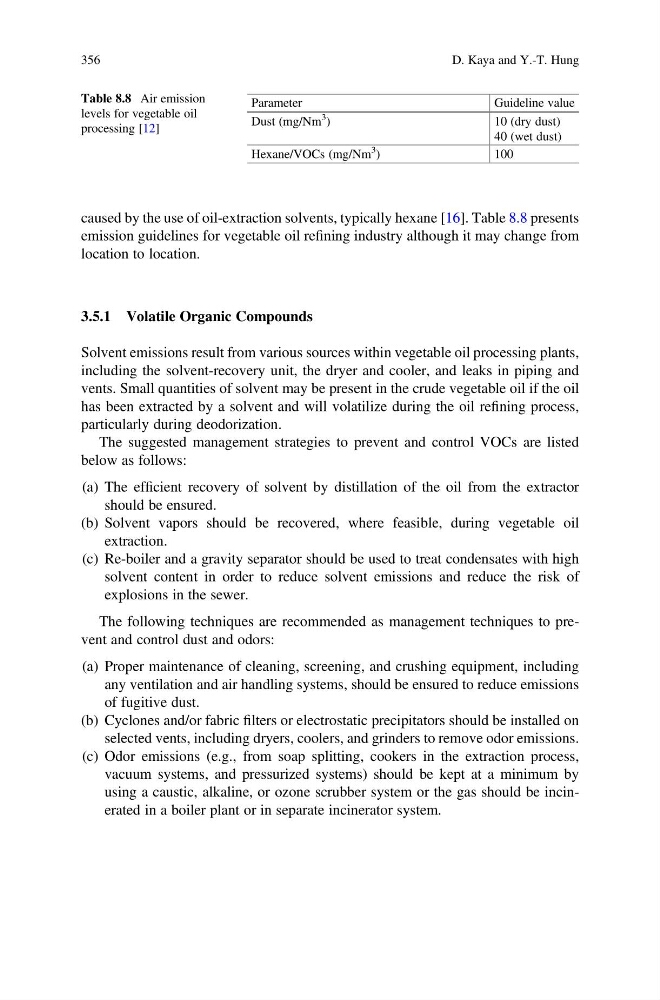
caused by the use of oil-extraction solvents, typically hexane [16]. Table 8.8 presents
emission guidelines for vegetable oil refining industry although it may change from
location to location.
3.5.1 Volatile Organic Compounds
Solvent emissions result from various sources within vegetable oil processing plants,
including the solvent-recovery unit, the dryer and cooler, and leaks in piping and
vents. Small quantities of solvent may be present in the crude vegetable oil if the oil
has been extracted by a solvent and will volatilize during the oil refining process,
particularly during deodorization.
The suggested management strategies to prevent and control VOCs are listed
below as follows:
(a) The efficient recovery of solvent by distillation of the oil from the extractor
should be ensured.
(b) Solvent vapors should be recovered, where feasible, during vegetable oil
extraction.
(c) Re-boiler and a gravity separator should be used to treat condensates with high
solvent content in order to reduce solvent emissions and reduce the risk of
explosions in the sewer.
The following techniques are recommended as management techniques to prevent and control dust and odors:
(a) Proper maintenance of cleaning, screening, and crushing equipment, including
any ventilation and air handling systems, should be ensured to reduce emissions
of fugitive dust.
(b) Cyclones and/or fabric filters or electrostatic precipitators should be installed on
selected vents, including dryers, coolers, and grinders to remove odor emissions.
(c) Odor emissions (e.g., from soap splitting, cookers in the extraction process,
vacuum systems, and pressurized systems) should be kept at a minimum by
using a caustic, alkaline, or ozone scrubber system or the gas should be incinerated in a boiler plant or in separate incinerator system.
Table 8.8 Air emission
levels for vegetable oil
processing [12]
Parameter
Guideline value
Dust (mg/Nm
3
)
10 (dry dust)
40 (wet dust)
Hexane/VOCs (mg/Nm
3
)
100
356
D. Kaya and Y.-T. Hung
emission guidelines for vegetable oil refining industry although it may change from
location to location.
3.5.1 Volatile Organic Compounds
Solvent emissions result from various sources within vegetable oil processing plants,
including the solvent-recovery unit, the dryer and cooler, and leaks in piping and
vents. Small quantities of solvent may be present in the crude vegetable oil if the oil
has been extracted by a solvent and will volatilize during the oil refining process,
particularly during deodorization.
The suggested management strategies to prevent and control VOCs are listed
below as follows:
(a) The efficient recovery of solvent by distillation of the oil from the extractor
should be ensured.
(b) Solvent vapors should be recovered, where feasible, during vegetable oil
extraction.
(c) Re-boiler and a gravity separator should be used to treat condensates with high
solvent content in order to reduce solvent emissions and reduce the risk of
explosions in the sewer.
The following techniques are recommended as management techniques to prevent and control dust and odors:
(a) Proper maintenance of cleaning, screening, and crushing equipment, including
any ventilation and air handling systems, should be ensured to reduce emissions
of fugitive dust.
(b) Cyclones and/or fabric filters or electrostatic precipitators should be installed on
selected vents, including dryers, coolers, and grinders to remove odor emissions.
(c) Odor emissions (e.g., from soap splitting, cookers in the extraction process,
vacuum systems, and pressurized systems) should be kept at a minimum by
using a caustic, alkaline, or ozone scrubber system or the gas should be incinerated in a boiler plant or in separate incinerator system.
Table 8.8 Air emission
levels for vegetable oil
processing [12]
Parameter
Guideline value
Dust (mg/Nm
3
)
10 (dry dust)
40 (wet dust)
Hexane/VOCs (mg/Nm
3
)
100
356
D. Kaya and Y.-T. Hung