

Wastewater generated during oil washing and neutralization may have a high
content of organic material and, therefore, a high biochemical oxygen demand
(BOD) and COD [13]. Wastewater may also have a high content of suspended
solids, organic nitrogen, and oil and fat and may contain pesticide residues from the
treatment of the raw materials; therefore, wastewaters from this industry need special
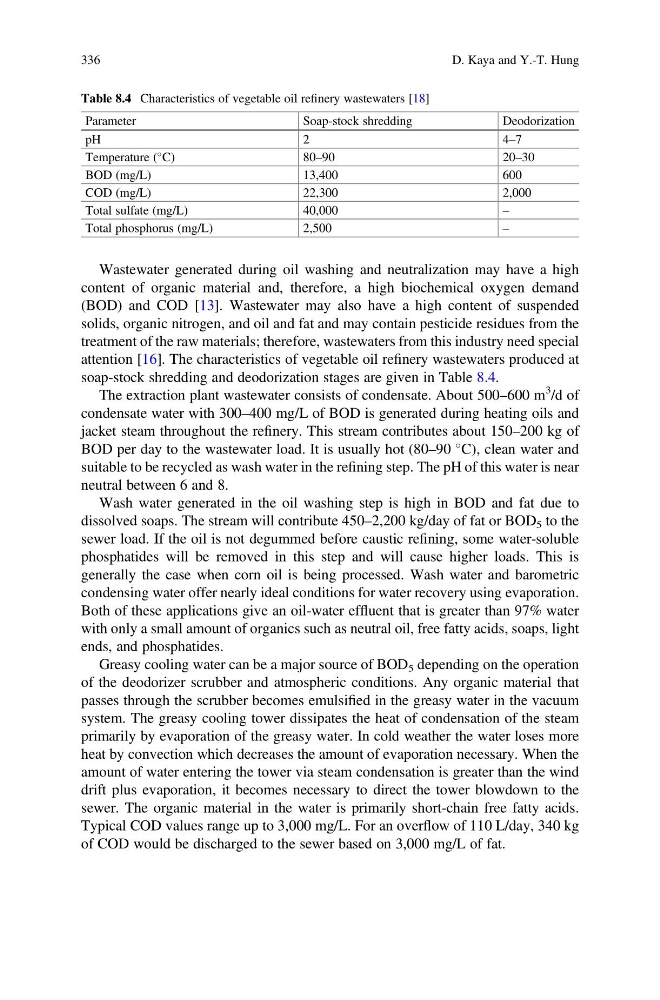
attention [16]. The characteristics of vegetable oil refinery wastewaters produced at
soap-stock shredding and deodorization stages are given in Table 8.4.
The extraction plant wastewater consists of condensate. About 500–600 m
3 /d of
condensate water with 300–400 mg/L of BOD is generated during heating oils and
jacket steam throughout the refinery. This stream contributes about 150–200 kg of
BOD per day to the wastewater load. It is usually hot (80–90
C), clean water and
suitable to be recycled as wash water in the refining step. The pH of this water is near
neutral between 6 and 8.
Wash water generated in the oil washing step is high in BOD and fat due to
dissolved soaps. The stream will contribute 450–2,200 kg/day of fat or BOD 5 to the
sewer load. If the oil is not degummed before caustic refining, some water-soluble
phosphatides will be removed in this step and will cause higher loads. This is
generally the case when corn oil is being processed. Wash water and barometric
condensing water offer nearly ideal conditions for water recovery using evaporation.
Both of these applications give an oil-water effluent that is greater than 97% water
with only a small amount of organics such as neutral oil, free fatty acids, soaps, light
ends, and phosphatides.
Greasy cooling water can be a major source of BOD 5 depending on the operation
of the deodorizer scrubber and atmospheric conditions. Any organic material that
passes through the scrubber becomes emulsified in the greasy water in the vacuum
system. The greasy cooling tower dissipates the heat of condensation of the steam
primarily by evaporation of the greasy water. In cold weather the water loses more
heat by convection which decreases the amount of evaporation necessary. When the
amount of water entering the tower via steam condensation is greater than the wind
drift plus evaporation, it becomes necessary to direct the tower blowdown to the
sewer. The organic material in the water is primarily short-chain free fatty acids.
Typical COD values range up to 3,000 mg/L. For an overflow of 110 L/day, 340 kg
of COD would be discharged to the sewer based on 3,000 mg/L of fat.
Table 8.4 Characteristics of vegetable oil refinery wastewaters [18]
Parameter
Soap-stock shredding
Deodorization
pH
2
4–7
Temperature (
C)
80–90
20–30
BOD (mg/L)
13,400
600
COD (mg/L)
22,300
2,000
Total sulfate (mg/L)
40,000
–
Total phosphorus (mg/L)
2,500
–
336
D. Kaya and Y.-T. Hung
content of organic material and, therefore, a high biochemical oxygen demand
(BOD) and COD [13]. Wastewater may also have a high content of suspended
solids, organic nitrogen, and oil and fat and may contain pesticide residues from the
treatment of the raw materials; therefore, wastewaters from this industry need special
attention [16]. The characteristics of vegetable oil refinery wastewaters produced at
soap-stock shredding and deodorization stages are given in Table 8.4.
The extraction plant wastewater consists of condensate. About 500–600 m
3 /d of
condensate water with 300–400 mg/L of BOD is generated during heating oils and
jacket steam throughout the refinery. This stream contributes about 150–200 kg of
BOD per day to the wastewater load. It is usually hot (80–90
C), clean water and
suitable to be recycled as wash water in the refining step. The pH of this water is near
neutral between 6 and 8.
Wash water generated in the oil washing step is high in BOD and fat due to
dissolved soaps. The stream will contribute 450–2,200 kg/day of fat or BOD 5 to the
sewer load. If the oil is not degummed before caustic refining, some water-soluble
phosphatides will be removed in this step and will cause higher loads. This is
generally the case when corn oil is being processed. Wash water and barometric
condensing water offer nearly ideal conditions for water recovery using evaporation.
Both of these applications give an oil-water effluent that is greater than 97% water
with only a small amount of organics such as neutral oil, free fatty acids, soaps, light
ends, and phosphatides.
Greasy cooling water can be a major source of BOD 5 depending on the operation
of the deodorizer scrubber and atmospheric conditions. Any organic material that
passes through the scrubber becomes emulsified in the greasy water in the vacuum
system. The greasy cooling tower dissipates the heat of condensation of the steam
primarily by evaporation of the greasy water. In cold weather the water loses more
heat by convection which decreases the amount of evaporation necessary. When the
amount of water entering the tower via steam condensation is greater than the wind
drift plus evaporation, it becomes necessary to direct the tower blowdown to the
sewer. The organic material in the water is primarily short-chain free fatty acids.
Typical COD values range up to 3,000 mg/L. For an overflow of 110 L/day, 340 kg
of COD would be discharged to the sewer based on 3,000 mg/L of fat.
Table 8.4 Characteristics of vegetable oil refinery wastewaters [18]
Parameter
Soap-stock shredding
Deodorization
pH
2
4–7
Temperature (
C)
80–90
20–30
BOD (mg/L)
13,400
600
COD (mg/L)
22,300
2,000
Total sulfate (mg/L)
40,000
–
Total phosphorus (mg/L)
2,500
–
336
D. Kaya and Y.-T. Hung