

Tank car washings vary from one to four cars per day. The effluent is characterized by high temperature, 70
C, and a variable amount of emulsified oil. The BOD 5
can be anywhere from 2,000 to 60,000 mg/L.
The refining of crude vegetable oils generates large amounts of wastewater. The
neutralization step, in particular, produces sodium salts of free fatty acids (soapstocks) which breaks down through the use of H 2 SO 4 and generates highly acidic
and oily wastewater [13]. Its characteristics depended largely on the type of oil
processed and on the process implemented. This type of wastewaters typically has
high COD, oil and grease, sulfate, and phosphate contents resulting in both high
inorganic and organic loading of the relevant process.
The neutralized acidulation water flow and COD are highly variable based on the
amount of flush water being used on the centrifuges and whether or not the oil is
being degummed prior to the refining. The phosphatides which would be removed in
degumming significantly increase the strength of the acidulation water due to their
water solubility. Fresh water can increase the moisture content of the soap from 50%
to 95% which does not affect the total BOD 5 load, but it does reduce the residence
time in treatment facilities and the processing time which is necessary to achieve
good oil separation. BOD 5 of this stream is very high (25,000 mg/L) and the fat is
relatively low (300–500 mg/L). This is the only waste stream from the refinery that is
not composed primarily of hexane-soluble material.
A typical day in vegetable oil processing facility would yield loadings of
1,800 kg/day BOD and 30 kg of fat based on 75,000 L at a 25,000 mg/L BOD 5
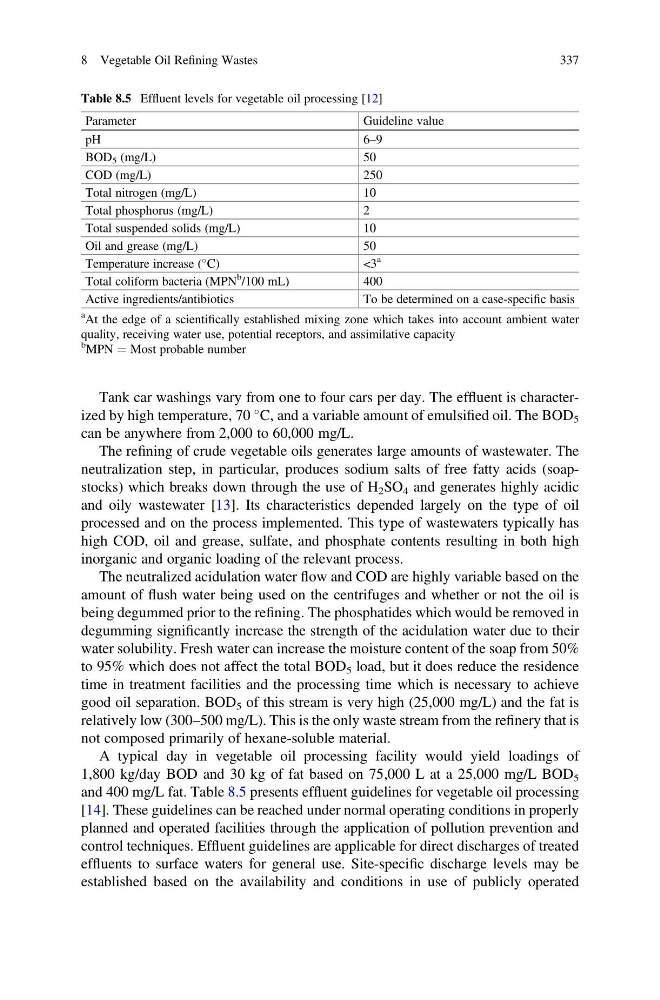
and 400 mg/L fat. Table 8.5 presents effluent guidelines for vegetable oil processing
[14]. These guidelines can be reached under normal operating conditions in properly
planned and operated facilities through the application of pollution prevention and
control techniques. Effluent guidelines are applicable for direct discharges of treated
effluents to surface waters for general use. Site-specific discharge levels may be
established based on the availability and conditions in use of publicly operated
Table 8.5 Effluent levels for vegetable oil processing [12]
Parameter
Guideline value
pH
6–9
BOD 5 (mg/L)
50
COD (mg/L)
250
Total nitrogen (mg/L)
10
Total phosphorus (mg/L)
2
Total suspended solids (mg/L)
10
Oil and grease (mg/L)
50
Temperature increase (
C)
<3
a
Total coliform bacteria (MPN
b
/100 mL)
400
Active ingredients/antibiotics
To be determined on a case-specific basis
a At the edge of a scientifically established mixing zone which takes into account ambient water
quality, receiving water use, potential receptors, and assimilative capacity
b
MPN ¼ Most probable number
8 Vegetable Oil Refining Wastes
337
C, and a variable amount of emulsified oil. The BOD 5
can be anywhere from 2,000 to 60,000 mg/L.
The refining of crude vegetable oils generates large amounts of wastewater. The
neutralization step, in particular, produces sodium salts of free fatty acids (soapstocks) which breaks down through the use of H 2 SO 4 and generates highly acidic
and oily wastewater [13]. Its characteristics depended largely on the type of oil
processed and on the process implemented. This type of wastewaters typically has
high COD, oil and grease, sulfate, and phosphate contents resulting in both high
inorganic and organic loading of the relevant process.
The neutralized acidulation water flow and COD are highly variable based on the
amount of flush water being used on the centrifuges and whether or not the oil is
being degummed prior to the refining. The phosphatides which would be removed in
degumming significantly increase the strength of the acidulation water due to their
water solubility. Fresh water can increase the moisture content of the soap from 50%
to 95% which does not affect the total BOD 5 load, but it does reduce the residence
time in treatment facilities and the processing time which is necessary to achieve
good oil separation. BOD 5 of this stream is very high (25,000 mg/L) and the fat is
relatively low (300–500 mg/L). This is the only waste stream from the refinery that is
not composed primarily of hexane-soluble material.
A typical day in vegetable oil processing facility would yield loadings of
1,800 kg/day BOD and 30 kg of fat based on 75,000 L at a 25,000 mg/L BOD 5
and 400 mg/L fat. Table 8.5 presents effluent guidelines for vegetable oil processing
[14]. These guidelines can be reached under normal operating conditions in properly
planned and operated facilities through the application of pollution prevention and
control techniques. Effluent guidelines are applicable for direct discharges of treated
effluents to surface waters for general use. Site-specific discharge levels may be
established based on the availability and conditions in use of publicly operated
Table 8.5 Effluent levels for vegetable oil processing [12]
Parameter
Guideline value
pH
6–9
BOD 5 (mg/L)
50
COD (mg/L)
250
Total nitrogen (mg/L)
10
Total phosphorus (mg/L)
2
Total suspended solids (mg/L)
10
Oil and grease (mg/L)
50
Temperature increase (
C)
<3
a
Total coliform bacteria (MPN
b
/100 mL)
400
Active ingredients/antibiotics
To be determined on a case-specific basis
a At the edge of a scientifically established mixing zone which takes into account ambient water
quality, receiving water use, potential receptors, and assimilative capacity
b
MPN ¼ Most probable number
8 Vegetable Oil Refining Wastes
337