

ions in the water-washing step. Also, some water is consumed in other indirect
applications, including barometric condensing water in deodorization vacuum systems, boiler feed water, cooling tower make-up water, fresh water in minor cooling
applications, and centrifuge service water.
The energy consumption of vegetable oil processing facilities depends on the type
of raw material, the equipment, and the manufacturing processes. Heating to produce
steam for process applications (especially for soap splitting and deodorization),
cooling, drying, milling, pressing, evaporation, and distillation are the major
energy-consuming steps. Some amount of energy is lost either during the cooling
of the product for the subsequent process or in terms of heat contained by the
wastewater.
About 200–500 kg of steam is consumed per ton of processed seed
(155–390 kWh/t) and the electricity consumption is in the range 25–50 kWh/t
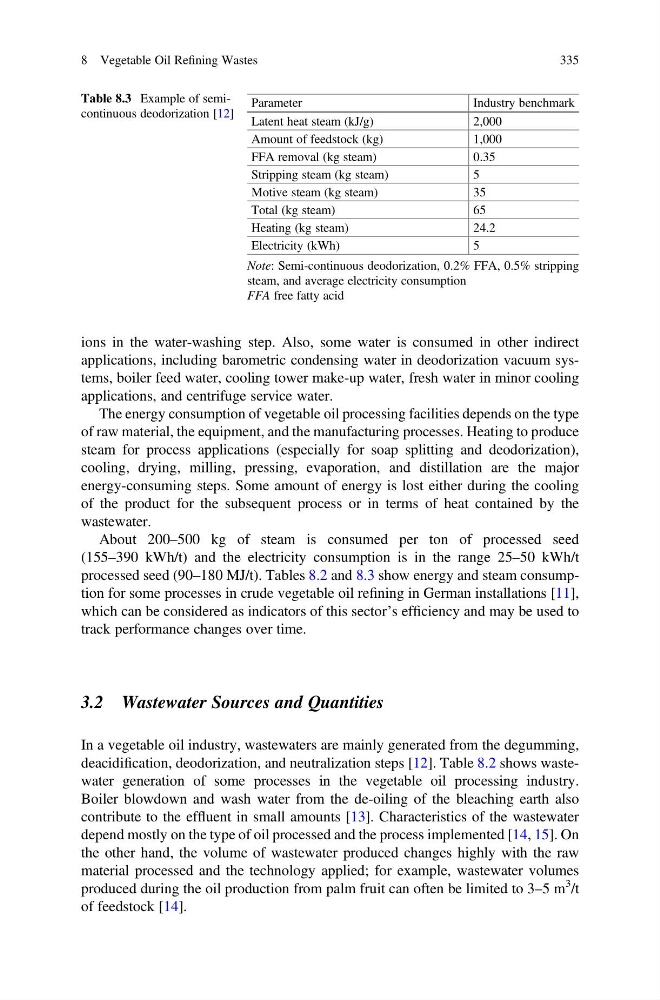
processed seed (90–180 MJ/t). Tables 8.2 and 8.3 show energy and steam consumption for some processes in crude vegetable oil refining in German installations [11],
which can be considered as indicators of this sector’s efficiency and may be used to
track performance changes over time.
3.2 Wastewater Sources and Quantities
In a vegetable oil industry, wastewaters are mainly generated from the degumming,
deacidification, deodorization, and neutralization steps [12]. Table 8.2 shows wastewater generation of some processes in the vegetable oil processing industry.
Boiler blowdown and wash water from the de-oiling of the bleaching earth also
contribute to the effluent in small amounts [13]. Characteristics of the wastewater
depend mostly on the type of oil processed and the process implemented [14, 15]. On
the other hand, the volume of wastewater produced changes highly with the raw
material processed and the technology applied; for example, wastewater volumes
produced during the oil production from palm fruit can often be limited to 3–5 m
3 /t
of feedstock [14].
Table 8.3 Example of semicontinuous deodorization [12]
Parameter
Industry benchmark
Latent heat steam (kJ/g)
2,000
Amount of feedstock (kg)
1,000
FFA removal (kg steam)
0.35
Stripping steam (kg steam)
5
Motive steam (kg steam)
35
Total (kg steam)
65
Heating (kg steam)
24.2
Electricity (kWh)
5
Note: Semi-continuous deodorization, 0.2% FFA, 0.5% stripping
steam, and average electricity consumption
FFA free fatty acid
8 Vegetable Oil Refining Wastes
335
applications, including barometric condensing water in deodorization vacuum systems, boiler feed water, cooling tower make-up water, fresh water in minor cooling
applications, and centrifuge service water.
The energy consumption of vegetable oil processing facilities depends on the type
of raw material, the equipment, and the manufacturing processes. Heating to produce
steam for process applications (especially for soap splitting and deodorization),
cooling, drying, milling, pressing, evaporation, and distillation are the major
energy-consuming steps. Some amount of energy is lost either during the cooling
of the product for the subsequent process or in terms of heat contained by the
wastewater.
About 200–500 kg of steam is consumed per ton of processed seed
(155–390 kWh/t) and the electricity consumption is in the range 25–50 kWh/t
processed seed (90–180 MJ/t). Tables 8.2 and 8.3 show energy and steam consumption for some processes in crude vegetable oil refining in German installations [11],
which can be considered as indicators of this sector’s efficiency and may be used to
track performance changes over time.
3.2 Wastewater Sources and Quantities
In a vegetable oil industry, wastewaters are mainly generated from the degumming,
deacidification, deodorization, and neutralization steps [12]. Table 8.2 shows wastewater generation of some processes in the vegetable oil processing industry.
Boiler blowdown and wash water from the de-oiling of the bleaching earth also
contribute to the effluent in small amounts [13]. Characteristics of the wastewater
depend mostly on the type of oil processed and the process implemented [14, 15]. On
the other hand, the volume of wastewater produced changes highly with the raw
material processed and the technology applied; for example, wastewater volumes
produced during the oil production from palm fruit can often be limited to 3–5 m
3 /t
of feedstock [14].
Table 8.3 Example of semicontinuous deodorization [12]
Parameter
Industry benchmark
Latent heat steam (kJ/g)
2,000
Amount of feedstock (kg)
1,000
FFA removal (kg steam)
0.35
Stripping steam (kg steam)
5
Motive steam (kg steam)
35
Total (kg steam)
65
Heating (kg steam)
24.2
Electricity (kWh)
5
Note: Semi-continuous deodorization, 0.2% FFA, 0.5% stripping
steam, and average electricity consumption
FFA free fatty acid
8 Vegetable Oil Refining Wastes
335