

and phosphoric acid can generally be used interchangeably in degumming
operations.
3.1 Water and Energy Consumption
An average 1,000 metric tons per day vegetable oil refinery can consume as much as
75,000 m
3 of fresh water annually. Water comes in contact directly with the oil
during a number of processes used within the typical refinery. The processes with the
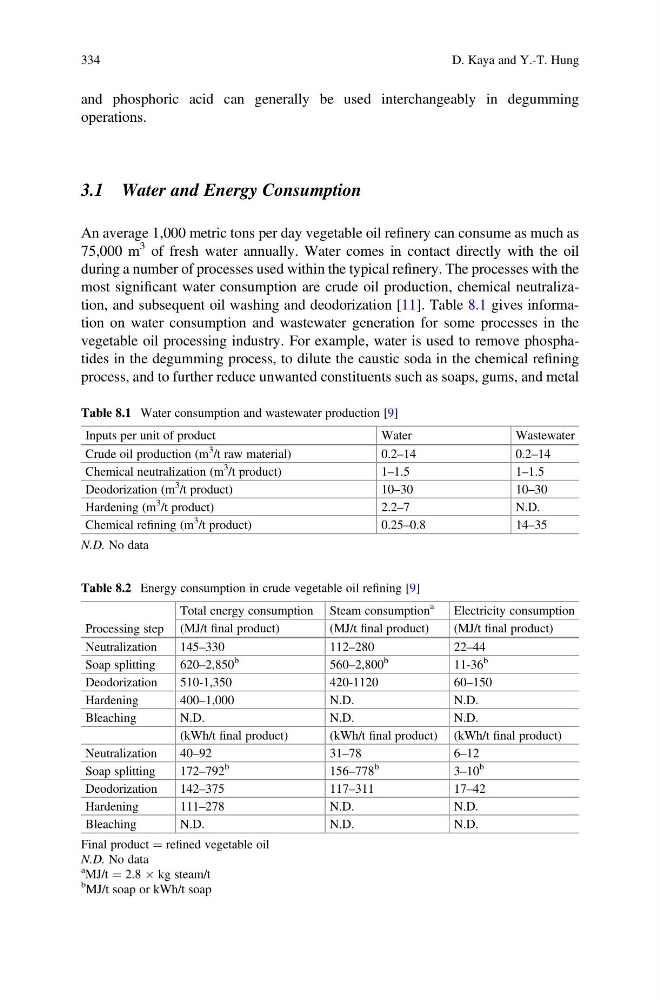
most significant water consumption are crude oil production, chemical neutralization, and subsequent oil washing and deodorization [11]. Table 8.1 gives information on water consumption and wastewater generation for some processes in the
vegetable oil processing industry. For example, water is used to remove phosphatides in the degumming process, to dilute the caustic soda in the chemical refining
process, and to further reduce unwanted constituents such as soaps, gums, and metal
Table 8.1 Water consumption and wastewater production [9]
Inputs per unit of product
Water
Wastewater
Crude oil production (m
3
/t raw material)
0.2–14
0.2–14
Chemical neutralization (m
3
/t product)
1–1.5
1–1.5
Deodorization (m
3
/t product)
10–30
10–30
Hardening (m
3
/t product)
2.2–7
N.D.
Chemical refining (m
3
/t product)
0.25–0.8
14–35
N.D. No data
Table 8.2 Energy consumption in crude vegetable oil refining [9]
Processing step
Total energy consumption Steam consumption
a
Electricity consumption
(MJ/t final product)
(MJ/t final product)
(MJ/t final product)
Neutralization
145–330
112–280
22–44
Soap splitting
620–2,850
b
560–2,800
b
11-36
b
Deodorization
510-1,350
420-1120
60–150
Hardening
400–1,000
N.D.
N.D.
Bleaching
N.D.
N.D.
N.D.
(kWh/t final product)
(kWh/t final product) (kWh/t final product)
Neutralization
40–92
31–78
6–12
Soap splitting
172–792
b
156–778
b
3–10
b
Deodorization
142–375
117–311
17–42
Hardening
111–278
N.D.
N.D.
Bleaching
N.D.
N.D.
N.D.
Final product ¼ refined vegetable oil
N.D. No data
a MJ/t ¼ 2.8 Â kg steam/t
b
MJ/t soap or kWh/t soap
334
D. Kaya and Y.-T. Hung
operations.
3.1 Water and Energy Consumption
An average 1,000 metric tons per day vegetable oil refinery can consume as much as
75,000 m
3 of fresh water annually. Water comes in contact directly with the oil
during a number of processes used within the typical refinery. The processes with the
most significant water consumption are crude oil production, chemical neutralization, and subsequent oil washing and deodorization [11]. Table 8.1 gives information on water consumption and wastewater generation for some processes in the
vegetable oil processing industry. For example, water is used to remove phosphatides in the degumming process, to dilute the caustic soda in the chemical refining
process, and to further reduce unwanted constituents such as soaps, gums, and metal
Table 8.1 Water consumption and wastewater production [9]
Inputs per unit of product
Water
Wastewater
Crude oil production (m
3
/t raw material)
0.2–14
0.2–14
Chemical neutralization (m
3
/t product)
1–1.5
1–1.5
Deodorization (m
3
/t product)
10–30
10–30
Hardening (m
3
/t product)
2.2–7
N.D.
Chemical refining (m
3
/t product)
0.25–0.8
14–35
N.D. No data
Table 8.2 Energy consumption in crude vegetable oil refining [9]
Processing step
Total energy consumption Steam consumption
a
Electricity consumption
(MJ/t final product)
(MJ/t final product)
(MJ/t final product)
Neutralization
145–330
112–280
22–44
Soap splitting
620–2,850
b
560–2,800
b
11-36
b
Deodorization
510-1,350
420-1120
60–150
Hardening
400–1,000
N.D.
N.D.
Bleaching
N.D.
N.D.
N.D.
(kWh/t final product)
(kWh/t final product) (kWh/t final product)
Neutralization
40–92
31–78
6–12
Soap splitting
172–792
b
156–778
b
3–10
b
Deodorization
142–375
117–311
17–42
Hardening
111–278
N.D.
N.D.
Bleaching
N.D.
N.D.
N.D.
Final product ¼ refined vegetable oil
N.D. No data
a MJ/t ¼ 2.8 Â kg steam/t
b
MJ/t soap or kWh/t soap
334
D. Kaya and Y.-T. Hung