

and environmental perspectives because less energy is required [74]. Studies have
demonstrated that waste containing relatively high contents of heavy metals, including Pb and Cd, can be successfully incorporated into ceramic products such as bricks
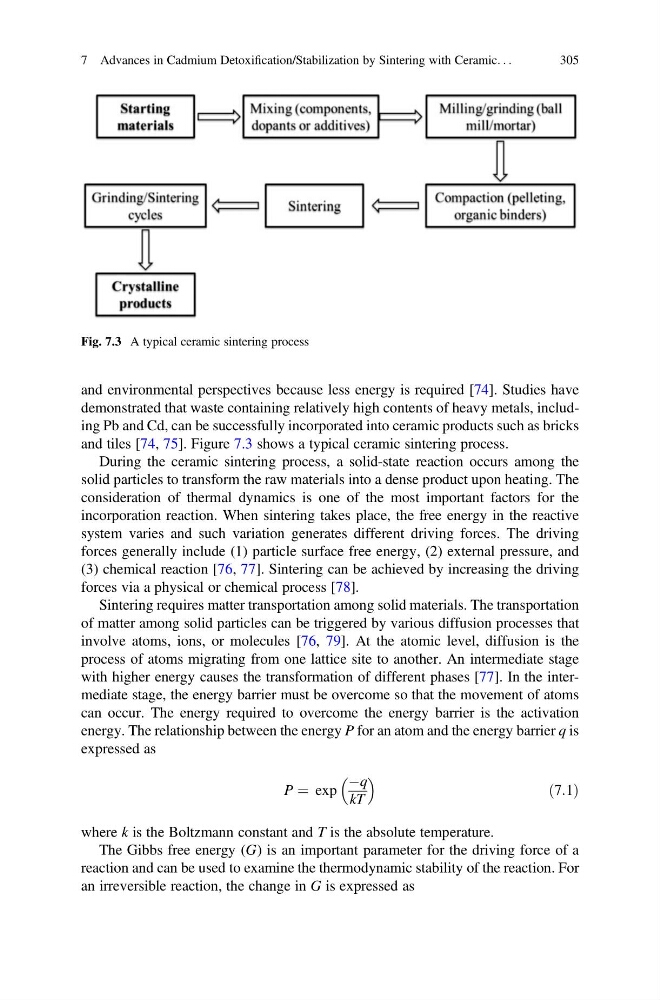
and tiles [74, 75]. Figure 7.3 shows a typical ceramic sintering process.
During the ceramic sintering process, a solid-state reaction occurs among the
solid particles to transform the raw materials into a dense product upon heating. The
consideration of thermal dynamics is one of the most important factors for the
incorporation reaction. When sintering takes place, the free energy in the reactive
system varies and such variation generates different driving forces. The driving
forces generally include (1) particle surface free energy, (2) external pressure, and
(3) chemical reaction [76, 77]. Sintering can be achieved by increasing the driving
forces via a physical or chemical process [78].
Sintering requires matter transportation among solid materials. The transportation
of matter among solid particles can be triggered by various diffusion processes that
involve atoms, ions, or molecules [76, 79]. At the atomic level, diffusion is the
process of atoms migrating from one lattice site to another. An intermediate stage
with higher energy causes the transformation of different phases [77]. In the intermediate stage, the energy barrier must be overcome so that the movement of atoms
can occur. The energy required to overcome the energy barrier is the activation
energy. The relationship between the energy P for an atom and the energy barrier q is
expressed as
P ¼ exp
Àq
kT
ð7:1Þ
where k is the Boltzmann constant and T is the absolute temperature.
The Gibbs free energy (G) is an important parameter for the driving force of a
reaction and can be used to examine the thermodynamic stability of the reaction. For
an irreversible reaction, the change in G is expressed as
Fig. 7.3 A typical ceramic sintering process
7 Advances in Cadmium Detoxification/Stabilization by Sintering with Ceramic. . .
305
demonstrated that waste containing relatively high contents of heavy metals, including Pb and Cd, can be successfully incorporated into ceramic products such as bricks
and tiles [74, 75]. Figure 7.3 shows a typical ceramic sintering process.
During the ceramic sintering process, a solid-state reaction occurs among the
solid particles to transform the raw materials into a dense product upon heating. The
consideration of thermal dynamics is one of the most important factors for the
incorporation reaction. When sintering takes place, the free energy in the reactive
system varies and such variation generates different driving forces. The driving
forces generally include (1) particle surface free energy, (2) external pressure, and
(3) chemical reaction [76, 77]. Sintering can be achieved by increasing the driving
forces via a physical or chemical process [78].
Sintering requires matter transportation among solid materials. The transportation
of matter among solid particles can be triggered by various diffusion processes that
involve atoms, ions, or molecules [76, 79]. At the atomic level, diffusion is the
process of atoms migrating from one lattice site to another. An intermediate stage
with higher energy causes the transformation of different phases [77]. In the intermediate stage, the energy barrier must be overcome so that the movement of atoms
can occur. The energy required to overcome the energy barrier is the activation
energy. The relationship between the energy P for an atom and the energy barrier q is
expressed as
P ¼ exp
Àq
kT
ð7:1Þ
where k is the Boltzmann constant and T is the absolute temperature.
The Gibbs free energy (G) is an important parameter for the driving force of a
reaction and can be used to examine the thermodynamic stability of the reaction. For
an irreversible reaction, the change in G is expressed as
Fig. 7.3 A typical ceramic sintering process
7 Advances in Cadmium Detoxification/Stabilization by Sintering with Ceramic. . .
305