

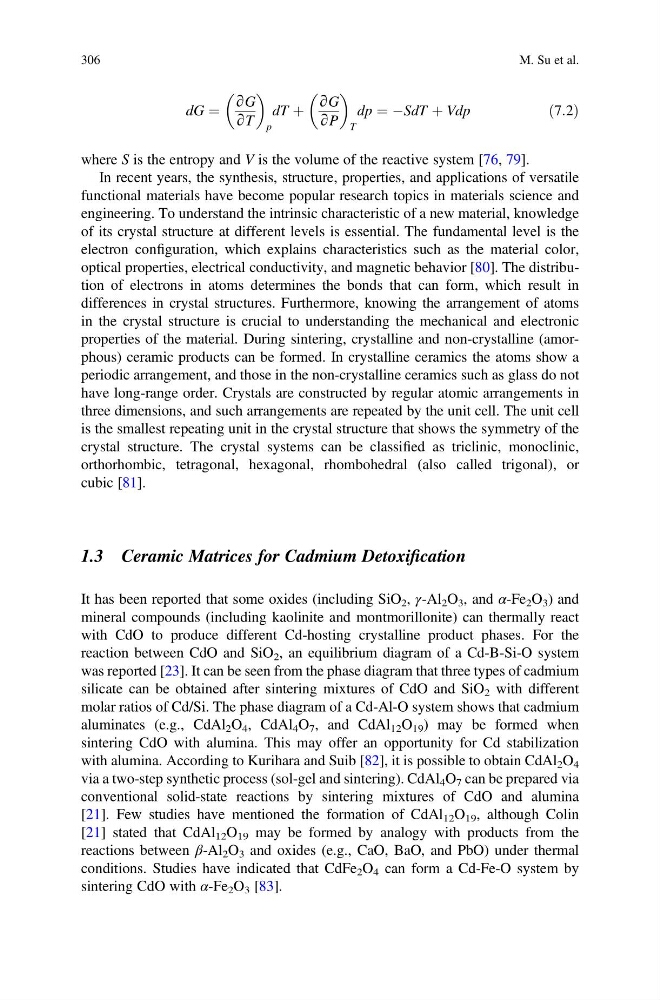
dG ¼
∂G
∂T
p
dT þ
∂G
∂P
T
dp ¼ ÀSdT þ Vdp
ð7:2Þ
where S is the entropy and V is the volume of the reactive system [76, 79].
In recent years, the synthesis, structure, properties, and applications of versatile
functional materials have become popular research topics in materials science and
engineering. To understand the intrinsic characteristic of a new material, knowledge
of its crystal structure at different levels is essential. The fundamental level is the
electron configuration, which explains characteristics such as the material color,
optical properties, electrical conductivity, and magnetic behavior [80]. The distribution of electrons in atoms determines the bonds that can form, which result in
differences in crystal structures. Furthermore, knowing the arrangement of atoms
in the crystal structure is crucial to understanding the mechanical and electronic
properties of the material. During sintering, crystalline and non-crystalline (amorphous) ceramic products can be formed. In crystalline ceramics the atoms show a
periodic arrangement, and those in the non-crystalline ceramics such as glass do not
have long-range order. Crystals are constructed by regular atomic arrangements in
three dimensions, and such arrangements are repeated by the unit cell. The unit cell
is the smallest repeating unit in the crystal structure that shows the symmetry of the
crystal structure. The crystal systems can be classified as triclinic, monoclinic,
orthorhombic, tetragonal, hexagonal, rhombohedral (also called trigonal), or
cubic [81].
1.3 Ceramic Matrices for Cadmium Detoxification
It has been reported that some oxides (including SiO 2 , γ-Al 2 O 3 , and α-Fe 2 O 3 ) and
mineral compounds (including kaolinite and montmorillonite) can thermally react
with CdO to produce different Cd-hosting crystalline product phases. For the
reaction between CdO and SiO 2 , an equilibrium diagram of a Cd-B-Si-O system
was reported [23]. It can be seen from the phase diagram that three types of cadmium
silicate can be obtained after sintering mixtures of CdO and SiO 2 with different
molar ratios of Cd/Si. The phase diagram of a Cd-Al-O system shows that cadmium
aluminates (e.g., CdAl 2 O 4 , CdAl 4 O 7 , and CdAl 12 O 19 ) may be formed when
sintering CdO with alumina. This may offer an opportunity for Cd stabilization
with alumina. According to Kurihara and Suib [82], it is possible to obtain CdAl 2 O 4
via a two-step synthetic process (sol-gel and sintering). CdAl 4 O 7 can be prepared via
conventional solid-state reactions by sintering mixtures of CdO and alumina
[21]. Few studies have mentioned the formation of CdAl 12 O 19 , although Colin
[21] stated that CdAl 12 O 19 may be formed by analogy with products from the
reactions between β-Al 2 O 3 and oxides (e.g., CaO, BaO, and PbO) under thermal
conditions. Studies have indicated that CdFe 2 O 4 can form a Cd-Fe-O system by
sintering CdO with α-Fe 2 O 3 [83].
306
M. Su et al.
∂G
∂T
p
dT þ
∂G
∂P
T
dp ¼ ÀSdT þ Vdp
ð7:2Þ
where S is the entropy and V is the volume of the reactive system [76, 79].
In recent years, the synthesis, structure, properties, and applications of versatile
functional materials have become popular research topics in materials science and
engineering. To understand the intrinsic characteristic of a new material, knowledge
of its crystal structure at different levels is essential. The fundamental level is the
electron configuration, which explains characteristics such as the material color,
optical properties, electrical conductivity, and magnetic behavior [80]. The distribution of electrons in atoms determines the bonds that can form, which result in
differences in crystal structures. Furthermore, knowing the arrangement of atoms
in the crystal structure is crucial to understanding the mechanical and electronic
properties of the material. During sintering, crystalline and non-crystalline (amorphous) ceramic products can be formed. In crystalline ceramics the atoms show a
periodic arrangement, and those in the non-crystalline ceramics such as glass do not
have long-range order. Crystals are constructed by regular atomic arrangements in
three dimensions, and such arrangements are repeated by the unit cell. The unit cell
is the smallest repeating unit in the crystal structure that shows the symmetry of the
crystal structure. The crystal systems can be classified as triclinic, monoclinic,
orthorhombic, tetragonal, hexagonal, rhombohedral (also called trigonal), or
cubic [81].
1.3 Ceramic Matrices for Cadmium Detoxification
It has been reported that some oxides (including SiO 2 , γ-Al 2 O 3 , and α-Fe 2 O 3 ) and
mineral compounds (including kaolinite and montmorillonite) can thermally react
with CdO to produce different Cd-hosting crystalline product phases. For the
reaction between CdO and SiO 2 , an equilibrium diagram of a Cd-B-Si-O system
was reported [23]. It can be seen from the phase diagram that three types of cadmium
silicate can be obtained after sintering mixtures of CdO and SiO 2 with different
molar ratios of Cd/Si. The phase diagram of a Cd-Al-O system shows that cadmium
aluminates (e.g., CdAl 2 O 4 , CdAl 4 O 7 , and CdAl 12 O 19 ) may be formed when
sintering CdO with alumina. This may offer an opportunity for Cd stabilization
with alumina. According to Kurihara and Suib [82], it is possible to obtain CdAl 2 O 4
via a two-step synthetic process (sol-gel and sintering). CdAl 4 O 7 can be prepared via
conventional solid-state reactions by sintering mixtures of CdO and alumina
[21]. Few studies have mentioned the formation of CdAl 12 O 19 , although Colin
[21] stated that CdAl 12 O 19 may be formed by analogy with products from the
reactions between β-Al 2 O 3 and oxides (e.g., CaO, BaO, and PbO) under thermal
conditions. Studies have indicated that CdFe 2 O 4 can form a Cd-Fe-O system by
sintering CdO with α-Fe 2 O 3 [83].
306
M. Su et al.