

oceans than over fresh water bodies. The difference becomes significant only in the
evaporation of salt brine. The motion of water also increases the evaporation as a
result of the increase in surface area created by waves and of course by the formation
of spray droplets from waterfalls. Also important is the shape of the bottom of the
body of water, particularly in lakes. The greater the relative area of shallow water to
deep water, the higher will be the rate of evaporation.
Several means are available for determining the amount of evaporation from open
water surfaces. The simplest is the use of the water budget, following the equation:
E ¼ P t À R 0 Æ S Æ L a
ð6:1Þ
in which
E ¼ evaporation
P t ¼ precipitation
R 0 ¼ runoff
S ¼ storage
L a ¼ leakage and refers to ground water flow into or out of the given basin
The precipitation may be fairly readily measured by means of rain gauges. The
runoff can be determined by a flow-measuring device on the outlet stream of the
body of water. Storage merely refers to the change in elevation during the period of
reference. It relates to the volume of water involved in any change in elevation.
Normally on an annual cycle using the water year beginning October 1, the storage is
approximately 0 from year to year. The ground water inflow or outflow is rather
difficult to determine. In actuality, this equation is often used to determine the
amount of leakage based upon some measured amounts of evaporation.
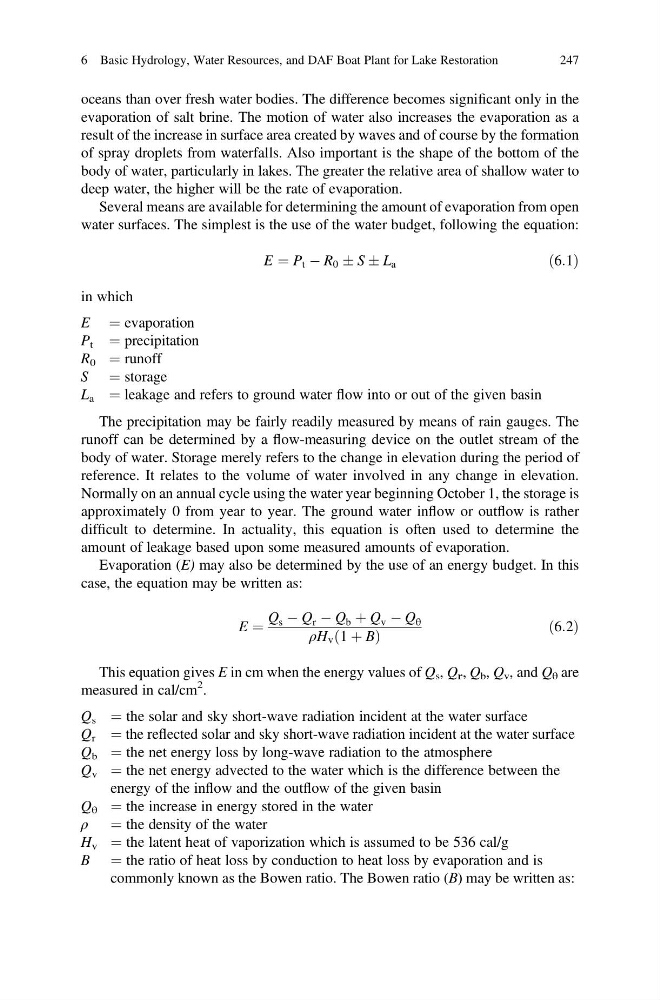
Evaporation (E) may also be determined by the use of an energy budget. In this
case, the equation may be written as:
E ¼
Q s À Q r À Q b þ Q v À Q θ
ρH v 1 þ B
ð
Þ
ð6:2Þ
This equation gives E in cm when the energy values of Q s , Q r , Q b , Q v , and Q θ are
measured in cal/cm
2 .
Q s ¼ the solar and sky short-wave radiation incident at the water surface
Q r ¼ the reflected solar and sky short-wave radiation incident at the water surface
Q b ¼ the net energy loss by long-wave radiation to the atmosphere
Q v ¼ the net energy advected to the water which is the difference between the
energy of the inflow and the outflow of the given basin
Q θ ¼ the increase in energy stored in the water
ρ ¼ the density of the water
H v ¼ the latent heat of vaporization which is assumed to be 536 cal/g
B ¼ the ratio of heat loss by conduction to heat loss by evaporation and is
commonly known as the Bowen ratio. The Bowen ratio (B) may be written as:
6 Basic Hydrology, Water Resources, and DAF Boat Plant for Lake Restoration
247
evaporation of salt brine. The motion of water also increases the evaporation as a
result of the increase in surface area created by waves and of course by the formation
of spray droplets from waterfalls. Also important is the shape of the bottom of the
body of water, particularly in lakes. The greater the relative area of shallow water to
deep water, the higher will be the rate of evaporation.
Several means are available for determining the amount of evaporation from open
water surfaces. The simplest is the use of the water budget, following the equation:
E ¼ P t À R 0 Æ S Æ L a
ð6:1Þ
in which
E ¼ evaporation
P t ¼ precipitation
R 0 ¼ runoff
S ¼ storage
L a ¼ leakage and refers to ground water flow into or out of the given basin
The precipitation may be fairly readily measured by means of rain gauges. The
runoff can be determined by a flow-measuring device on the outlet stream of the
body of water. Storage merely refers to the change in elevation during the period of
reference. It relates to the volume of water involved in any change in elevation.
Normally on an annual cycle using the water year beginning October 1, the storage is
approximately 0 from year to year. The ground water inflow or outflow is rather
difficult to determine. In actuality, this equation is often used to determine the
amount of leakage based upon some measured amounts of evaporation.
Evaporation (E) may also be determined by the use of an energy budget. In this
case, the equation may be written as:
E ¼
Q s À Q r À Q b þ Q v À Q θ
ρH v 1 þ B
ð
Þ
ð6:2Þ
This equation gives E in cm when the energy values of Q s , Q r , Q b , Q v , and Q θ are
measured in cal/cm
2 .
Q s ¼ the solar and sky short-wave radiation incident at the water surface
Q r ¼ the reflected solar and sky short-wave radiation incident at the water surface
Q b ¼ the net energy loss by long-wave radiation to the atmosphere
Q v ¼ the net energy advected to the water which is the difference between the
energy of the inflow and the outflow of the given basin
Q θ ¼ the increase in energy stored in the water
ρ ¼ the density of the water
H v ¼ the latent heat of vaporization which is assumed to be 536 cal/g
B ¼ the ratio of heat loss by conduction to heat loss by evaporation and is
commonly known as the Bowen ratio. The Bowen ratio (B) may be written as:
6 Basic Hydrology, Water Resources, and DAF Boat Plant for Lake Restoration
247