

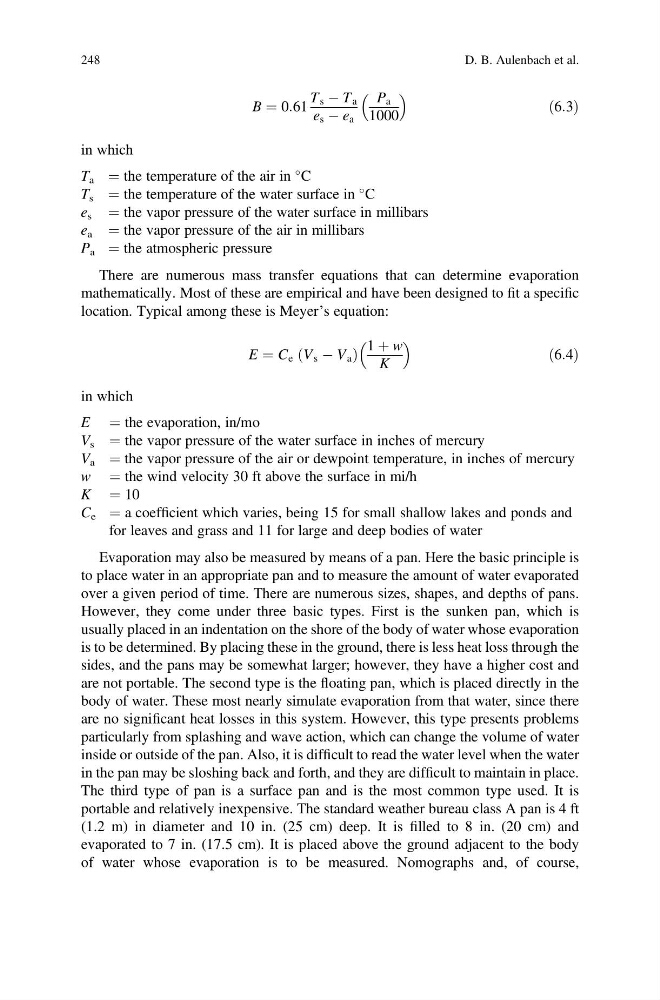
B ¼ 0:61
T s À T a
e s À e a
P a
1000
ð6:3Þ
in which
T a ¼ the temperature of the air in
C
T s ¼ the temperature of the water surface in
C
e s ¼ the vapor pressure of the water surface in millibars
e a ¼ the vapor pressure of the air in millibars
P a ¼ the atmospheric pressure
There are numerous mass transfer equations that can determine evaporation
mathematically. Most of these are empirical and have been designed to fit a specific
location. Typical among these is Meyer’s equation:
E ¼ C e V s À V a
ð
Þ
1 þ w
K
ð6:4Þ
in which
E ¼ the evaporation, in/mo
V s ¼ the vapor pressure of the water surface in inches of mercury
V a ¼ the vapor pressure of the air or dewpoint temperature, in inches of mercury
w ¼ the wind velocity 30 ft above the surface in mi/h
K ¼ 10
C e ¼ a coefficient which varies, being 15 for small shallow lakes and ponds and
for leaves and grass and 11 for large and deep bodies of water
Evaporation may also be measured by means of a pan. Here the basic principle is
to place water in an appropriate pan and to measure the amount of water evaporated
over a given period of time. There are numerous sizes, shapes, and depths of pans.
However, they come under three basic types. First is the sunken pan, which is
usually placed in an indentation on the shore of the body of water whose evaporation
is to be determined. By placing these in the ground, there is less heat loss through the
sides, and the pans may be somewhat larger; however, they have a higher cost and
are not portable. The second type is the floating pan, which is placed directly in the
body of water. These most nearly simulate evaporation from that water, since there
are no significant heat losses in this system. However, this type presents problems
particularly from splashing and wave action, which can change the volume of water
inside or outside of the pan. Also, it is difficult to read the water level when the water
in the pan may be sloshing back and forth, and they are difficult to maintain in place.
The third type of pan is a surface pan and is the most common type used. It is
portable and relatively inexpensive. The standard weather bureau class A pan is 4 ft
(1.2 m) in diameter and 10 in. (25 cm) deep. It is filled to 8 in. (20 cm) and
evaporated to 7 in. (17.5 cm). It is placed above the ground adjacent to the body
of water whose evaporation is to be measured. Nomographs and, of course,
248
D. B. Aulenbach et al.
T s À T a
e s À e a
P a
1000
ð6:3Þ
in which
T a ¼ the temperature of the air in
C
T s ¼ the temperature of the water surface in
C
e s ¼ the vapor pressure of the water surface in millibars
e a ¼ the vapor pressure of the air in millibars
P a ¼ the atmospheric pressure
There are numerous mass transfer equations that can determine evaporation
mathematically. Most of these are empirical and have been designed to fit a specific
location. Typical among these is Meyer’s equation:
E ¼ C e V s À V a
ð
Þ
1 þ w
K
ð6:4Þ
in which
E ¼ the evaporation, in/mo
V s ¼ the vapor pressure of the water surface in inches of mercury
V a ¼ the vapor pressure of the air or dewpoint temperature, in inches of mercury
w ¼ the wind velocity 30 ft above the surface in mi/h
K ¼ 10
C e ¼ a coefficient which varies, being 15 for small shallow lakes and ponds and
for leaves and grass and 11 for large and deep bodies of water
Evaporation may also be measured by means of a pan. Here the basic principle is
to place water in an appropriate pan and to measure the amount of water evaporated
over a given period of time. There are numerous sizes, shapes, and depths of pans.
However, they come under three basic types. First is the sunken pan, which is
usually placed in an indentation on the shore of the body of water whose evaporation
is to be determined. By placing these in the ground, there is less heat loss through the
sides, and the pans may be somewhat larger; however, they have a higher cost and
are not portable. The second type is the floating pan, which is placed directly in the
body of water. These most nearly simulate evaporation from that water, since there
are no significant heat losses in this system. However, this type presents problems
particularly from splashing and wave action, which can change the volume of water
inside or outside of the pan. Also, it is difficult to read the water level when the water
in the pan may be sloshing back and forth, and they are difficult to maintain in place.
The third type of pan is a surface pan and is the most common type used. It is
portable and relatively inexpensive. The standard weather bureau class A pan is 4 ft
(1.2 m) in diameter and 10 in. (25 cm) deep. It is filled to 8 in. (20 cm) and
evaporated to 7 in. (17.5 cm). It is placed above the ground adjacent to the body
of water whose evaporation is to be measured. Nomographs and, of course,
248
D. B. Aulenbach et al.