

the tower and the colder (heavier) air outside the tower. Wind velocity blowing
across the tower opening may additionally aid this airflow; however, if the tower is
correctly designed, the operation of the cooling tower will not be dependent upon
wind flows. This type of cooling tower design is illustrated in Figs. 5.6 and 5.7.
The bottom 3–6 m (10–20 ft) contains fill (packing) that supports extended
surface-to-surface contacts of air and water in both the counter and cross-flow
designs. In a counter-flow design, warm water is distributed by spray nozzles over
the fill material and flows downward as the air passes upward. If cross-flow design is
utilized, warm water flows downward over the fill as air passes in a 90
plane to the
water flow. The center of the tower is open and the airflow here turns upward to exit
the tower.
Counter-flow design supports more efficient heat transfer as the coolest water will
always be in contact with the coolest air and the minimum amount of fill is required.
However, the geometry of the cross-flow design promotes improved air/water
contact, and at the same capacity as the counter-flow tower, the cross-flow tower
will operate at a lower head loss.
The purpose of the fill (packing) material, as mentioned above, is to support and
enhance surface-to-surface contact of air and water to facilitate heat transfer. Transfer of heat may be modeled based upon a thin film of air surrounding a water droplet
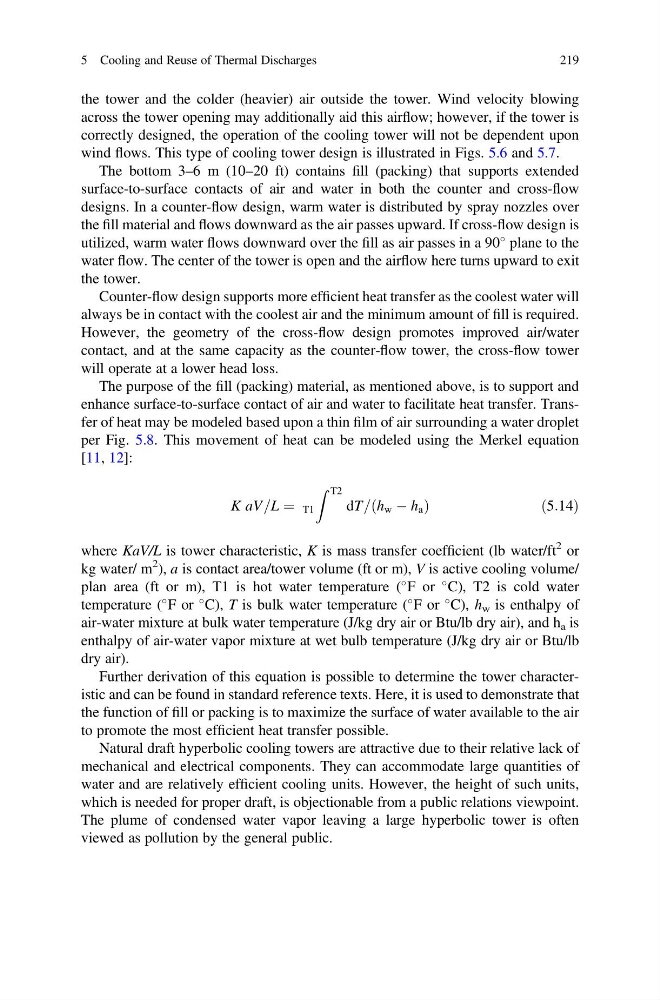
per Fig. 5.8. This movement of heat can be modeled using the Merkel equation
[11, 12]:
K aV=L ¼ T1
Z T2
dT= h w À h a
ð
Þ
ð 5:14Þ
where KaV/L is tower characteristic, K is mass transfer coefficient (lb water/ft
2 or
kg water/ m
2 ), a is contact area/tower volume (ft or m), V is active cooling volume/
plan area (ft or m), T1 is hot water temperature (
F or
C), T2 is cold water
temperature (
F or
C), T is bulk water temperature (
F or
C), h w is enthalpy of
air-water mixture at bulk water temperature (J/kg dry air or Btu/lb dry air), and h a is
enthalpy of air-water vapor mixture at wet bulb temperature (J/kg dry air or Btu/lb
dry air).
Further derivation of this equation is possible to determine the tower characteristic and can be found in standard reference texts. Here, it is used to demonstrate that
the function of fill or packing is to maximize the surface of water available to the air
to promote the most efficient heat transfer possible.
Natural draft hyperbolic cooling towers are attractive due to their relative lack of
mechanical and electrical components. They can accommodate large quantities of
water and are relatively efficient cooling units. However, the height of such units,
which is needed for proper draft, is objectionable from a public relations viewpoint.
The plume of condensed water vapor leaving a large hyperbolic tower is often
viewed as pollution by the general public.
5 Cooling and Reuse of Thermal Discharges
219
across the tower opening may additionally aid this airflow; however, if the tower is
correctly designed, the operation of the cooling tower will not be dependent upon
wind flows. This type of cooling tower design is illustrated in Figs. 5.6 and 5.7.
The bottom 3–6 m (10–20 ft) contains fill (packing) that supports extended
surface-to-surface contacts of air and water in both the counter and cross-flow
designs. In a counter-flow design, warm water is distributed by spray nozzles over
the fill material and flows downward as the air passes upward. If cross-flow design is
utilized, warm water flows downward over the fill as air passes in a 90
plane to the
water flow. The center of the tower is open and the airflow here turns upward to exit
the tower.
Counter-flow design supports more efficient heat transfer as the coolest water will
always be in contact with the coolest air and the minimum amount of fill is required.
However, the geometry of the cross-flow design promotes improved air/water
contact, and at the same capacity as the counter-flow tower, the cross-flow tower
will operate at a lower head loss.
The purpose of the fill (packing) material, as mentioned above, is to support and
enhance surface-to-surface contact of air and water to facilitate heat transfer. Transfer of heat may be modeled based upon a thin film of air surrounding a water droplet
per Fig. 5.8. This movement of heat can be modeled using the Merkel equation
[11, 12]:
K aV=L ¼ T1
Z T2
dT= h w À h a
ð
Þ
ð 5:14Þ
where KaV/L is tower characteristic, K is mass transfer coefficient (lb water/ft
2 or
kg water/ m
2 ), a is contact area/tower volume (ft or m), V is active cooling volume/
plan area (ft or m), T1 is hot water temperature (
F or
C), T2 is cold water
temperature (
F or
C), T is bulk water temperature (
F or
C), h w is enthalpy of
air-water mixture at bulk water temperature (J/kg dry air or Btu/lb dry air), and h a is
enthalpy of air-water vapor mixture at wet bulb temperature (J/kg dry air or Btu/lb
dry air).
Further derivation of this equation is possible to determine the tower characteristic and can be found in standard reference texts. Here, it is used to demonstrate that
the function of fill or packing is to maximize the surface of water available to the air
to promote the most efficient heat transfer possible.
Natural draft hyperbolic cooling towers are attractive due to their relative lack of
mechanical and electrical components. They can accommodate large quantities of
water and are relatively efficient cooling units. However, the height of such units,
which is needed for proper draft, is objectionable from a public relations viewpoint.
The plume of condensed water vapor leaving a large hyperbolic tower is often
viewed as pollution by the general public.
5 Cooling and Reuse of Thermal Discharges
219