

3.5 Example 1
Select the proper wet bulb temperature for a proposed cooling tower in southern
California. When designing a cooling tower, the highest possible wet bulb temperature must be determined. This will assure that the cooling tower will operate at
all times. The Los Angeles airport has the following maximum wet bulb temperatures [4]:
• 67
F is exceeded during 2% of summer hours.
• 69
F is exceeded during 0.5% of summer hours.
• 71
F is exceeded during 0.1% of summer hours.
Depending upon how critical the application is, the designer may wish to design
to a slightly higher temperature that 71
F. Note that at 0.1% of the summer hours, if
71
F is used for design purposes, the tower may be expected to fail over 20 h, or
approximately 1 d:
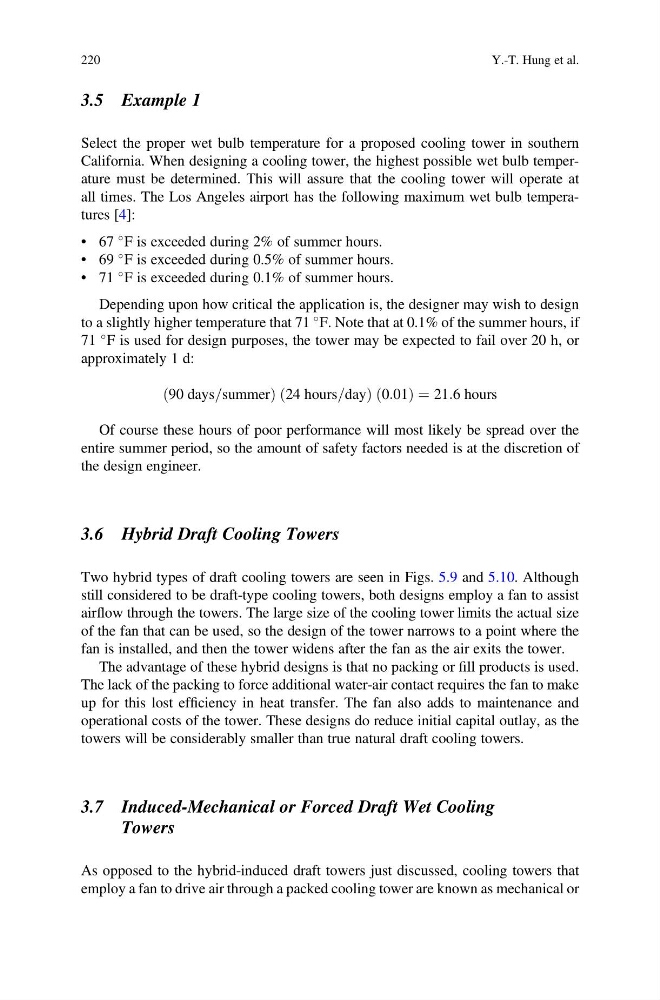
90 days=summer
ð
Þ24 hours=day
ð
Þ0:01 ð
Þ ¼ 21:6 hours
Of course these hours of poor performance will most likely be spread over the
entire summer period, so the amount of safety factors needed is at the discretion of
the design engineer.
3.6 Hybrid Draft Cooling Towers
Two hybrid types of draft cooling towers are seen in Figs. 5.9 and 5.10. Although
still considered to be draft-type cooling towers, both designs employ a fan to assist
airflow through the towers. The large size of the cooling tower limits the actual size
of the fan that can be used, so the design of the tower narrows to a point where the
fan is installed, and then the tower widens after the fan as the air exits the tower.
The advantage of these hybrid designs is that no packing or fill products is used.
The lack of the packing to force additional water-air contact requires the fan to make
up for this lost efficiency in heat transfer. The fan also adds to maintenance and
operational costs of the tower. These designs do reduce initial capital outlay, as the
towers will be considerably smaller than true natural draft cooling towers.
3.7 Induced-Mechanical or Forced Draft Wet Cooling
Towers
As opposed to the hybrid-induced draft towers just discussed, cooling towers that
employ a fan to drive air through a packed cooling tower are known as mechanical or
220
Y.-T. Hung et al.
Select the proper wet bulb temperature for a proposed cooling tower in southern
California. When designing a cooling tower, the highest possible wet bulb temperature must be determined. This will assure that the cooling tower will operate at
all times. The Los Angeles airport has the following maximum wet bulb temperatures [4]:
• 67
F is exceeded during 2% of summer hours.
• 69
F is exceeded during 0.5% of summer hours.
• 71
F is exceeded during 0.1% of summer hours.
Depending upon how critical the application is, the designer may wish to design
to a slightly higher temperature that 71
F. Note that at 0.1% of the summer hours, if
71
F is used for design purposes, the tower may be expected to fail over 20 h, or
approximately 1 d:
90 days=summer
ð
Þ24 hours=day
ð
Þ0:01 ð
Þ ¼ 21:6 hours
Of course these hours of poor performance will most likely be spread over the
entire summer period, so the amount of safety factors needed is at the discretion of
the design engineer.
3.6 Hybrid Draft Cooling Towers
Two hybrid types of draft cooling towers are seen in Figs. 5.9 and 5.10. Although
still considered to be draft-type cooling towers, both designs employ a fan to assist
airflow through the towers. The large size of the cooling tower limits the actual size
of the fan that can be used, so the design of the tower narrows to a point where the
fan is installed, and then the tower widens after the fan as the air exits the tower.
The advantage of these hybrid designs is that no packing or fill products is used.
The lack of the packing to force additional water-air contact requires the fan to make
up for this lost efficiency in heat transfer. The fan also adds to maintenance and
operational costs of the tower. These designs do reduce initial capital outlay, as the
towers will be considerably smaller than true natural draft cooling towers.
3.7 Induced-Mechanical or Forced Draft Wet Cooling
Towers
As opposed to the hybrid-induced draft towers just discussed, cooling towers that
employ a fan to drive air through a packed cooling tower are known as mechanical or
220
Y.-T. Hung et al.