

Disadvantages
Comparatively large sizes needed for a given heat load
High initial capital cost
High pumping costs
Must have unobstructed location to take advantage of available winds
Cooling is dependent upon wind direction and velocity
Often had excessive drift loss
The last disadvantage is of concern. Drift droplets will likely contain chemical
impurities and as such will be considered to be airborne emissions by governmental
regulatory agencies [8, 9].
Ozone treatment of cooling tower water has recently been suggested by the US
Department of energy as a method of treating cooling tower water that saves costs
and reduces the need for chemical additives [10].
3.4 Natural Draft, Wet Hyperbolic Cooling Towers
As seen in Fig. 5.3, this type of tower is named for the distinctive, hyperbolic shape
of the stack through which air passes after contacting warm water sprayed over
packing inside the lower part of the tower. Often massive in size, hyperbolic cooling
towers are often 150–180 m (490–515 ft) high and 100–135 m (330–450 ft) in
diameter. Such towers are often made from reinforced concrete. Airflow through the
tower is driven by the density difference between the heated (so lighter) air leaving
Water Outlet
Water
Inlet
Water
Inlet
Air
Inlet
Air
Inlet
Air Outlet
Fan
Fill
Induced Draft Crossflow Tower
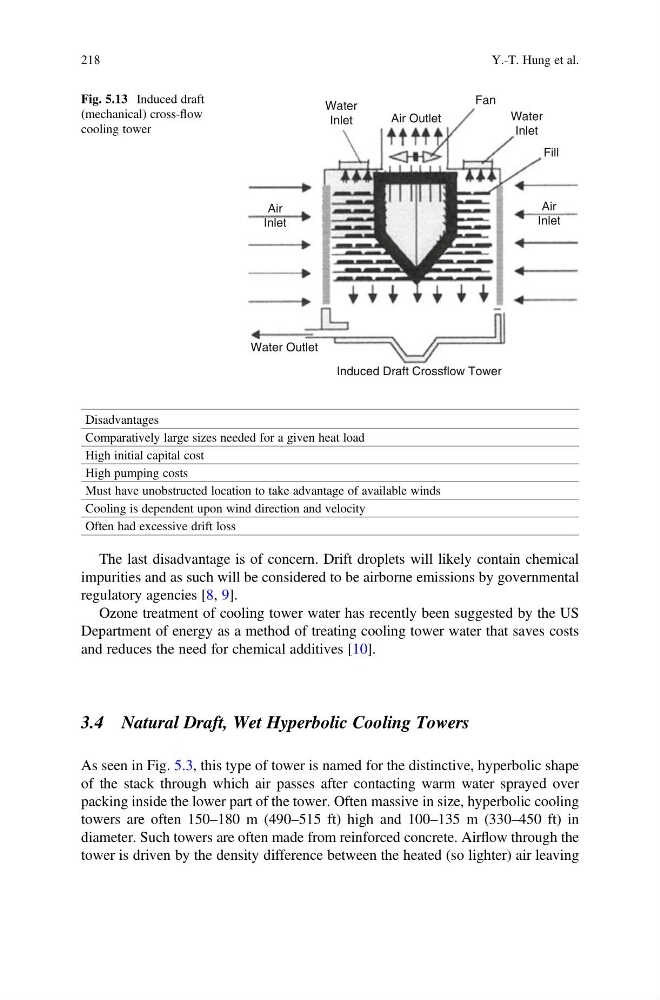
Fig. 5.13 Induced draft
(mechanical) cross-flow
cooling tower
218
Y.-T. Hung et al.
Comparatively large sizes needed for a given heat load
High initial capital cost
High pumping costs
Must have unobstructed location to take advantage of available winds
Cooling is dependent upon wind direction and velocity
Often had excessive drift loss
The last disadvantage is of concern. Drift droplets will likely contain chemical
impurities and as such will be considered to be airborne emissions by governmental
regulatory agencies [8, 9].
Ozone treatment of cooling tower water has recently been suggested by the US
Department of energy as a method of treating cooling tower water that saves costs
and reduces the need for chemical additives [10].
3.4 Natural Draft, Wet Hyperbolic Cooling Towers
As seen in Fig. 5.3, this type of tower is named for the distinctive, hyperbolic shape
of the stack through which air passes after contacting warm water sprayed over
packing inside the lower part of the tower. Often massive in size, hyperbolic cooling
towers are often 150–180 m (490–515 ft) high and 100–135 m (330–450 ft) in
diameter. Such towers are often made from reinforced concrete. Airflow through the
tower is driven by the density difference between the heated (so lighter) air leaving
Water Outlet
Water
Inlet
Water
Inlet
Air
Inlet
Air
Inlet
Air Outlet
Fan
Fill
Induced Draft Crossflow Tower
Fig. 5.13 Induced draft
(mechanical) cross-flow
cooling tower
218
Y.-T. Hung et al.