

Calculation of Pond Exit Temperature
In the previous example the following values were found to be appropriate:
K ¼ 778:5 kcal=m
2 d
C
C p ¼ 1:0 kcal=kg
C
and
ρ ¼ 1:0 g=cm
3
¼ 1, 000 kg=m
3
The volumetric flow, Q, in terms of m
3 /d is determined as follows:
Q ¼ 9, 255 L=s ¼ 9, 225
ð
Þ 60
ð Þ 60
ð Þ 24
ð Þ=1, 000 ¼ 8:0 Â 10
3 m
3
=d
Assumed inlet temperature of water entering the power plant condensers is 28
C.
If the water is warmed 10
C as it passes the condensers, the temperature of the water
entering the cooling pond can be assumed to be 38
C (T o ). Therefore, the following
data applies:
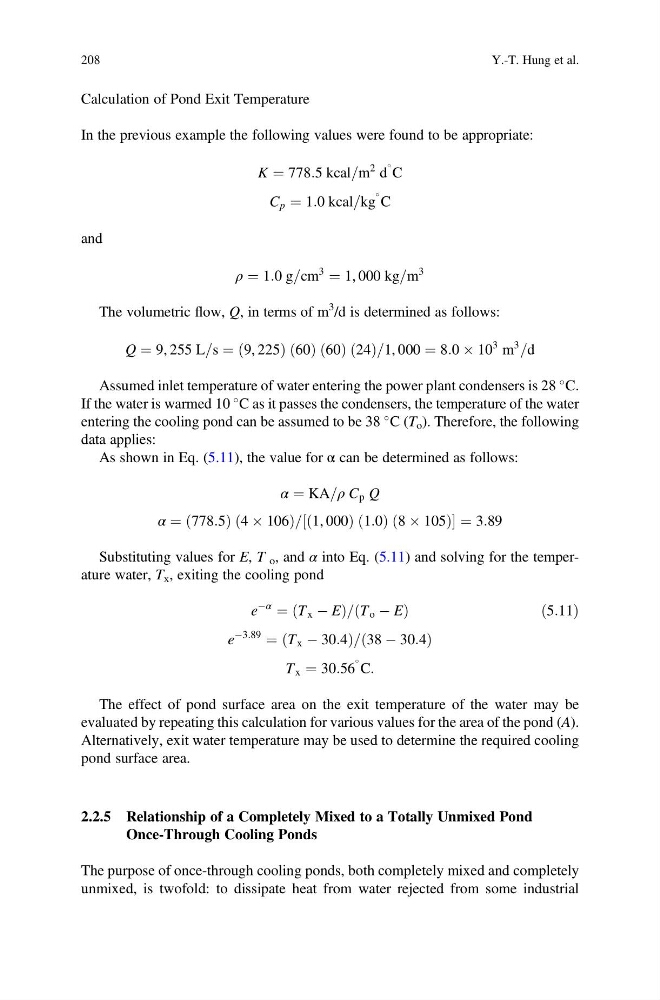
As shown in Eq. (5.11), the value for α can be determined as follows:
α ¼ KA=ρ C p Q
α ¼ 778:5
ð
Þ 4 Â 106
ð
Þ = 1, 000
ð
Þ 1:0
ð Þ 8 Â 105
ð
Þ
½
¼ 3:89
Substituting values for E, T o , and α into Eq. (5.11) and solving for the temperature water, T x , exiting the cooling pond
e
Àα
¼ T x À E
ð
Þ= T o À E
ð
Þ
ð5:11Þ
e
À3:89
¼ T x À 30:4
ð
Þ = 38 À 30:4
ð
Þ
T x ¼ 30:56
C:
The effect of pond surface area on the exit temperature of the water may be
evaluated by repeating this calculation for various values for the area of the pond (A).
Alternatively, exit water temperature may be used to determine the required cooling
pond surface area.
2.2.5 Relationship of a Completely Mixed to a Totally Unmixed Pond
Once-Through Cooling Ponds
The purpose of once-through cooling ponds, both completely mixed and completely
unmixed, is twofold: to dissipate heat from water rejected from some industrial
208
Y.-T. Hung et al.
In the previous example the following values were found to be appropriate:
K ¼ 778:5 kcal=m
2 d
C
C p ¼ 1:0 kcal=kg
C
and
ρ ¼ 1:0 g=cm
3
¼ 1, 000 kg=m
3
The volumetric flow, Q, in terms of m
3 /d is determined as follows:
Q ¼ 9, 255 L=s ¼ 9, 225
ð
Þ 60
ð Þ 60
ð Þ 24
ð Þ=1, 000 ¼ 8:0 Â 10
3 m
3
=d
Assumed inlet temperature of water entering the power plant condensers is 28
C.
If the water is warmed 10
C as it passes the condensers, the temperature of the water
entering the cooling pond can be assumed to be 38
C (T o ). Therefore, the following
data applies:
As shown in Eq. (5.11), the value for α can be determined as follows:
α ¼ KA=ρ C p Q
α ¼ 778:5
ð
Þ 4 Â 106
ð
Þ = 1, 000
ð
Þ 1:0
ð Þ 8 Â 105
ð
Þ
½
¼ 3:89
Substituting values for E, T o , and α into Eq. (5.11) and solving for the temperature water, T x , exiting the cooling pond
e
Àα
¼ T x À E
ð
Þ= T o À E
ð
Þ
ð5:11Þ
e
À3:89
¼ T x À 30:4
ð
Þ = 38 À 30:4
ð
Þ
T x ¼ 30:56
C:
The effect of pond surface area on the exit temperature of the water may be
evaluated by repeating this calculation for various values for the area of the pond (A).
Alternatively, exit water temperature may be used to determine the required cooling
pond surface area.
2.2.5 Relationship of a Completely Mixed to a Totally Unmixed Pond
Once-Through Cooling Ponds
The purpose of once-through cooling ponds, both completely mixed and completely
unmixed, is twofold: to dissipate heat from water rejected from some industrial
208
Y.-T. Hung et al.