

process and to achieve the lowest possible effluent temperature of water exiting the
pond. Both results are directly related to both longitudinal mixing and shortcircuiting currents present within the pond.
Comparison Between Net Plant Temperature Rise of a Completely Mixed
Pond vs. a Completely Unmixed Pond
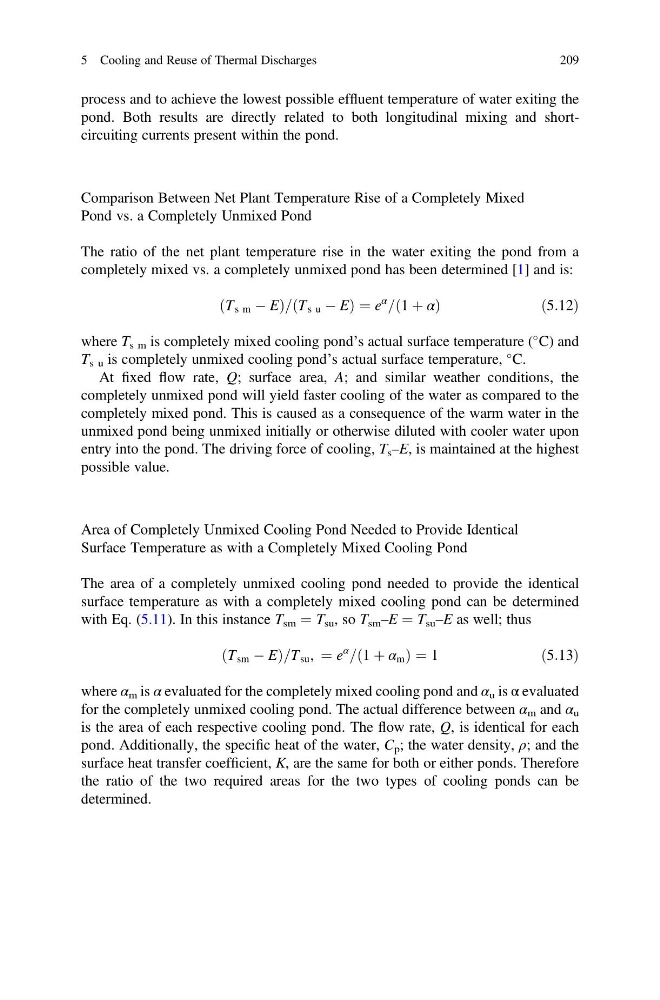
The ratio of the net plant temperature rise in the water exiting the pond from a
completely mixed vs. a completely unmixed pond has been determined [1] and is:
T s m À E
ð
Þ = T s u À E
ð
Þ¼e
α
= 1 þ α
ð
Þ
ð5:12Þ
where T s m is completely mixed cooling pond’s actual surface temperature (
C) and
T s u is completely unmixed cooling pond’s actual surface temperature,
C.
At fixed flow rate, Q; surface area, A; and similar weather conditions, the
completely unmixed pond will yield faster cooling of the water as compared to the
completely mixed pond. This is caused as a consequence of the warm water in the
unmixed pond being unmixed initially or otherwise diluted with cooler water upon
entry into the pond. The driving force of cooling, T s –E, is maintained at the highest
possible value.
Area of Completely Unmixed Cooling Pond Needed to Provide Identical
Surface Temperature as with a Completely Mixed Cooling Pond
The area of a completely unmixed cooling pond needed to provide the identical
surface temperature as with a completely mixed cooling pond can be determined
with Eq. (5.11). In this instance T sm ¼ T su , so T sm –E ¼ T su –E as well; thus
T sm À E
ð
Þ =T su , ¼ e
α
= 1 þ α m
ð
Þ¼1
ð5:13Þ
where α m is α evaluated for the completely mixed cooling pond and α u is α evaluated
for the completely unmixed cooling pond. The actual difference between α m and α u
is the area of each respective cooling pond. The flow rate, Q, is identical for each
pond. Additionally, the specific heat of the water, C p ; the water density, ρ; and the
surface heat transfer coefficient, K, are the same for both or either ponds. Therefore
the ratio of the two required areas for the two types of cooling ponds can be
determined.
5 Cooling and Reuse of Thermal Discharges
209
pond. Both results are directly related to both longitudinal mixing and shortcircuiting currents present within the pond.
Comparison Between Net Plant Temperature Rise of a Completely Mixed
Pond vs. a Completely Unmixed Pond
The ratio of the net plant temperature rise in the water exiting the pond from a
completely mixed vs. a completely unmixed pond has been determined [1] and is:
T s m À E
ð
Þ = T s u À E
ð
Þ¼e
α
= 1 þ α
ð
Þ
ð5:12Þ
where T s m is completely mixed cooling pond’s actual surface temperature (
C) and
T s u is completely unmixed cooling pond’s actual surface temperature,
C.
At fixed flow rate, Q; surface area, A; and similar weather conditions, the
completely unmixed pond will yield faster cooling of the water as compared to the
completely mixed pond. This is caused as a consequence of the warm water in the
unmixed pond being unmixed initially or otherwise diluted with cooler water upon
entry into the pond. The driving force of cooling, T s –E, is maintained at the highest
possible value.
Area of Completely Unmixed Cooling Pond Needed to Provide Identical
Surface Temperature as with a Completely Mixed Cooling Pond
The area of a completely unmixed cooling pond needed to provide the identical
surface temperature as with a completely mixed cooling pond can be determined
with Eq. (5.11). In this instance T sm ¼ T su , so T sm –E ¼ T su –E as well; thus
T sm À E
ð
Þ =T su , ¼ e
α
= 1 þ α m
ð
Þ¼1
ð5:13Þ
where α m is α evaluated for the completely mixed cooling pond and α u is α evaluated
for the completely unmixed cooling pond. The actual difference between α m and α u
is the area of each respective cooling pond. The flow rate, Q, is identical for each
pond. Additionally, the specific heat of the water, C p ; the water density, ρ; and the
surface heat transfer coefficient, K, are the same for both or either ponds. Therefore
the ratio of the two required areas for the two types of cooling ponds can be
determined.
5 Cooling and Reuse of Thermal Discharges
209