

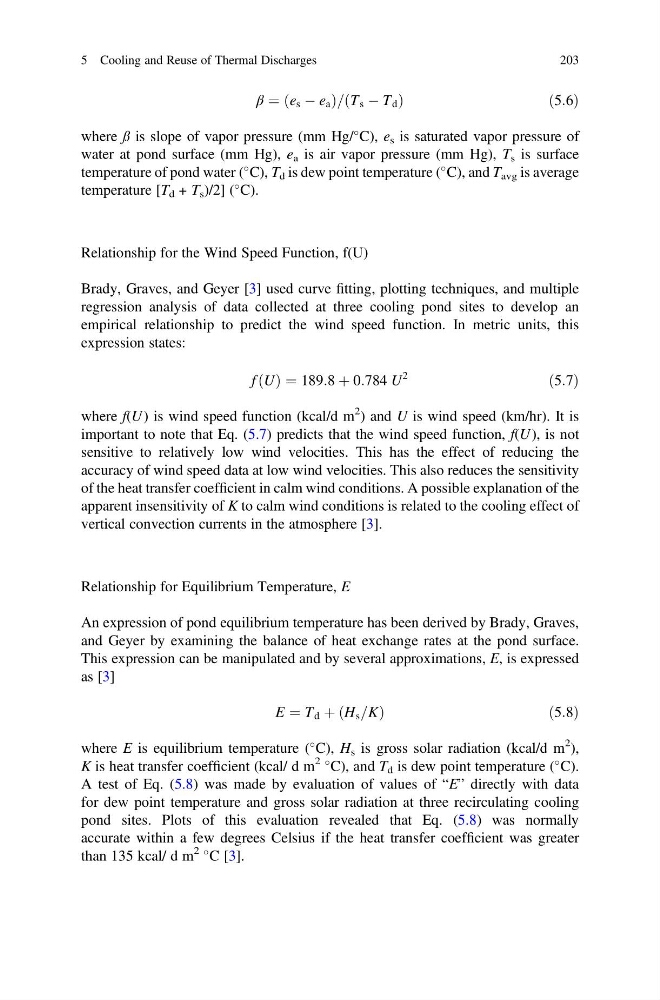
β ¼ e s À e a
ð
Þ= T s À T d
ð
Þ
ð 5:6Þ
where ß is slope of vapor pressure (mm Hg/
C), e s is saturated vapor pressure of
water at pond surface (mm Hg), e a is air vapor pressure (mm Hg), T s is surface
temperature of pond water (
C), T d is dew point temperature (
C), and T avg is average
temperature [T d + T s )/2] (
C).
Relationship for the Wind Speed Function, f(U)
Brady, Graves, and Geyer [3] used curve fitting, plotting techniques, and multiple
regression analysis of data collected at three cooling pond sites to develop an
empirical relationship to predict the wind speed function. In metric units, this
expression states:
f U
ð Þ ¼ 189:8 þ 0:784 U
2
ð5:7Þ
where f(U ) is wind speed function (kcal/d m
2 ) and U is wind speed (km/hr). It is
important to note that Eq. (5.7) predicts that the wind speed function, f(U ), is not
sensitive to relatively low wind velocities. This has the effect of reducing the
accuracy of wind speed data at low wind velocities. This also reduces the sensitivity
of the heat transfer coefficient in calm wind conditions. A possible explanation of the
apparent insensitivity of K to calm wind conditions is related to the cooling effect of
vertical convection currents in the atmosphere [3].
Relationship for Equilibrium Temperature, E
An expression of pond equilibrium temperature has been derived by Brady, Graves,
and Geyer by examining the balance of heat exchange rates at the pond surface.
This expression can be manipulated and by several approximations, E, is expressed
as [3]
E ¼ T d þ H s =K
ð
Þ
ð5:8Þ
where E is equilibrium temperature (
C), H s is gross solar radiation (kcal/d m
2 ),
K is heat transfer coefficient (kcal/ d m
2 C), and T d is dew point temperature (
C).
A test of Eq. (5.8) was made by evaluation of values of “E” directly with data
for dew point temperature and gross solar radiation at three recirculating cooling
pond sites. Plots of this evaluation revealed that Eq. (5.8) was normally
accurate within a few degrees Celsius if the heat transfer coefficient was greater
than 135 kcal/ d m
2 C [3].
5 Cooling and Reuse of Thermal Discharges
203
ð
Þ= T s À T d
ð
Þ
ð 5:6Þ
where ß is slope of vapor pressure (mm Hg/
C), e s is saturated vapor pressure of
water at pond surface (mm Hg), e a is air vapor pressure (mm Hg), T s is surface
temperature of pond water (
C), T d is dew point temperature (
C), and T avg is average
temperature [T d + T s )/2] (
C).
Relationship for the Wind Speed Function, f(U)
Brady, Graves, and Geyer [3] used curve fitting, plotting techniques, and multiple
regression analysis of data collected at three cooling pond sites to develop an
empirical relationship to predict the wind speed function. In metric units, this
expression states:
f U
ð Þ ¼ 189:8 þ 0:784 U
2
ð5:7Þ
where f(U ) is wind speed function (kcal/d m
2 ) and U is wind speed (km/hr). It is
important to note that Eq. (5.7) predicts that the wind speed function, f(U ), is not
sensitive to relatively low wind velocities. This has the effect of reducing the
accuracy of wind speed data at low wind velocities. This also reduces the sensitivity
of the heat transfer coefficient in calm wind conditions. A possible explanation of the
apparent insensitivity of K to calm wind conditions is related to the cooling effect of
vertical convection currents in the atmosphere [3].
Relationship for Equilibrium Temperature, E
An expression of pond equilibrium temperature has been derived by Brady, Graves,
and Geyer by examining the balance of heat exchange rates at the pond surface.
This expression can be manipulated and by several approximations, E, is expressed
as [3]
E ¼ T d þ H s =K
ð
Þ
ð5:8Þ
where E is equilibrium temperature (
C), H s is gross solar radiation (kcal/d m
2 ),
K is heat transfer coefficient (kcal/ d m
2 C), and T d is dew point temperature (
C).
A test of Eq. (5.8) was made by evaluation of values of “E” directly with data
for dew point temperature and gross solar radiation at three recirculating cooling
pond sites. Plots of this evaluation revealed that Eq. (5.8) was normally
accurate within a few degrees Celsius if the heat transfer coefficient was greater
than 135 kcal/ d m
2 C [3].
5 Cooling and Reuse of Thermal Discharges
203