

2.2.2 Prediction of Surface Temperature, T s , of a Completely Mixed
Recirculating Cooling Pond
The surface heat transfer coefficient (K ) and the equilibrium temperature (E) can be
determined using known weather conditions and Eqs. (5.5, 5.6, 5.7, and 5.8). An
iterative approach is used to account for the fact that the average surface temperature
(T s ) is not known initially. The first estimate of T s is corrected in successive
approximations. Required weather conditions are the dew point temperature, gross
solar radiation, and the wind speed. With these values known T s can be calculated for
a specific heating load [3].
Calculation of Cooling Pond Exit Temperature
Problem
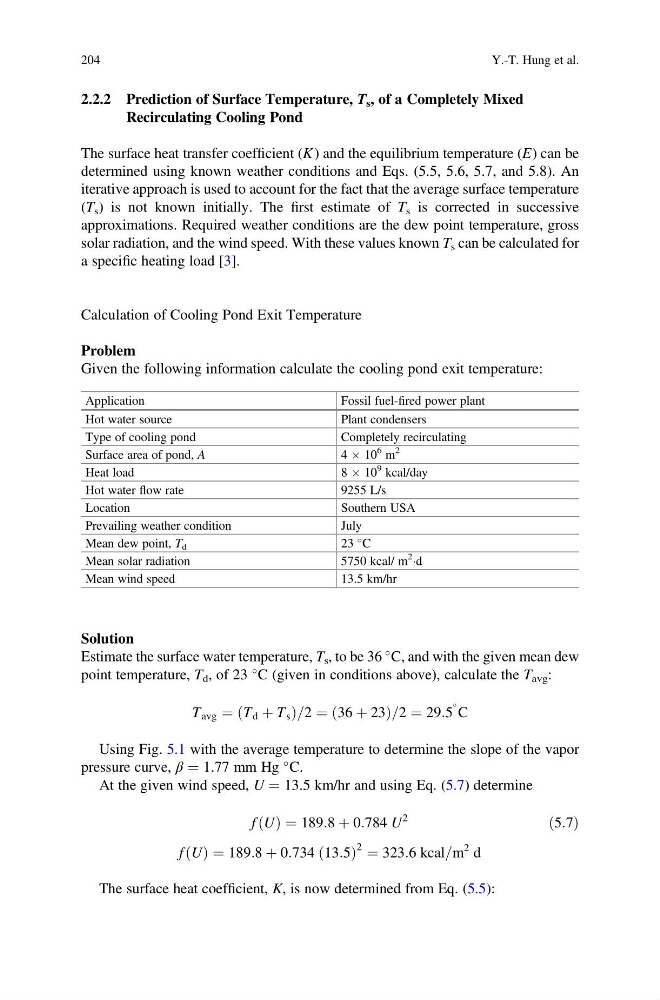
Given the following information calculate the cooling pond exit temperature:
Application
Fossil fuel-fired power plant
Hot water source
Plant condensers
Type of cooling pond
Completely recirculating
Surface area of pond, A
4 Â 10
6 m
2
Heat load
8 Â 10
9 kcal/day
Hot water flow rate
9255 L/s
Location
Southern USA
Prevailing weather condition
July
Mean dew point, T d
23
C
Mean solar radiation
5750 kcal/ m
2
Ád
Mean wind speed
13.5 km/hr
Solution
Estimate the surface water temperature, T s , to be 36
C, and with the given mean dew
point temperature, T d , of 23
C (given in conditions above), calculate the T avg :
T avg ¼ T d þ T s
ð
Þ =2 ¼ 36 þ 23
ð
Þ =2 ¼ 29:5
C
Using Fig. 5.1 with the average temperature to determine the slope of the vapor
pressure curve, β ¼ 1.77 mm Hg
C.
At the given wind speed, U ¼ 13.5 km/hr and using Eq. (5.7) determine
f U
ð Þ ¼ 189:8 þ 0:784 U
2
ð5:7Þ
f U
ð Þ ¼ 189:8 þ 0:734 13:5
ð
Þ
2 ¼ 323:6 kcal=m
2 d
The surface heat coefficient, K, is now determined from Eq. (5.5):
204
Y.-T. Hung et al.
Recirculating Cooling Pond
The surface heat transfer coefficient (K ) and the equilibrium temperature (E) can be
determined using known weather conditions and Eqs. (5.5, 5.6, 5.7, and 5.8). An
iterative approach is used to account for the fact that the average surface temperature
(T s ) is not known initially. The first estimate of T s is corrected in successive
approximations. Required weather conditions are the dew point temperature, gross
solar radiation, and the wind speed. With these values known T s can be calculated for
a specific heating load [3].
Calculation of Cooling Pond Exit Temperature
Problem
Given the following information calculate the cooling pond exit temperature:
Application
Fossil fuel-fired power plant
Hot water source
Plant condensers
Type of cooling pond
Completely recirculating
Surface area of pond, A
4 Â 10
6 m
2
Heat load
8 Â 10
9 kcal/day
Hot water flow rate
9255 L/s
Location
Southern USA
Prevailing weather condition
July
Mean dew point, T d
23
C
Mean solar radiation
5750 kcal/ m
2
Ád
Mean wind speed
13.5 km/hr
Solution
Estimate the surface water temperature, T s , to be 36
C, and with the given mean dew
point temperature, T d , of 23
C (given in conditions above), calculate the T avg :
T avg ¼ T d þ T s
ð
Þ =2 ¼ 36 þ 23
ð
Þ =2 ¼ 29:5
C
Using Fig. 5.1 with the average temperature to determine the slope of the vapor
pressure curve, β ¼ 1.77 mm Hg
C.
At the given wind speed, U ¼ 13.5 km/hr and using Eq. (5.7) determine
f U
ð Þ ¼ 189:8 þ 0:784 U
2
ð5:7Þ
f U
ð Þ ¼ 189:8 þ 0:734 13:5
ð
Þ
2 ¼ 323:6 kcal=m
2 d
The surface heat coefficient, K, is now determined from Eq. (5.5):
204
Y.-T. Hung et al.