

Basic design equations are presented here for both recirculating cooling ponds as
well as for once-through type ponds. The effects of longitudinal mixing and short
circuiting of both types of cooling ponds are discussed. Seasonal and geographical
considerations are also considered, as well as other miscellaneous considerations
regarding cooling pond design.
2.2.1 Evaluation of Heat Dissipation of Completely Mixed
and Recirculating Cooling Ponds
The primary parameter when designing a recirculating cooling pond is the amount of
water surface area required to dissipate the excess heat of the water that enters the
pond. An example would be a cooling pond at a thermal electrical power generation
site. In the design, a difference will exist above the equilibrium surface temperature
of the pond. The surface area of the pond needed to dissipate the surplus heat of the
water in the pond is directly related to the mean surface heat transfer capacity of the
pond [1].
Capacity of a Completely Recirculating Pond to Dissipate Added Heat Loads
The ability of a pond to dissipate a heat load from an influent has been demonstrated
to be described as [1]:
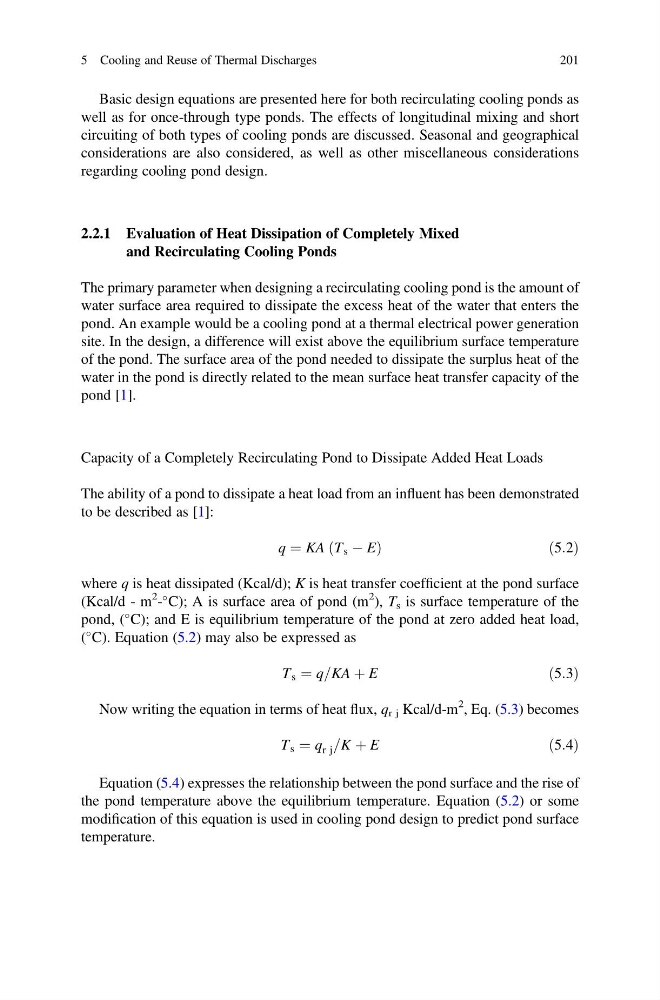
q ¼ KA T s À E
ð
Þ
ð5:2Þ
where q is heat dissipated (Kcal/d); K is heat transfer coefficient at the pond surface
(Kcal/d - m
2 -
C); A is surface area of pond (m
2 ), T s is surface temperature of the
pond, (
C); and E is equilibrium temperature of the pond at zero added heat load,
(
C). Equation (5.2) may also be expressed as
T s ¼ q=KA þ E
ð5:3Þ
Now writing the equation in terms of heat flux, q r j Kcal/d-m
2 , Eq. (5.3) becomes
T s ¼ q r j =K þ E
ð5:4Þ
Equation (5.4) expresses the relationship between the pond surface and the rise of
the pond temperature above the equilibrium temperature. Equation (5.2) or some
modification of this equation is used in cooling pond design to predict pond surface
temperature.
5 Cooling and Reuse of Thermal Discharges
201
well as for once-through type ponds. The effects of longitudinal mixing and short
circuiting of both types of cooling ponds are discussed. Seasonal and geographical
considerations are also considered, as well as other miscellaneous considerations
regarding cooling pond design.
2.2.1 Evaluation of Heat Dissipation of Completely Mixed
and Recirculating Cooling Ponds
The primary parameter when designing a recirculating cooling pond is the amount of
water surface area required to dissipate the excess heat of the water that enters the
pond. An example would be a cooling pond at a thermal electrical power generation
site. In the design, a difference will exist above the equilibrium surface temperature
of the pond. The surface area of the pond needed to dissipate the surplus heat of the
water in the pond is directly related to the mean surface heat transfer capacity of the
pond [1].
Capacity of a Completely Recirculating Pond to Dissipate Added Heat Loads
The ability of a pond to dissipate a heat load from an influent has been demonstrated
to be described as [1]:
q ¼ KA T s À E
ð
Þ
ð5:2Þ
where q is heat dissipated (Kcal/d); K is heat transfer coefficient at the pond surface
(Kcal/d - m
2 -
C); A is surface area of pond (m
2 ), T s is surface temperature of the
pond, (
C); and E is equilibrium temperature of the pond at zero added heat load,
(
C). Equation (5.2) may also be expressed as
T s ¼ q=KA þ E
ð5:3Þ
Now writing the equation in terms of heat flux, q r j Kcal/d-m
2 , Eq. (5.3) becomes
T s ¼ q r j =K þ E
ð5:4Þ
Equation (5.4) expresses the relationship between the pond surface and the rise of
the pond temperature above the equilibrium temperature. Equation (5.2) or some
modification of this equation is used in cooling pond design to predict pond surface
temperature.
5 Cooling and Reuse of Thermal Discharges
201