

Outputs
3. q s r ¼ reflected portion of q s
q s r ranges from 109 to 542 Kcal/day-m
2 or from 40 to 200 Btu/day-ft
2
4. q a r ¼ reflected portion of q a
q a r ranges from 190 to 325 Kcal/day-m
2 or from 70 to 120 Btu/day-ft
2
5. q b r ¼ long-wave black radiation from water surface
q b r ranges from 6504 to 9756 Kcal/day-m
2 or from 2400 to 3600 Btu/day-ft
2
6. q e ¼ evaporative heat loss
q e ranges from 5420 to 21,680 Kcal/day-m
2 or from 2000 to 8000 Btu/day-ft
2
Input or Output: Dependent upon Circumstances
7. q c ¼ conductive-convective heat loss
q c ranges from À867 to +1084 Kcal/day-m
2 or from À320 to +400 Btu/day-ft
2
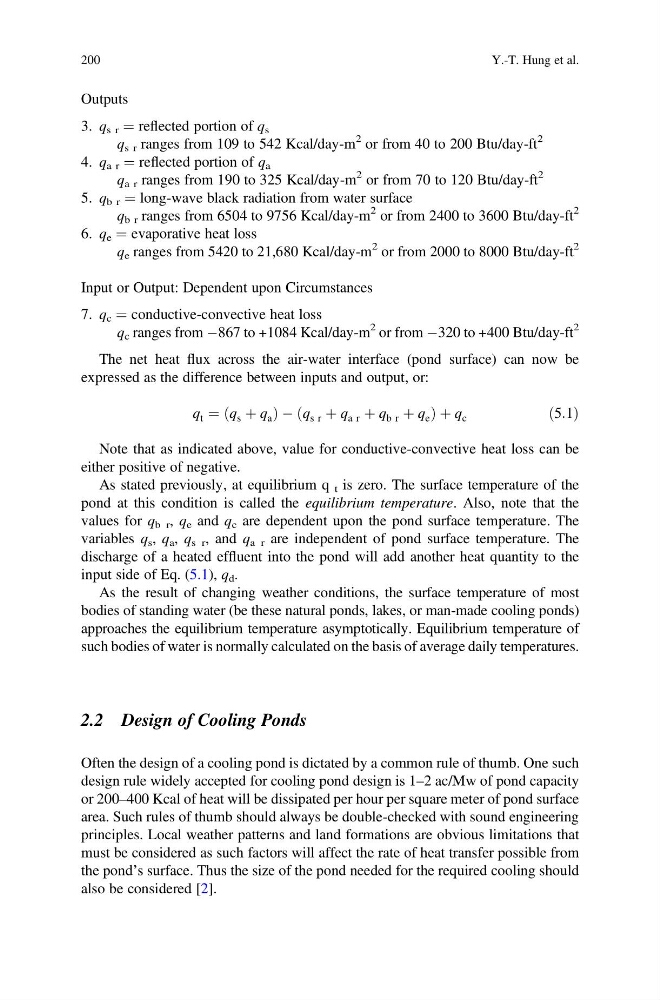
The net heat flux across the air-water interface (pond surface) can now be
expressed as the difference between inputs and output, or:
q t ¼ q s þ q a
ð
ÞÀ q s r þ q a r þ q b r þ q e
ð
Þ þ q c
ð5:1Þ
Note that as indicated above, value for conductive-convective heat loss can be
either positive of negative.
As stated previously, at equilibrium q t is zero. The surface temperature of the
pond at this condition is called the equilibrium temperature. Also, note that the
values for q b r , q e and q c are dependent upon the pond surface temperature. The
variables q s , q a , q s r , and q a r are independent of pond surface temperature. The
discharge of a heated effluent into the pond will add another heat quantity to the
input side of Eq. (5.1), q d .
As the result of changing weather conditions, the surface temperature of most
bodies of standing water (be these natural ponds, lakes, or man-made cooling ponds)
approaches the equilibrium temperature asymptotically. Equilibrium temperature of
such bodies of water is normally calculated on the basis of average daily temperatures.
2.2 Design of Cooling Ponds
Often the design of a cooling pond is dictated by a common rule of thumb. One such
design rule widely accepted for cooling pond design is 1–2 ac/Mw of pond capacity
or 200–400 Kcal of heat will be dissipated per hour per square meter of pond surface
area. Such rules of thumb should always be double-checked with sound engineering
principles. Local weather patterns and land formations are obvious limitations that
must be considered as such factors will affect the rate of heat transfer possible from
the pond’s surface. Thus the size of the pond needed for the required cooling should
also be considered [2].
200
Y.-T. Hung et al.
3. q s r ¼ reflected portion of q s
q s r ranges from 109 to 542 Kcal/day-m
2 or from 40 to 200 Btu/day-ft
2
4. q a r ¼ reflected portion of q a
q a r ranges from 190 to 325 Kcal/day-m
2 or from 70 to 120 Btu/day-ft
2
5. q b r ¼ long-wave black radiation from water surface
q b r ranges from 6504 to 9756 Kcal/day-m
2 or from 2400 to 3600 Btu/day-ft
2
6. q e ¼ evaporative heat loss
q e ranges from 5420 to 21,680 Kcal/day-m
2 or from 2000 to 8000 Btu/day-ft
2
Input or Output: Dependent upon Circumstances
7. q c ¼ conductive-convective heat loss
q c ranges from À867 to +1084 Kcal/day-m
2 or from À320 to +400 Btu/day-ft
2
The net heat flux across the air-water interface (pond surface) can now be
expressed as the difference between inputs and output, or:
q t ¼ q s þ q a
ð
ÞÀ q s r þ q a r þ q b r þ q e
ð
Þ þ q c
ð5:1Þ
Note that as indicated above, value for conductive-convective heat loss can be
either positive of negative.
As stated previously, at equilibrium q t is zero. The surface temperature of the
pond at this condition is called the equilibrium temperature. Also, note that the
values for q b r , q e and q c are dependent upon the pond surface temperature. The
variables q s , q a , q s r , and q a r are independent of pond surface temperature. The
discharge of a heated effluent into the pond will add another heat quantity to the
input side of Eq. (5.1), q d .
As the result of changing weather conditions, the surface temperature of most
bodies of standing water (be these natural ponds, lakes, or man-made cooling ponds)
approaches the equilibrium temperature asymptotically. Equilibrium temperature of
such bodies of water is normally calculated on the basis of average daily temperatures.
2.2 Design of Cooling Ponds
Often the design of a cooling pond is dictated by a common rule of thumb. One such
design rule widely accepted for cooling pond design is 1–2 ac/Mw of pond capacity
or 200–400 Kcal of heat will be dissipated per hour per square meter of pond surface
area. Such rules of thumb should always be double-checked with sound engineering
principles. Local weather patterns and land formations are obvious limitations that
must be considered as such factors will affect the rate of heat transfer possible from
the pond’s surface. Thus the size of the pond needed for the required cooling should
also be considered [2].
200
Y.-T. Hung et al.