

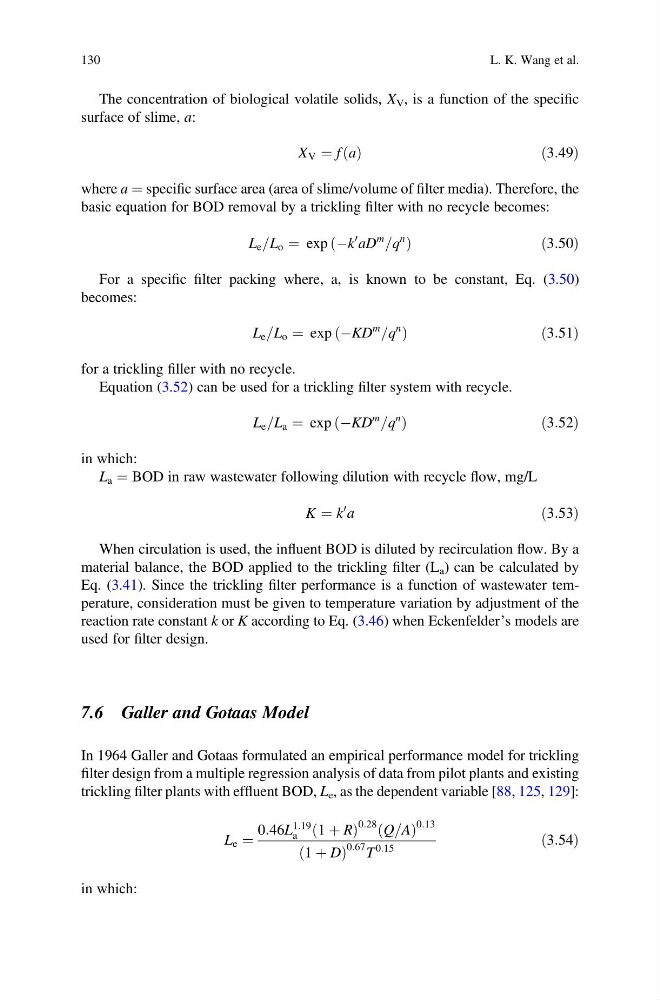
The concentration of biological volatile solids, X V , is a function of the specific
surface of slime, a:
X V ¼ f a
ð Þ
ð3:49Þ
where a ¼ specific surface area (area of slime/volume of filter media). Therefore, the
basic equation for BOD removal by a trickling filter with no recycle becomes:
L e =L o ¼ exp Àk
0 aD
m
=q
n
ð
Þ
ð 3:50Þ
For a specific filter packing where, a, is known to be constant, Eq. (3.50)
becomes:
L e =L o ¼ exp ÀKD
m
=q
n
ð
Þ
ð 3:51Þ
for a trickling filler with no recycle.
Equation (3.52) can be used for a trickling filter system with recycle.
L e =L a ¼ exp ÀKD
m
=q
n
ð
Þ
ð 3:52Þ
in which:
L a ¼ BOD in raw wastewater following dilution with recycle flow, mg/L
K ¼ k
0 a
ð3:53Þ
When circulation is used, the influent BOD is diluted by recirculation flow. By a
material balance, the BOD applied to the trickling filter (L a ) can be calculated by
Eq. (3.41). Since the trickling filter performance is a function of wastewater temperature, consideration must be given to temperature variation by adjustment of the
reaction rate constant k or K according to Eq. (3.46) when Eckenfelder’s models are
used for filter design.
7.6 Galler and Gotaas Model
In 1964 Galler and Gotaas formulated an empirical performance model for trickling
filter design from a multiple regression analysis of data from pilot plants and existing
trickling filter plants with effluent BOD, L e , as the dependent variable [88, 125, 129]:
L e ¼
0:46L
1:19
a
1 þ R
ð
Þ
0:28 Q=A
ð
Þ
0:13
1 þ D
ð
Þ
0:67 T
0:15
ð3:54Þ
in which:
130
L. K. Wang et al.
surface of slime, a:
X V ¼ f a
ð Þ
ð3:49Þ
where a ¼ specific surface area (area of slime/volume of filter media). Therefore, the
basic equation for BOD removal by a trickling filter with no recycle becomes:
L e =L o ¼ exp Àk
0 aD
m
=q
n
ð
Þ
ð 3:50Þ
For a specific filter packing where, a, is known to be constant, Eq. (3.50)
becomes:
L e =L o ¼ exp ÀKD
m
=q
n
ð
Þ
ð 3:51Þ
for a trickling filler with no recycle.
Equation (3.52) can be used for a trickling filter system with recycle.
L e =L a ¼ exp ÀKD
m
=q
n
ð
Þ
ð 3:52Þ
in which:
L a ¼ BOD in raw wastewater following dilution with recycle flow, mg/L
K ¼ k
0 a
ð3:53Þ
When circulation is used, the influent BOD is diluted by recirculation flow. By a
material balance, the BOD applied to the trickling filter (L a ) can be calculated by
Eq. (3.41). Since the trickling filter performance is a function of wastewater temperature, consideration must be given to temperature variation by adjustment of the
reaction rate constant k or K according to Eq. (3.46) when Eckenfelder’s models are
used for filter design.
7.6 Galler and Gotaas Model
In 1964 Galler and Gotaas formulated an empirical performance model for trickling
filter design from a multiple regression analysis of data from pilot plants and existing
trickling filter plants with effluent BOD, L e , as the dependent variable [88, 125, 129]:
L e ¼
0:46L
1:19
a
1 þ R
ð
Þ
0:28 Q=A
ð
Þ
0:13
1 þ D
ð
Þ
0:67 T
0:15
ð3:54Þ
in which:
130
L. K. Wang et al.