

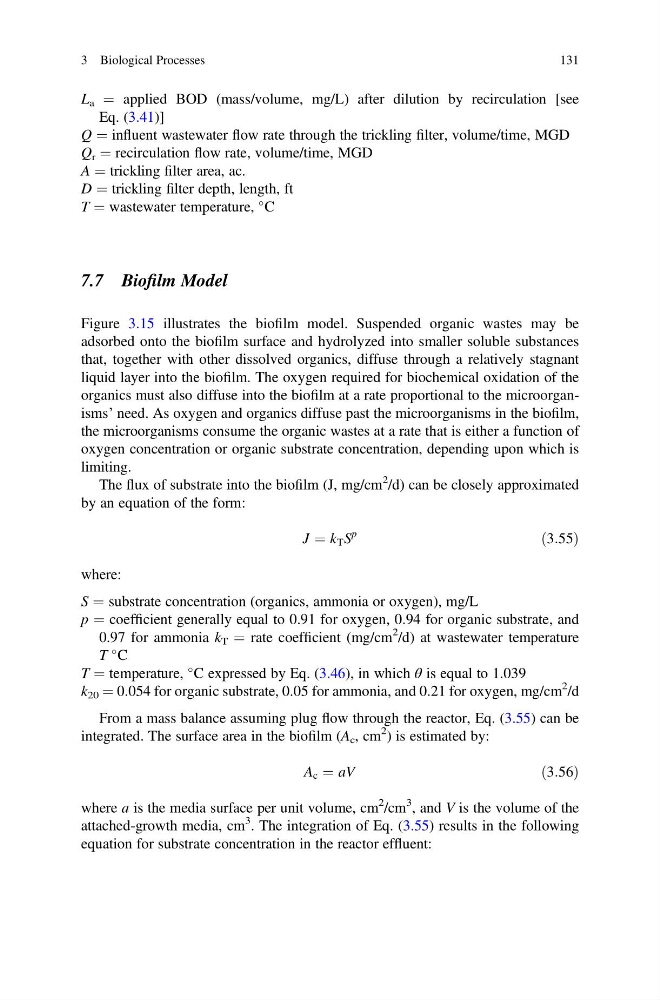
L a ¼ applied BOD (mass/volume, mg/L) after dilution by recirculation [see
Eq. (3.41)]
Q ¼ influent wastewater flow rate through the trickling filter, volume/time, MGD
Q r ¼ recirculation flow rate, volume/time, MGD
A ¼ trickling filter area, ac.
D ¼ trickling filter depth, length, ft
T ¼ wastewater temperature,
C
7.7 Biofilm Model
Figure 3.15 illustrates the biofilm model. Suspended organic wastes may be
adsorbed onto the biofilm surface and hydrolyzed into smaller soluble substances
that, together with other dissolved organics, diffuse through a relatively stagnant
liquid layer into the biofilm. The oxygen required for biochemical oxidation of the
organics must also diffuse into the biofilm at a rate proportional to the microorganisms’ need. As oxygen and organics diffuse past the microorganisms in the biofilm,
the microorganisms consume the organic wastes at a rate that is either a function of
oxygen concentration or organic substrate concentration, depending upon which is
limiting.
The flux of substrate into the biofilm (J, mg/cm
2 /d) can be closely approximated
by an equation of the form:
J ¼ k T S
p
ð3:55Þ
where:
S ¼ substrate concentration (organics, ammonia or oxygen), mg/L
p ¼ coefficient generally equal to 0.91 for oxygen, 0.94 for organic substrate, and
0.97 for ammonia k T ¼ rate coefficient (mg/cm
2 /d) at wastewater temperature
T
C
T ¼ temperature,
C expressed by Eq. (3.46), in which θ is equal to 1.039
k 20 ¼ 0.054 for organic substrate, 0.05 for ammonia, and 0.21 for oxygen, mg/cm
2 /d
From a mass balance assuming plug flow through the reactor, Eq. (3.55) can be
integrated. The surface area in the biofilm (A c , cm
2 ) is estimated by:
A c ¼ aV
ð3:56Þ
where a is the media surface per unit volume, cm
2 /cm
3 , and V is the volume of the
attached-growth media, cm
3 . The integration of Eq. (3.55) results in the following
equation for substrate concentration in the reactor effluent:
3 Biological Processes
131
Eq. (3.41)]
Q ¼ influent wastewater flow rate through the trickling filter, volume/time, MGD
Q r ¼ recirculation flow rate, volume/time, MGD
A ¼ trickling filter area, ac.
D ¼ trickling filter depth, length, ft
T ¼ wastewater temperature,
C
7.7 Biofilm Model
Figure 3.15 illustrates the biofilm model. Suspended organic wastes may be
adsorbed onto the biofilm surface and hydrolyzed into smaller soluble substances
that, together with other dissolved organics, diffuse through a relatively stagnant
liquid layer into the biofilm. The oxygen required for biochemical oxidation of the
organics must also diffuse into the biofilm at a rate proportional to the microorganisms’ need. As oxygen and organics diffuse past the microorganisms in the biofilm,
the microorganisms consume the organic wastes at a rate that is either a function of
oxygen concentration or organic substrate concentration, depending upon which is
limiting.
The flux of substrate into the biofilm (J, mg/cm
2 /d) can be closely approximated
by an equation of the form:
J ¼ k T S
p
ð3:55Þ
where:
S ¼ substrate concentration (organics, ammonia or oxygen), mg/L
p ¼ coefficient generally equal to 0.91 for oxygen, 0.94 for organic substrate, and
0.97 for ammonia k T ¼ rate coefficient (mg/cm
2 /d) at wastewater temperature
T
C
T ¼ temperature,
C expressed by Eq. (3.46), in which θ is equal to 1.039
k 20 ¼ 0.054 for organic substrate, 0.05 for ammonia, and 0.21 for oxygen, mg/cm
2 /d
From a mass balance assuming plug flow through the reactor, Eq. (3.55) can be
integrated. The surface area in the biofilm (A c , cm
2 ) is estimated by:
A c ¼ aV
ð3:56Þ
where a is the media surface per unit volume, cm
2 /cm
3 , and V is the volume of the
attached-growth media, cm
3 . The integration of Eq. (3.55) results in the following
equation for substrate concentration in the reactor effluent:
3 Biological Processes
131