

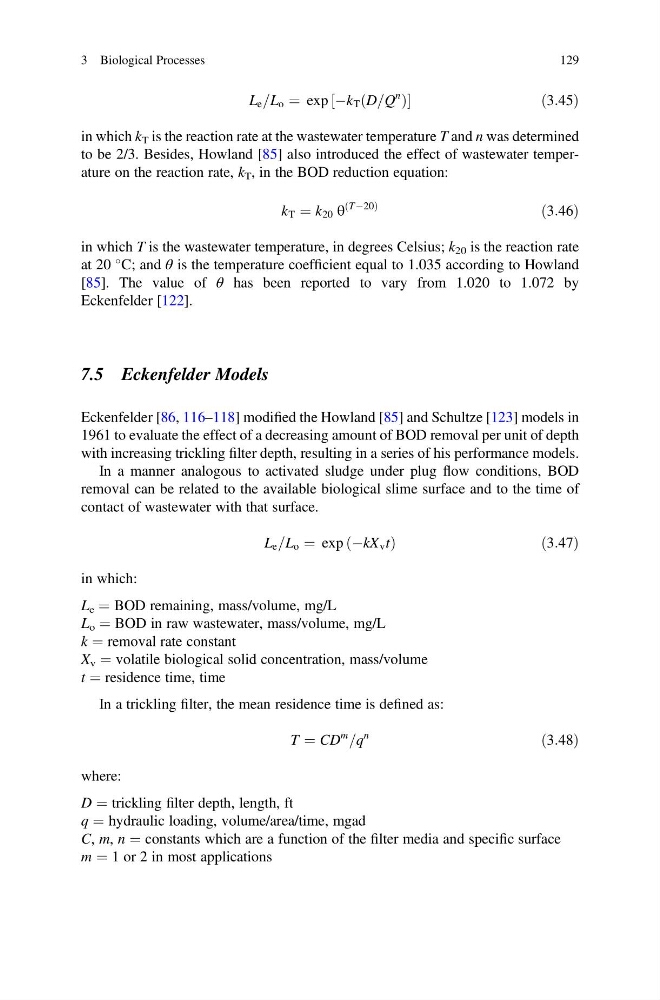
L e =L o ¼ exp Àk T D=Q
n
ð
Þ
½
ð 3:45Þ
in which k T is the reaction rate at the wastewater temperature T and n was determined
to be 2/3. Besides, Howland [85] also introduced the effect of wastewater temperature on the reaction rate, k T , in the BOD reduction equation:
k T ¼ k 20 θ
TÀ20
ð
Þ
ð3:46Þ
in which T is the wastewater temperature, in degrees Celsius; k 20 is the reaction rate
at 20
C; and θ is the temperature coefficient equal to 1.035 according to Howland
[85]. The value of θ has been reported to vary from 1.020 to 1.072 by
Eckenfelder [122].
7.5 Eckenfelder Models
Eckenfelder [86, 116–118] modified the Howland [85] and Schultze [123] models in
1961 to evaluate the effect of a decreasing amount of BOD removal per unit of depth
with increasing trickling filter depth, resulting in a series of his performance models.
In a manner analogous to activated sludge under plug flow conditions, BOD
removal can be related to the available biological slime surface and to the time of
contact of wastewater with that surface.
L e =L o ¼ exp ÀkX v t
ð
Þ
ð3:47Þ
in which:
L e ¼ BOD remaining, mass/volume, mg/L
L o ¼ BOD in raw wastewater, mass/volume, mg/L
k ¼ removal rate constant
X v ¼ volatile biological solid concentration, mass/volume
t ¼ residence time, time
In a trickling filter, the mean residence time is defined as:
T ¼ CD
m
=q
n
ð3:48Þ
where:
D ¼ trickling filter depth, length, ft
q ¼ hydraulic loading, volume/area/time, mgad
C, m, n ¼ constants which are a function of the filter media and specific surface
m ¼ 1 or 2 in most applications
3 Biological Processes
129
n
ð
Þ
½
ð 3:45Þ
in which k T is the reaction rate at the wastewater temperature T and n was determined
to be 2/3. Besides, Howland [85] also introduced the effect of wastewater temperature on the reaction rate, k T , in the BOD reduction equation:
k T ¼ k 20 θ
TÀ20
ð
Þ
ð3:46Þ
in which T is the wastewater temperature, in degrees Celsius; k 20 is the reaction rate
at 20
C; and θ is the temperature coefficient equal to 1.035 according to Howland
[85]. The value of θ has been reported to vary from 1.020 to 1.072 by
Eckenfelder [122].
7.5 Eckenfelder Models
Eckenfelder [86, 116–118] modified the Howland [85] and Schultze [123] models in
1961 to evaluate the effect of a decreasing amount of BOD removal per unit of depth
with increasing trickling filter depth, resulting in a series of his performance models.
In a manner analogous to activated sludge under plug flow conditions, BOD
removal can be related to the available biological slime surface and to the time of
contact of wastewater with that surface.
L e =L o ¼ exp ÀkX v t
ð
Þ
ð3:47Þ
in which:
L e ¼ BOD remaining, mass/volume, mg/L
L o ¼ BOD in raw wastewater, mass/volume, mg/L
k ¼ removal rate constant
X v ¼ volatile biological solid concentration, mass/volume
t ¼ residence time, time
In a trickling filter, the mean residence time is defined as:
T ¼ CD
m
=q
n
ð3:48Þ
where:
D ¼ trickling filter depth, length, ft
q ¼ hydraulic loading, volume/area/time, mgad
C, m, n ¼ constants which are a function of the filter media and specific surface
m ¼ 1 or 2 in most applications
3 Biological Processes
129