

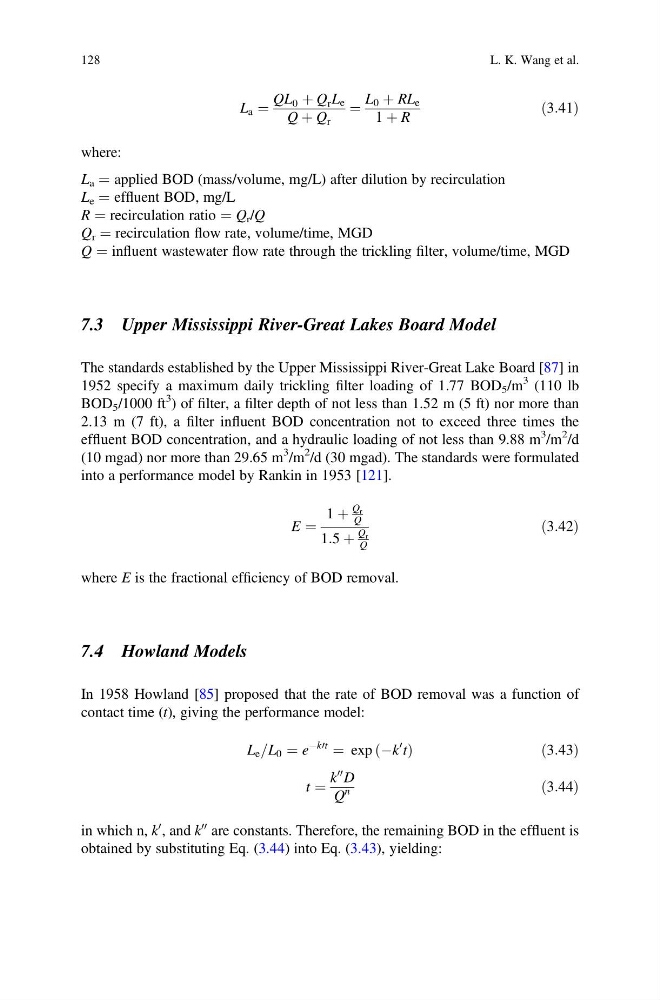
L a ¼
QL 0 þ Q r L e
Q þ Q r
¼
L 0 þ RL e
1 þ R
ð3:41Þ
where:
L a ¼ applied BOD (mass/volume, mg/L) after dilution by recirculation
L e ¼ effluent BOD, mg/L
R ¼ recirculation ratio ¼ Q r /Q
Q r ¼ recirculation flow rate, volume/time, MGD
Q ¼ influent wastewater flow rate through the trickling filter, volume/time, MGD
7.3 Upper Mississippi River-Great Lakes Board Model
The standards established by the Upper Mississippi River-Great Lake Board [87] in
1952 specify a maximum daily trickling filter loading of 1.77 BOD 5 /m
3 (110 lb
BOD 5 /1000 ft
3 ) of filter, a filter depth of not less than 1.52 m (5 ft) nor more than
2.13 m (7 ft), a filter influent BOD concentration not to exceed three times the
effluent BOD concentration, and a hydraulic loading of not less than 9.88 m
3 /m
2 /d
(10 mgad) nor more than 29.65 m
3 /m
2 /d (30 mgad). The standards were formulated
into a performance model by Rankin in 1953 [121].
E ¼
1 þ
Q r
Q
1:5 þ
Q r
Q
ð3:42Þ
where E is the fractional efficiency of BOD removal.
7.4 Howland Models
In 1958 Howland [85] proposed that the rate of BOD removal was a function of
contact time (t), giving the performance model:
L e =L 0 ¼ e
Àk0t
¼ exp Àk
0 t
ð
Þ
ð3:43Þ
t ¼
k
00 D
Q
n
ð3:44Þ
in which n, k
0 , and k
00 are constants. Therefore, the remaining BOD in the effluent is
obtained by substituting Eq. (3.44) into Eq. (3.43), yielding:
128
L. K. Wang et al.
QL 0 þ Q r L e
Q þ Q r
¼
L 0 þ RL e
1 þ R
ð3:41Þ
where:
L a ¼ applied BOD (mass/volume, mg/L) after dilution by recirculation
L e ¼ effluent BOD, mg/L
R ¼ recirculation ratio ¼ Q r /Q
Q r ¼ recirculation flow rate, volume/time, MGD
Q ¼ influent wastewater flow rate through the trickling filter, volume/time, MGD
7.3 Upper Mississippi River-Great Lakes Board Model
The standards established by the Upper Mississippi River-Great Lake Board [87] in
1952 specify a maximum daily trickling filter loading of 1.77 BOD 5 /m
3 (110 lb
BOD 5 /1000 ft
3 ) of filter, a filter depth of not less than 1.52 m (5 ft) nor more than
2.13 m (7 ft), a filter influent BOD concentration not to exceed three times the
effluent BOD concentration, and a hydraulic loading of not less than 9.88 m
3 /m
2 /d
(10 mgad) nor more than 29.65 m
3 /m
2 /d (30 mgad). The standards were formulated
into a performance model by Rankin in 1953 [121].
E ¼
1 þ
Q r
Q
1:5 þ
Q r
Q
ð3:42Þ
where E is the fractional efficiency of BOD removal.
7.4 Howland Models
In 1958 Howland [85] proposed that the rate of BOD removal was a function of
contact time (t), giving the performance model:
L e =L 0 ¼ e
Àk0t
¼ exp Àk
0 t
ð
Þ
ð3:43Þ
t ¼
k
00 D
Q
n
ð3:44Þ
in which n, k
0 , and k
00 are constants. Therefore, the remaining BOD in the effluent is
obtained by substituting Eq. (3.44) into Eq. (3.43), yielding:
128
L. K. Wang et al.