

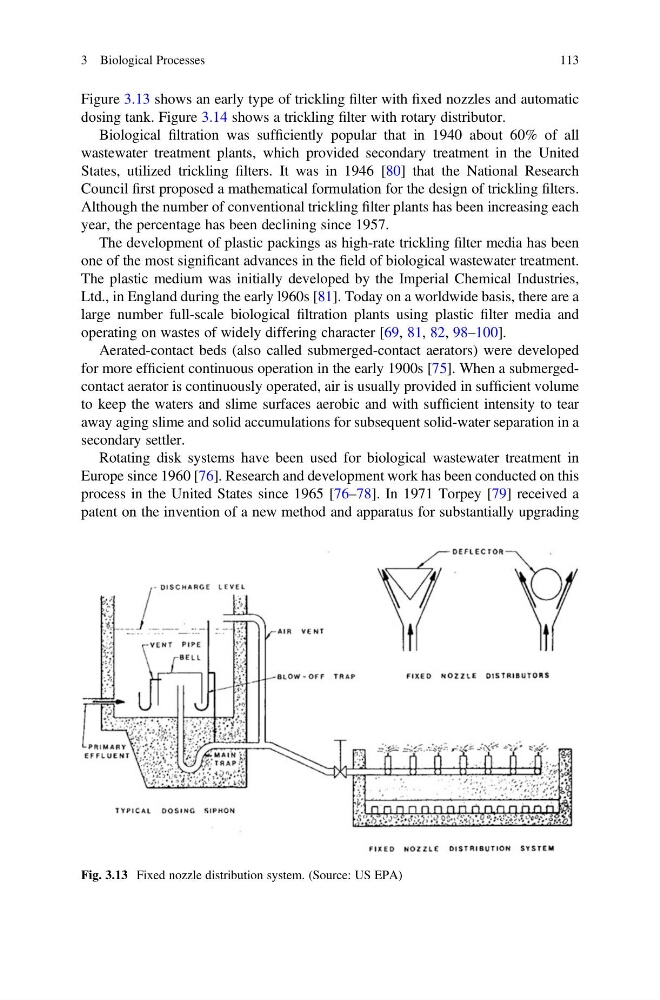
Figure 3.13 shows an early type of trickling filter with fixed nozzles and automatic
dosing tank. Figure 3.14 shows a trickling filter with rotary distributor.
Biological filtration was sufficiently popular that in 1940 about 60% of all
wastewater treatment plants, which provided secondary treatment in the United
States, utilized trickling filters. It was in 1946 [80] that the National Research
Council first proposed a mathematical formulation for the design of trickling filters.
Although the number of conventional trickling filter plants has been increasing each
year, the percentage has been declining since 1957.
The development of plastic packings as high-rate trickling filter media has been
one of the most significant advances in the field of biological wastewater treatment.
The plastic medium was initially developed by the Imperial Chemical Industries,
Ltd., in England during the early l960s [81]. Today on a worldwide basis, there are a
large number full-scale biological filtration plants using plastic filter media and
operating on wastes of widely differing character [69, 81, 82, 98–100].
Aerated-contact beds (also called submerged-contact aerators) were developed
for more efficient continuous operation in the early 1900s [75]. When a submergedcontact aerator is continuously operated, air is usually provided in sufficient volume
to keep the waters and slime surfaces aerobic and with sufficient intensity to tear
away aging slime and solid accumulations for subsequent solid-water separation in a
secondary settler.
Rotating disk systems have been used for biological wastewater treatment in
Europe since 1960 [76]. Research and development work has been conducted on this
process in the United States since 1965 [76–78]. In 1971 Torpey [79] received a
patent on the invention of a new method and apparatus for substantially upgrading
Fig. 3.13 Fixed nozzle distribution system. (Source: US EPA)
3 Biological Processes
113
dosing tank. Figure 3.14 shows a trickling filter with rotary distributor.
Biological filtration was sufficiently popular that in 1940 about 60% of all
wastewater treatment plants, which provided secondary treatment in the United
States, utilized trickling filters. It was in 1946 [80] that the National Research
Council first proposed a mathematical formulation for the design of trickling filters.
Although the number of conventional trickling filter plants has been increasing each
year, the percentage has been declining since 1957.
The development of plastic packings as high-rate trickling filter media has been
one of the most significant advances in the field of biological wastewater treatment.
The plastic medium was initially developed by the Imperial Chemical Industries,
Ltd., in England during the early l960s [81]. Today on a worldwide basis, there are a
large number full-scale biological filtration plants using plastic filter media and
operating on wastes of widely differing character [69, 81, 82, 98–100].
Aerated-contact beds (also called submerged-contact aerators) were developed
for more efficient continuous operation in the early 1900s [75]. When a submergedcontact aerator is continuously operated, air is usually provided in sufficient volume
to keep the waters and slime surfaces aerobic and with sufficient intensity to tear
away aging slime and solid accumulations for subsequent solid-water separation in a
secondary settler.
Rotating disk systems have been used for biological wastewater treatment in
Europe since 1960 [76]. Research and development work has been conducted on this
process in the United States since 1965 [76–78]. In 1971 Torpey [79] received a
patent on the invention of a new method and apparatus for substantially upgrading
Fig. 3.13 Fixed nozzle distribution system. (Source: US EPA)
3 Biological Processes
113