

the operating efficiency of a biological rotating disk system. Torpey’s invention
utilizes forcibly rotating bodies that are partially submerged in the wastewater to
provide surface area on which biological slimes develop for the purpose of removing
pollutants from the wastewater.
The application of contact beds, trickling filters, or rotating contact systems to
wastewater treatment has been found profitable in areas where:
(a) Wastewater treatment personnel may be limited
(b) Small flows exist
(c) A plant effluent of from 20 to 30 mg/L of BOD 5 is acceptable
(d) Land area requirements dictate height to be increased to achieve the designed
bio-oxidation capacity
(e) Intermittent discharges of toxic or inhibitory waste stream create shock
conditions
(f) Partial treatment or a specific treatment may be required on an industrial waste
stream
A new process, activated biofilters (ABF), which combines both attached and
suspended-growth biological treatment systems, has been developed by Neptune
Microfloc. The process entails the use of a redwood-medium trickling filter followed
by aeration. The return sludge from the clarifier is recycled to the biocell along with
the biocell underflow. Although the redwood medium is recommended by the
manufacturer, plastic media may provide equally effective treatment [101].
Another development in the field of attached-growth wastewater treatment processes is the anaerobic filter [102]. It is primarily a column filled with various types
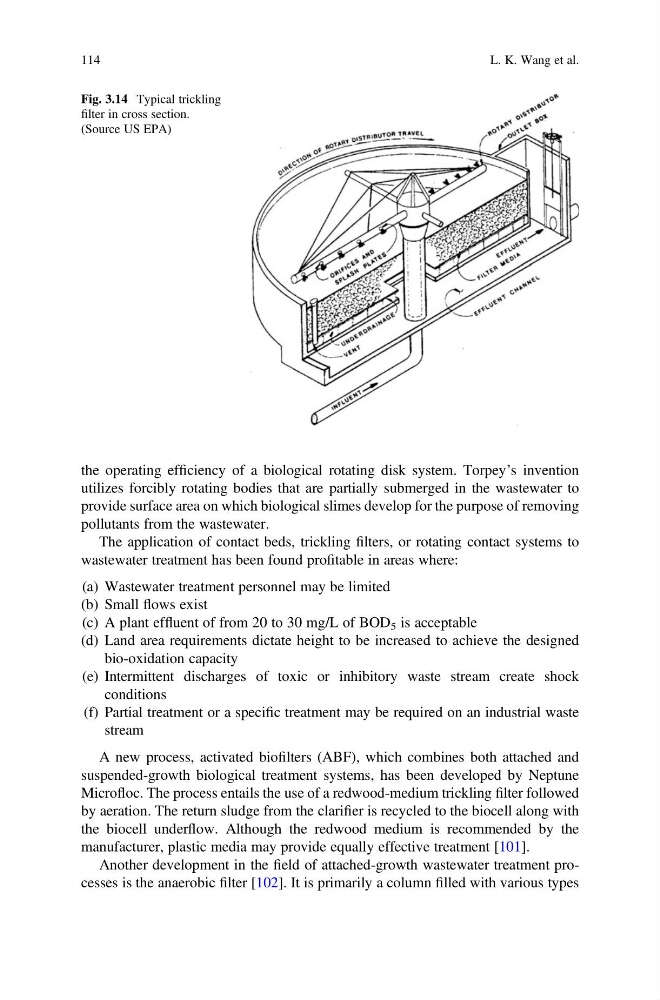
Fig. 3.14 Typical trickling
filter in cross section.
(Source US EPA)
114
L. K. Wang et al.
utilizes forcibly rotating bodies that are partially submerged in the wastewater to
provide surface area on which biological slimes develop for the purpose of removing
pollutants from the wastewater.
The application of contact beds, trickling filters, or rotating contact systems to
wastewater treatment has been found profitable in areas where:
(a) Wastewater treatment personnel may be limited
(b) Small flows exist
(c) A plant effluent of from 20 to 30 mg/L of BOD 5 is acceptable
(d) Land area requirements dictate height to be increased to achieve the designed
bio-oxidation capacity
(e) Intermittent discharges of toxic or inhibitory waste stream create shock
conditions
(f) Partial treatment or a specific treatment may be required on an industrial waste
stream
A new process, activated biofilters (ABF), which combines both attached and
suspended-growth biological treatment systems, has been developed by Neptune
Microfloc. The process entails the use of a redwood-medium trickling filter followed
by aeration. The return sludge from the clarifier is recycled to the biocell along with
the biocell underflow. Although the redwood medium is recommended by the
manufacturer, plastic media may provide equally effective treatment [101].
Another development in the field of attached-growth wastewater treatment processes is the anaerobic filter [102]. It is primarily a column filled with various types
Fig. 3.14 Typical trickling
filter in cross section.
(Source US EPA)
114
L. K. Wang et al.