

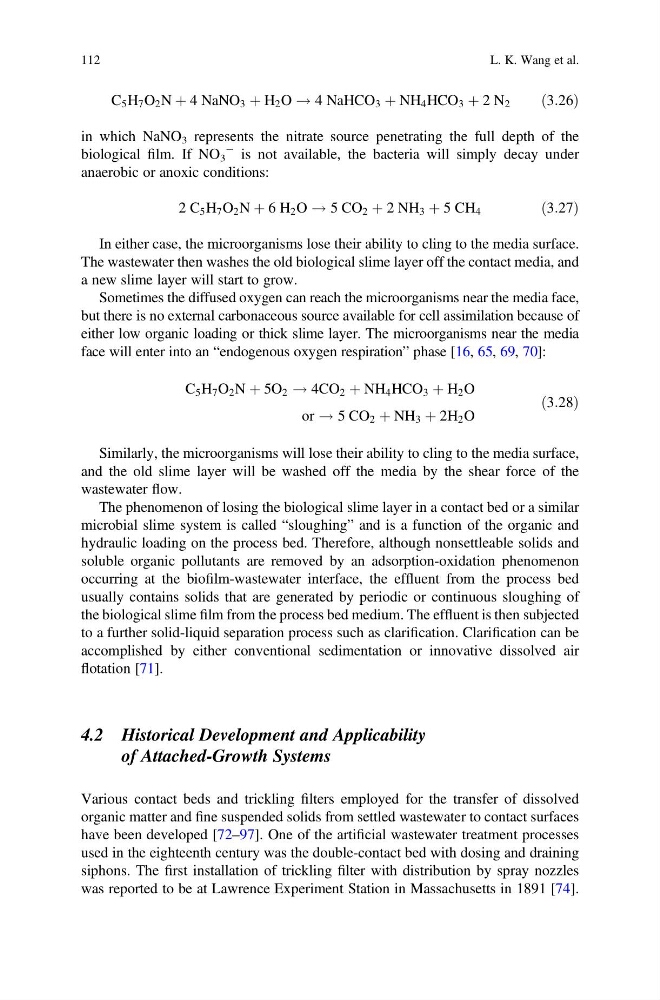
C 5 H 7 O 2 N þ 4 NaNO 3 þ H 2 O ! 4 NaHCO 3 þ NH 4 HCO 3 þ 2 N 2
ð3:26Þ
in which NaNO 3 represents the nitrate source penetrating the full depth of the
biological film. If NO 3
À is not available, the bacteria will simply decay under
anaerobic or anoxic conditions:
2 C 5 H 7 O 2 N þ 6 H 2 O ! 5 CO 2 þ 2 NH 3 þ 5 CH 4
ð3:27Þ
In either case, the microorganisms lose their ability to cling to the media surface.
The wastewater then washes the old biological slime layer off the contact media, and
a new slime layer will start to grow.
Sometimes the diffused oxygen can reach the microorganisms near the media face,
but there is no external carbonaceous source available for cell assimilation because of
either low organic loading or thick slime layer. The microorganisms near the media
face will enter into an “endogenous oxygen respiration” phase [16, 65, 69, 70]:
C 5 H 7 O 2 N þ 5O 2 ! 4CO 2 þ NH 4 HCO 3 þ H 2 O
or ! 5 CO 2 þ NH 3 þ 2H 2 O
ð3:28Þ
Similarly, the microorganisms will lose their ability to cling to the media surface,
and the old slime layer will be washed off the media by the shear force of the
wastewater flow.
The phenomenon of losing the biological slime layer in a contact bed or a similar
microbial slime system is called “sloughing” and is a function of the organic and
hydraulic loading on the process bed. Therefore, although nonsettleable solids and
soluble organic pollutants are removed by an adsorption-oxidation phenomenon
occurring at the biofilm-wastewater interface, the effluent from the process bed
usually contains solids that are generated by periodic or continuous sloughing of
the biological slime film from the process bed medium. The effluent is then subjected
to a further solid-liquid separation process such as clarification. Clarification can be
accomplished by either conventional sedimentation or innovative dissolved air
flotation [71].
4.2 Historical Development and Applicability
of Attached-Growth Systems
Various contact beds and trickling filters employed for the transfer of dissolved
organic matter and fine suspended solids from settled wastewater to contact surfaces
have been developed [72–97]. One of the artificial wastewater treatment processes
used in the eighteenth century was the double-contact bed with dosing and draining
siphons. The first installation of trickling filter with distribution by spray nozzles
was reported to be at Lawrence Experiment Station in Massachusetts in 1891 [74].
112
L. K. Wang et al.
ð3:26Þ
in which NaNO 3 represents the nitrate source penetrating the full depth of the
biological film. If NO 3
À is not available, the bacteria will simply decay under
anaerobic or anoxic conditions:
2 C 5 H 7 O 2 N þ 6 H 2 O ! 5 CO 2 þ 2 NH 3 þ 5 CH 4
ð3:27Þ
In either case, the microorganisms lose their ability to cling to the media surface.
The wastewater then washes the old biological slime layer off the contact media, and
a new slime layer will start to grow.
Sometimes the diffused oxygen can reach the microorganisms near the media face,
but there is no external carbonaceous source available for cell assimilation because of
either low organic loading or thick slime layer. The microorganisms near the media
face will enter into an “endogenous oxygen respiration” phase [16, 65, 69, 70]:
C 5 H 7 O 2 N þ 5O 2 ! 4CO 2 þ NH 4 HCO 3 þ H 2 O
or ! 5 CO 2 þ NH 3 þ 2H 2 O
ð3:28Þ
Similarly, the microorganisms will lose their ability to cling to the media surface,
and the old slime layer will be washed off the media by the shear force of the
wastewater flow.
The phenomenon of losing the biological slime layer in a contact bed or a similar
microbial slime system is called “sloughing” and is a function of the organic and
hydraulic loading on the process bed. Therefore, although nonsettleable solids and
soluble organic pollutants are removed by an adsorption-oxidation phenomenon
occurring at the biofilm-wastewater interface, the effluent from the process bed
usually contains solids that are generated by periodic or continuous sloughing of
the biological slime film from the process bed medium. The effluent is then subjected
to a further solid-liquid separation process such as clarification. Clarification can be
accomplished by either conventional sedimentation or innovative dissolved air
flotation [71].
4.2 Historical Development and Applicability
of Attached-Growth Systems
Various contact beds and trickling filters employed for the transfer of dissolved
organic matter and fine suspended solids from settled wastewater to contact surfaces
have been developed [72–97]. One of the artificial wastewater treatment processes
used in the eighteenth century was the double-contact bed with dosing and draining
siphons. The first installation of trickling filter with distribution by spray nozzles
was reported to be at Lawrence Experiment Station in Massachusetts in 1891 [74].
112
L. K. Wang et al.