

in which the end product NH 3 can be further oxidized to NO 2
À and/or NO 3
À . The
microorganisms in the biological slime film grow following Eq. (3.23) and/or
Eq. (3.24) [16, 65, 66]:
NH 4
þ
þ 4 CO 2 þ HCO 3
À
þ H 2 O ! C 5 H 7 O 2 N þ 5 O 2
ð3:23Þ
C 10 H 19 O 3 N þ 1:5 NH 3 þ 2:5 CO 2 ! 2:5 C 5 H 7 O 2 N þ 3 H 2 O
ð3:24Þ
in which C 5 H 7 O 2 N is the empirical formula of bacterial cell and C 10 H 19 O 3 N is the
empirical composition of domestic wastewater [67]. When the thickness of the
biological film increases to a degree that the diffused oxygen is almost totally
consumed before it can reach the full depth of the film, an anaerobic (or anoxic)
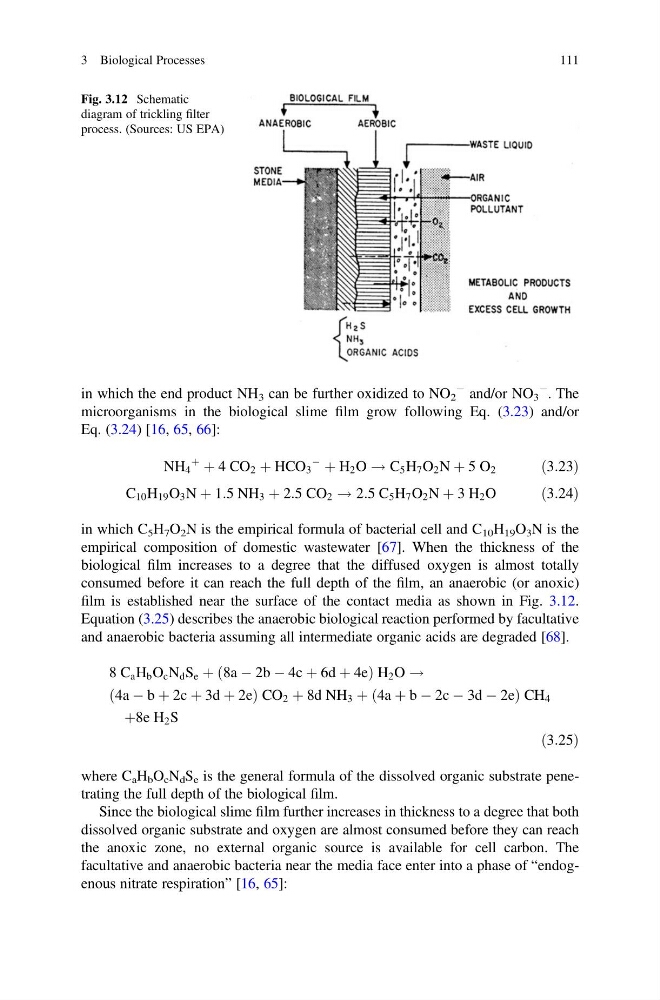
film is established near the surface of the contact media as shown in Fig. 3.12.
Equation (3.25) describes the anaerobic biological reaction performed by facultative
and anaerobic bacteria assuming all intermediate organic acids are degraded [68].
8 C a H b O c N d S e þ 8a À 2b À 4c þ 6d þ 4e
ð
Þ H 2 O !
4a À b þ 2c þ 3d þ 2e
ð
Þ CO 2 þ 8d NH 3 þ 4a þ b À 2c À 3d À 2e
ð
Þ CH 4
þ8e H 2 S
ð3:25Þ
where C a H b O c N d S e is the general formula of the dissolved organic substrate penetrating the full depth of the biological film.
Since the biological slime film further increases in thickness to a degree that both
dissolved organic substrate and oxygen are almost consumed before they can reach
the anoxic zone, no external organic source is available for cell carbon. The
facultative and anaerobic bacteria near the media face enter into a phase of “endogenous nitrate respiration” [16, 65]:
Fig. 3.12 Schematic
diagram of trickling filter
process. (Sources: US EPA)
3 Biological Processes
111
À and/or NO 3
À . The
microorganisms in the biological slime film grow following Eq. (3.23) and/or
Eq. (3.24) [16, 65, 66]:
NH 4
þ
þ 4 CO 2 þ HCO 3
À
þ H 2 O ! C 5 H 7 O 2 N þ 5 O 2
ð3:23Þ
C 10 H 19 O 3 N þ 1:5 NH 3 þ 2:5 CO 2 ! 2:5 C 5 H 7 O 2 N þ 3 H 2 O
ð3:24Þ
in which C 5 H 7 O 2 N is the empirical formula of bacterial cell and C 10 H 19 O 3 N is the
empirical composition of domestic wastewater [67]. When the thickness of the
biological film increases to a degree that the diffused oxygen is almost totally
consumed before it can reach the full depth of the film, an anaerobic (or anoxic)
film is established near the surface of the contact media as shown in Fig. 3.12.
Equation (3.25) describes the anaerobic biological reaction performed by facultative
and anaerobic bacteria assuming all intermediate organic acids are degraded [68].
8 C a H b O c N d S e þ 8a À 2b À 4c þ 6d þ 4e
ð
Þ H 2 O !
4a À b þ 2c þ 3d þ 2e
ð
Þ CO 2 þ 8d NH 3 þ 4a þ b À 2c À 3d À 2e
ð
Þ CH 4
þ8e H 2 S
ð3:25Þ
where C a H b O c N d S e is the general formula of the dissolved organic substrate penetrating the full depth of the biological film.
Since the biological slime film further increases in thickness to a degree that both
dissolved organic substrate and oxygen are almost consumed before they can reach
the anoxic zone, no external organic source is available for cell carbon. The
facultative and anaerobic bacteria near the media face enter into a phase of “endogenous nitrate respiration” [16, 65]:
Fig. 3.12 Schematic
diagram of trickling filter
process. (Sources: US EPA)
3 Biological Processes
111