

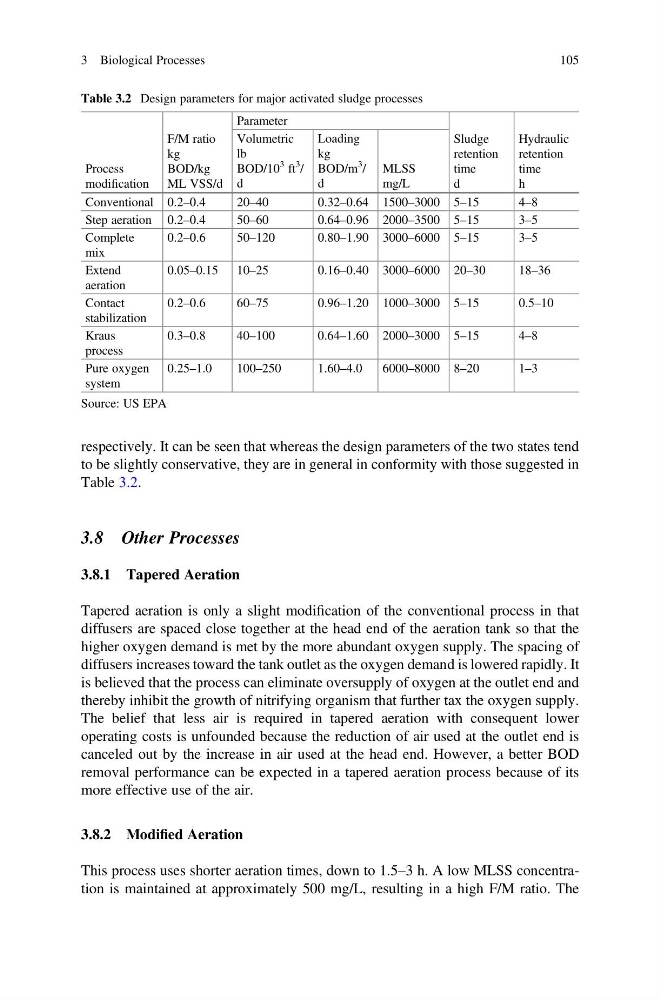
respectively. It can be seen that whereas the design parameters of the two states tend
to be slightly conservative, they are in general in conformity with those suggested in
Table 3.2.
3.8 Other Processes
3.8.1 Tapered Aeration
Tapered aeration is only a slight modification of the conventional process in that
diffusers are spaced close together at the head end of the aeration tank so that the
higher oxygen demand is met by the more abundant oxygen supply. The spacing of
diffusers increases toward the tank outlet as the oxygen demand is lowered rapidly. It
is believed that the process can eliminate oversupply of oxygen at the outlet end and
thereby inhibit the growth of nitrifying organism that further tax the oxygen supply.
The belief that less air is required in tapered aeration with consequent lower
operating costs is unfounded because the reduction of air used at the outlet end is
canceled out by the increase in air used at the head end. However, a better BOD
removal performance can be expected in a tapered aeration process because of its
more effective use of the air.
3.8.2 Modified Aeration
This process uses shorter aeration times, down to 1.5–3 h. A low MLSS concentration is maintained at approximately 500 mg/L, resulting in a high F/M ratio. The
Table 3.2 Design parameters for major activated sludge processes
Process
modification
F/M ratio
kg
BOD/kg
ML VSS/d
Parameter
Sludge
retention
time
d
Hydraulic
retention
time
h
Volumetric
lb
BOD/10
3 ft
3
/
d
Loading
kg
BOD/m
3
/
d
MLSS
mg/L
Conventional 0.2–0.4
20–40
0.32–0.64 1500–3000 5–15
4–8
Step aeration 0.2–0.4
50–60
0.64–0.96 2000–3500 5–15
3–5
Complete
mix
0.2–0.6
50–120
0.80–1.90 3000–6000 5–15
3–5
Extend
aeration
0.05–0.15 10–25
0.16–0.40 3000–6000 20–30
18–36
Contact
stabilization
0.2–0.6
60–75
0.96–1.20 1000–3000 5–15
0.5–10
Kraus
process
0.3–0.8
40–100
0.64–1.60 2000–3000 5–15
4–8
Pure oxygen
system
0.25–1.0
100–250
1.60–4.0
6000–8000 8–20
1–3
Source: US EPA
3 Biological Processes
105
to be slightly conservative, they are in general in conformity with those suggested in
Table 3.2.
3.8 Other Processes
3.8.1 Tapered Aeration
Tapered aeration is only a slight modification of the conventional process in that
diffusers are spaced close together at the head end of the aeration tank so that the
higher oxygen demand is met by the more abundant oxygen supply. The spacing of
diffusers increases toward the tank outlet as the oxygen demand is lowered rapidly. It
is believed that the process can eliminate oversupply of oxygen at the outlet end and
thereby inhibit the growth of nitrifying organism that further tax the oxygen supply.
The belief that less air is required in tapered aeration with consequent lower
operating costs is unfounded because the reduction of air used at the outlet end is
canceled out by the increase in air used at the head end. However, a better BOD
removal performance can be expected in a tapered aeration process because of its
more effective use of the air.
3.8.2 Modified Aeration
This process uses shorter aeration times, down to 1.5–3 h. A low MLSS concentration is maintained at approximately 500 mg/L, resulting in a high F/M ratio. The
Table 3.2 Design parameters for major activated sludge processes
Process
modification
F/M ratio
kg
BOD/kg
ML VSS/d
Parameter
Sludge
retention
time
d
Hydraulic
retention
time
h
Volumetric
lb
BOD/10
3 ft
3
/
d
Loading
kg
BOD/m
3
/
d
MLSS
mg/L
Conventional 0.2–0.4
20–40
0.32–0.64 1500–3000 5–15
4–8
Step aeration 0.2–0.4
50–60
0.64–0.96 2000–3500 5–15
3–5
Complete
mix
0.2–0.6
50–120
0.80–1.90 3000–6000 5–15
3–5
Extend
aeration
0.05–0.15 10–25
0.16–0.40 3000–6000 20–30
18–36
Contact
stabilization
0.2–0.6
60–75
0.96–1.20 1000–3000 5–15
0.5–10
Kraus
process
0.3–0.8
40–100
0.64–1.60 2000–3000 5–15
4–8
Pure oxygen
system
0.25–1.0
100–250
1.60–4.0
6000–8000 8–20
1–3
Source: US EPA
3 Biological Processes
105