

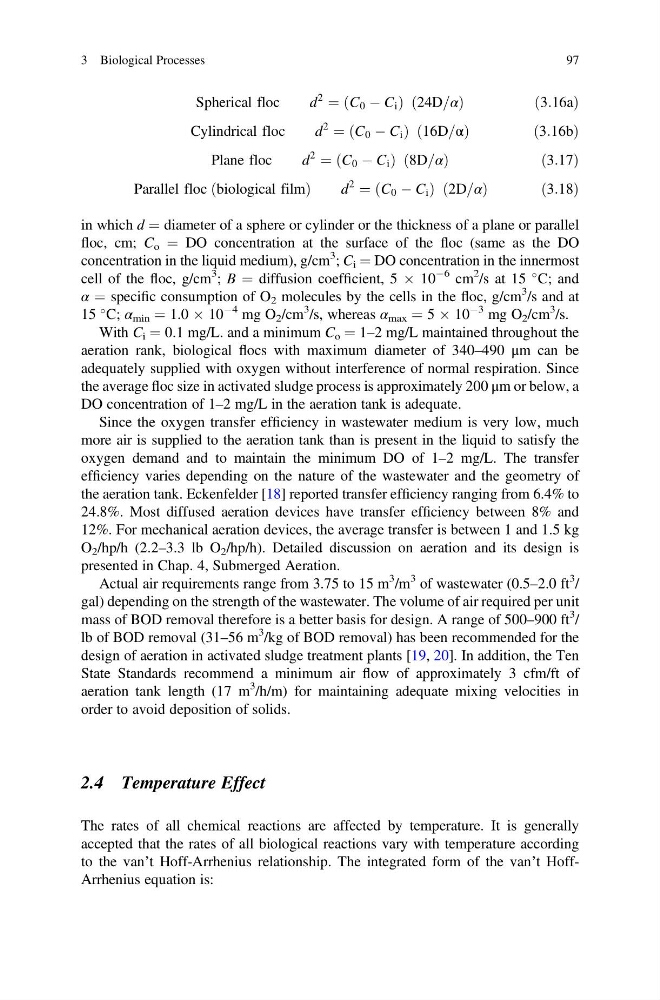
Spherical floc
d
2
¼ C 0 À C i
ð
Þ 24D=α
ð
Þ
ð3:16aÞ
Cylindrical floc
d
2
¼ C 0 À C i
ð
Þ 16D=α
ð
Þ
ð3:16bÞ
Plane floc
d
2
¼ C 0 À C i
ð
Þ 8D=α
ð
Þ
ð3:17Þ
Parallel floc biological film
ð
Þ
d
2
¼ C 0 À C i
ð
Þ 2D=α
ð
Þ
ð3:18Þ
in which d ¼ diameter of a sphere or cylinder or the thickness of a plane or parallel
floc, cm; C o ¼ DO concentration at the surface of the floc (same as the DO
concentration in the liquid medium), g/cm
3
; C i ¼ DO concentration in the innermost
cell of the floc, g/cm
3 ; B ¼ diffusion coefficient, 5 Â 10
À6 cm
2 /s at 15
C; and
α ¼ specific consumption of O 2 molecules by the cells in the floc, g/cm
3
/s and at
15
C; α min ¼ 1.0 Â 10
À4 mg O 2 /cm
3 /s, whereas α max ¼ 5 Â 10
À3 mg O 2 /cm
3 /s.
With C i ¼ 0.1 mg/L. and a minimum C o ¼ 1–2 mg/L maintained throughout the
aeration rank, biological flocs with maximum diameter of 340–490 μm can be
adequately supplied with oxygen without interference of normal respiration. Since
the average floc size in activated sludge process is approximately 200 μm or below, a
DO concentration of 1–2 mg/L in the aeration tank is adequate.
Since the oxygen transfer efficiency in wastewater medium is very low, much
more air is supplied to the aeration tank than is present in the liquid to satisfy the
oxygen demand and to maintain the minimum DO of 1–2 mg/L. The transfer
efficiency varies depending on the nature of the wastewater and the geometry of
the aeration tank. Eckenfelder [18] reported transfer efficiency ranging from 6.4% to
24.8%. Most diffused aeration devices have transfer efficiency between 8% and
12%. For mechanical aeration devices, the average transfer is between 1 and 1.5 kg
O 2 /hp/h (2.2–3.3 lb O 2 /hp/h). Detailed discussion on aeration and its design is
presented in Chap. 4, Submerged Aeration.
Actual air requirements range from 3.75 to 15 m
3 /m
3 of wastewater (0.5–2.0 ft
3 /
gal) depending on the strength of the wastewater. The volume of air required per unit
mass of BOD removal therefore is a better basis for design. A range of 500–900 ft
3 /
lb of BOD removal (31–56 m
3 /kg of BOD removal) has been recommended for the
design of aeration in activated sludge treatment plants [19, 20]. In addition, the Ten
State Standards recommend a minimum air flow of approximately 3 cfm/ft of
aeration tank length (17 m
3 /h/m) for maintaining adequate mixing velocities in
order to avoid deposition of solids.
2.4 Temperature Effect
The rates of all chemical reactions are affected by temperature. It is generally
accepted that the rates of all biological reactions vary with temperature according
to the van’t Hoff-Arrhenius relationship. The integrated form of the van’t HoffArrhenius equation is:
3 Biological Processes
97
d
2
¼ C 0 À C i
ð
Þ 24D=α
ð
Þ
ð3:16aÞ
Cylindrical floc
d
2
¼ C 0 À C i
ð
Þ 16D=α
ð
Þ
ð3:16bÞ
Plane floc
d
2
¼ C 0 À C i
ð
Þ 8D=α
ð
Þ
ð3:17Þ
Parallel floc biological film
ð
Þ
d
2
¼ C 0 À C i
ð
Þ 2D=α
ð
Þ
ð3:18Þ
in which d ¼ diameter of a sphere or cylinder or the thickness of a plane or parallel
floc, cm; C o ¼ DO concentration at the surface of the floc (same as the DO
concentration in the liquid medium), g/cm
3
; C i ¼ DO concentration in the innermost
cell of the floc, g/cm
3 ; B ¼ diffusion coefficient, 5 Â 10
À6 cm
2 /s at 15
C; and
α ¼ specific consumption of O 2 molecules by the cells in the floc, g/cm
3
/s and at
15
C; α min ¼ 1.0 Â 10
À4 mg O 2 /cm
3 /s, whereas α max ¼ 5 Â 10
À3 mg O 2 /cm
3 /s.
With C i ¼ 0.1 mg/L. and a minimum C o ¼ 1–2 mg/L maintained throughout the
aeration rank, biological flocs with maximum diameter of 340–490 μm can be
adequately supplied with oxygen without interference of normal respiration. Since
the average floc size in activated sludge process is approximately 200 μm or below, a
DO concentration of 1–2 mg/L in the aeration tank is adequate.
Since the oxygen transfer efficiency in wastewater medium is very low, much
more air is supplied to the aeration tank than is present in the liquid to satisfy the
oxygen demand and to maintain the minimum DO of 1–2 mg/L. The transfer
efficiency varies depending on the nature of the wastewater and the geometry of
the aeration tank. Eckenfelder [18] reported transfer efficiency ranging from 6.4% to
24.8%. Most diffused aeration devices have transfer efficiency between 8% and
12%. For mechanical aeration devices, the average transfer is between 1 and 1.5 kg
O 2 /hp/h (2.2–3.3 lb O 2 /hp/h). Detailed discussion on aeration and its design is
presented in Chap. 4, Submerged Aeration.
Actual air requirements range from 3.75 to 15 m
3 /m
3 of wastewater (0.5–2.0 ft
3 /
gal) depending on the strength of the wastewater. The volume of air required per unit
mass of BOD removal therefore is a better basis for design. A range of 500–900 ft
3 /
lb of BOD removal (31–56 m
3 /kg of BOD removal) has been recommended for the
design of aeration in activated sludge treatment plants [19, 20]. In addition, the Ten
State Standards recommend a minimum air flow of approximately 3 cfm/ft of
aeration tank length (17 m
3 /h/m) for maintaining adequate mixing velocities in
order to avoid deposition of solids.
2.4 Temperature Effect
The rates of all chemical reactions are affected by temperature. It is generally
accepted that the rates of all biological reactions vary with temperature according
to the van’t Hoff-Arrhenius relationship. The integrated form of the van’t HoffArrhenius equation is:
3 Biological Processes
97