

using an appropriate conversion factor, The respiration oxygen demand is 1.42 g O 2 /
g VSS based on the empirical equation [15, 16]:
C 5 H 7 NO 2 þ 5O 2 ! 5CO 2 þ 2H 2 O þ NH 3
Since part of the VSS produced is wasted in the process operation for the control
of sludge retention time, the respiration oxygen demand is reduced by an amount
prepositional to the amount of wasted sludge. The theoretical oxygen requirement
for an activated sludge process is therefore:
Theoretical O 2 requirement ¼ BOD L of wastewater utilized=d
ð
Þ
À1:42 VSS wasted=d
ð
Þ
ð3:15Þ
in which all terms are expressed in mass per day.
In practice, air is supplied to the aeration tank liquid to maintain a minimum
dissolved oxygen concentration of 1–2 mg/L. The objective is to maintain a
dissolved oxygen gradient across the liquid-floc interface to ensure an effective
oxygen transfer into the biological flocs. The critical O 2 tension for the biological
floc is believed to be in the neighborhood of 0.1 mg/L DO. Based on the geometry of
floc particles, the passive transport of O 2 molecules through aggregates of living
cells by diffusion has been mathematically resolved by Wuhrmann [17] as follows:
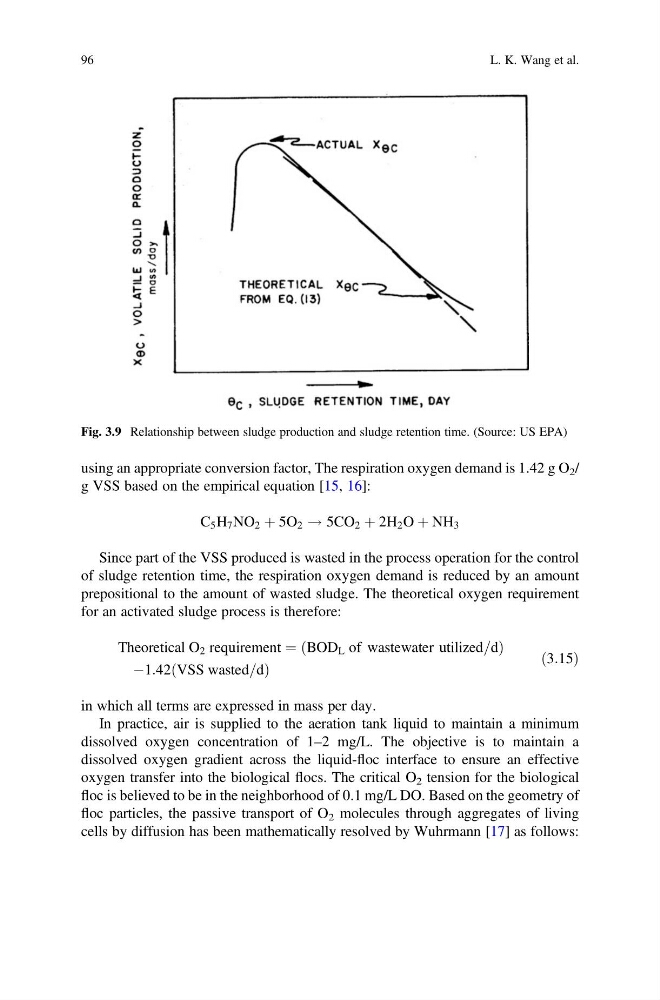
Fig. 3.9 Relationship between sludge production and sludge retention time. (Source: US EPA)
96
L. K. Wang et al.
g VSS based on the empirical equation [15, 16]:
C 5 H 7 NO 2 þ 5O 2 ! 5CO 2 þ 2H 2 O þ NH 3
Since part of the VSS produced is wasted in the process operation for the control
of sludge retention time, the respiration oxygen demand is reduced by an amount
prepositional to the amount of wasted sludge. The theoretical oxygen requirement
for an activated sludge process is therefore:
Theoretical O 2 requirement ¼ BOD L of wastewater utilized=d
ð
Þ
À1:42 VSS wasted=d
ð
Þ
ð3:15Þ
in which all terms are expressed in mass per day.
In practice, air is supplied to the aeration tank liquid to maintain a minimum
dissolved oxygen concentration of 1–2 mg/L. The objective is to maintain a
dissolved oxygen gradient across the liquid-floc interface to ensure an effective
oxygen transfer into the biological flocs. The critical O 2 tension for the biological
floc is believed to be in the neighborhood of 0.1 mg/L DO. Based on the geometry of
floc particles, the passive transport of O 2 molecules through aggregates of living
cells by diffusion has been mathematically resolved by Wuhrmann [17] as follows:
Fig. 3.9 Relationship between sludge production and sludge retention time. (Source: US EPA)
96
L. K. Wang et al.