

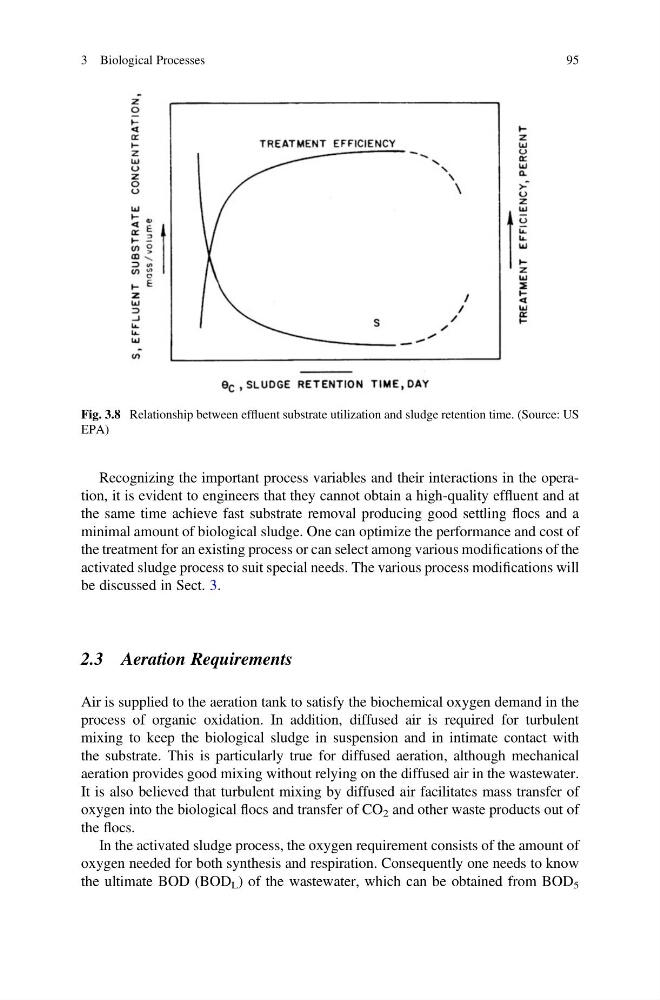
Recognizing the important process variables and their interactions in the operation, it is evident to engineers that they cannot obtain a high-quality effluent and at
the same time achieve fast substrate removal producing good settling flocs and a
minimal amount of biological sludge. One can optimize the performance and cost of
the treatment for an existing process or can select among various modifications of the
activated sludge process to suit special needs. The various process modifications will
be discussed in Sect. 3.
2.3 Aeration Requirements
Air is supplied to the aeration tank to satisfy the biochemical oxygen demand in the
process of organic oxidation. In addition, diffused air is required for turbulent
mixing to keep the biological sludge in suspension and in intimate contact with
the substrate. This is particularly true for diffused aeration, although mechanical
aeration provides good mixing without relying on the diffused air in the wastewater.
It is also believed that turbulent mixing by diffused air facilitates mass transfer of
oxygen into the biological flocs and transfer of CO 2 and other waste products out of
the flocs.
In the activated sludge process, the oxygen requirement consists of the amount of
oxygen needed for both synthesis and respiration. Consequently one needs to know
the ultimate BOD (BOD L ) of the wastewater, which can be obtained from BOD 5
Fig. 3.8 Relationship between effluent substrate utilization and sludge retention time. (Source: US
EPA)
3 Biological Processes
95
the same time achieve fast substrate removal producing good settling flocs and a
minimal amount of biological sludge. One can optimize the performance and cost of
the treatment for an existing process or can select among various modifications of the
activated sludge process to suit special needs. The various process modifications will
be discussed in Sect. 3.
2.3 Aeration Requirements
Air is supplied to the aeration tank to satisfy the biochemical oxygen demand in the
process of organic oxidation. In addition, diffused air is required for turbulent
mixing to keep the biological sludge in suspension and in intimate contact with
the substrate. This is particularly true for diffused aeration, although mechanical
aeration provides good mixing without relying on the diffused air in the wastewater.
It is also believed that turbulent mixing by diffused air facilitates mass transfer of
oxygen into the biological flocs and transfer of CO 2 and other waste products out of
the flocs.
In the activated sludge process, the oxygen requirement consists of the amount of
oxygen needed for both synthesis and respiration. Consequently one needs to know
the ultimate BOD (BOD L ) of the wastewater, which can be obtained from BOD 5
Fig. 3.8 Relationship between effluent substrate utilization and sludge retention time. (Source: US
EPA)
3 Biological Processes
95